Porta's treatise on cryptography represents one of the most sophisticated Renaissance treatments of secret writing, positioning the Neapolitan polymath squarely within the tradition of natural magic while anticipating more systematic approaches to cipher systems. First published in Naples in 1563 under the title De Furtivis Literarum Notis, the work went through several editions as interest in cryptographic methods grew among diplomats, military commanders, and the merely curious. This 1606 Strasbourg edition from Lazarus Zetzner's press, described on the title page as "editio postrema, priori castigatior" (the final edition, more correct than the previous), includes the Auctuarium of supplementary material that expanded the original five books.
The work sits at a fascinating intersection of practical statecraft and esoteric knowledge. Porta treats ciphers not as occult secrets in the theurgic sense but as "occult" in the literal meaning: hidden, concealed from those without the key. His cipher wheels, visible in the woodcuts preserved here, became influential models for cryptographic instruments. Yet the book circulated among readers interested in broader currents of Renaissance secrecy, from the steganographic techniques of Trithemius to the philosophical implications of hidden communication. For historians of Western esotericism, Porta's work illuminates how "natural magic" could encompass technical disciplines that we might now classify separately from the occult sciences.
Zetzner, the Strasbourg publisher responsible for this edition, had a particular affinity for such material; his press also produced editions of alchemical and Rosicrucian texts, and his decision to issue a corrected Porta suggests a recognized market among learned readers of German-speaking lands.
This copy, despite its defects, preserves the essential apparatus of cipher diagrams and retains its original binding, offering evidence of how such practical manuals were used and preserved. The loosening gatherings and general wear suggest a volume that was consulted rather than merely shelved.
PORTA, Giambattista (1535-1615) De Occultis Literarum Notis, seu Artis Animi Sensa Occulte Aliis Significandi, aut ab aliis significata expiscandi enodandique, Libri Quinque: Quibus Auctarium Accessit, Additamenta quaedam continens, ad praecedentes libros, tum novis inventis, tum pluribus exemplis, auctiores & illustriores reddendos... Editio postrema, priori castigatior. Argentorati [Strasbourg]: Impensis Lazari Zetzneri Bibliop., M.DC.VI. [1606].
Physical Description: 8vo. [2 blank leaves], 8 preliminary leaves, 585 pp., 16 leaves of index, [blanks]. Lacking pp. 292-297 (gatherings T3 and T4). Woodcut printer's device on title page depicting a helmeted figure with motto "Scientia Immutabilis." Text illustrated with woodcut diagrams including cipher wheels with pointing hands (manicules) surrounded by cryptographic symbols. Decorative woodcut tailpiece at conclusion of index.
Binding: Contemporary limp vellum, manuscript spine title reading "Porta d'occult[is] liter[is]" with date. Binding shows significant wear; vellum soiled and stained with characteristic discoloration. Sewing partially broken at rear, with several gatherings toward end of volume loosening from text block.
Condition: A working copy showing honest wear. Title page browned and spotted with marginal staining. Worming present throughout, more pronounced toward end of volume. General toning and browning, heavier in places. Occasional marginal dampstaining. Rear gatherings loose as noted.
Provenance: Circular stamp present, not legible.
Porta's treatise on cryptography represents one of the most sophisticated Renaissance treatments of secret writing, positioning the Neapolitan polymath squarely within the tradition of natural magic while anticipating more systematic approaches to cipher systems. First published in Naples in 1563 under the title De Furtivis Literarum Notis, the work went through several editions as interest in cryptographic methods grew among diplomats, military commanders, and the merely curious. This 1606 Strasbourg edition from Lazarus Zetzner's press, described on the title page as "editio postrema, priori castigatior" (the final edition, more correct than the previous), includes the Auctuarium of supplementary material that expanded the original five books.
The work sits at a fascinating intersection of practical statecraft and esoteric knowledge. Porta treats ciphers not as occult secrets in the theurgic sense but as "occult" in the literal meaning: hidden, concealed from those without the key. His cipher wheels, visible in the woodcuts preserved here, became influential models for cryptographic instruments. Yet the book circulated among readers interested in broader currents of Renaissance secrecy, from the steganographic techniques of Trithemius to the philosophical implications of hidden communication. For historians of Western esotericism, Porta's work illuminates how "natural magic" could encompass technical disciplines that we might now classify separately from the occult sciences.
Zetzner, the Strasbourg publisher responsible for this edition, had a particular affinity for such material; his press also produced editions of alchemical and Rosicrucian texts, and his decision to issue a corrected Porta suggests a recognized market among learned readers of German-speaking lands.
This copy, despite its defects, preserves the essential apparatus of cipher diagrams and retains its original binding, offering evidence of how such practical manuals were used and preserved. The loosening gatherings and general wear suggest a volume that was consulted rather than merely shelved.
PORTA, Giambattista (1535-1615) De Occultis Literarum Notis, seu Artis Animi Sensa Occulte Aliis Significandi, aut ab aliis significata expiscandi enodandique, Libri Quinque: Quibus Auctarium Accessit, Additamenta quaedam continens, ad praecedentes libros, tum novis inventis, tum pluribus exemplis, auctiores & illustriores reddendos... Editio postrema, priori castigatior. Argentorati [Strasbourg]: Impensis Lazari Zetzneri Bibliop., M.DC.VI. [1606].
Physical Description: 8vo. [2 blank leaves], 8 preliminary leaves, 585 pp., 16 leaves of index, [blanks]. Lacking pp. 292-297 (gatherings T3 and T4). Woodcut printer's device on title page depicting a helmeted figure with motto "Scientia Immutabilis." Text illustrated with woodcut diagrams including cipher wheels with pointing hands (manicules) surrounded by cryptographic symbols. Decorative woodcut tailpiece at conclusion of index.
Binding: Contemporary limp vellum, manuscript spine title reading "Porta d'occult[is] liter[is]" with date. Binding shows significant wear; vellum soiled and stained with characteristic discoloration. Sewing partially broken at rear, with several gatherings toward end of volume loosening from text block.
Condition: A working copy showing honest wear. Title page browned and spotted with marginal staining. Worming present throughout, more pronounced toward end of volume. General toning and browning, heavier in places. Occasional marginal dampstaining. Rear gatherings loose as noted.
Provenance: Circular stamp present, not legible.

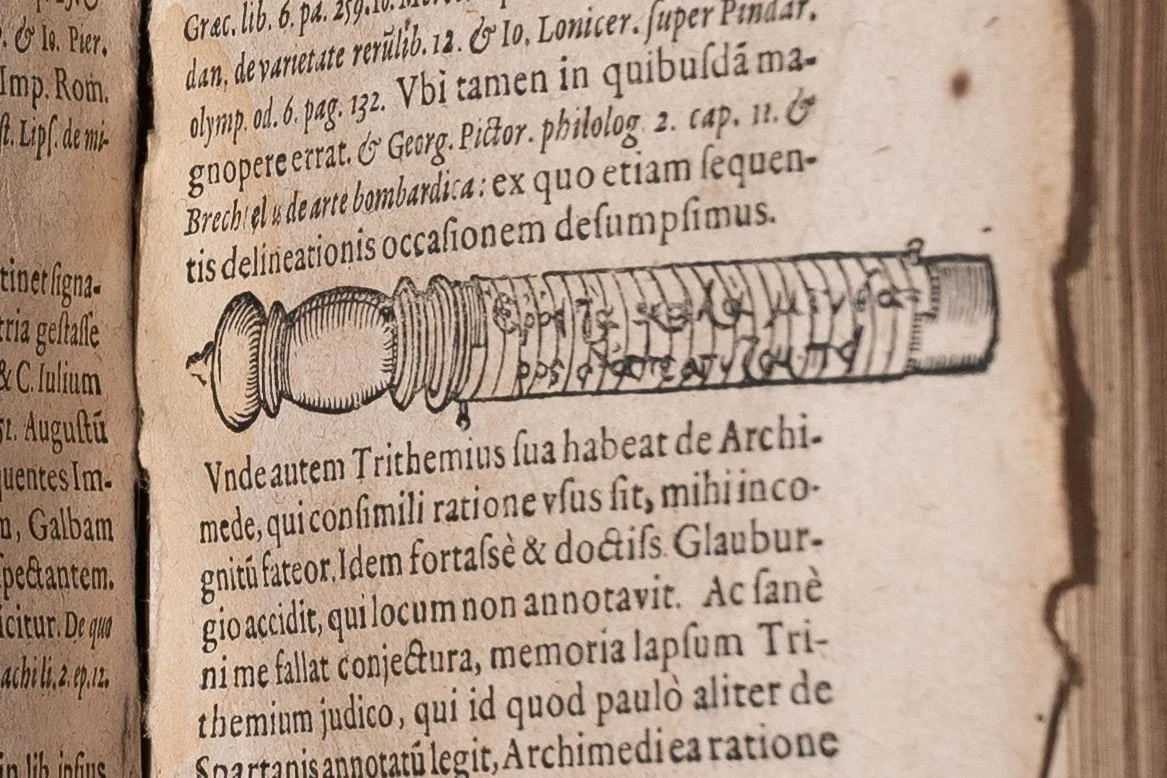 Image 1 of 6
 Image 2 of 6
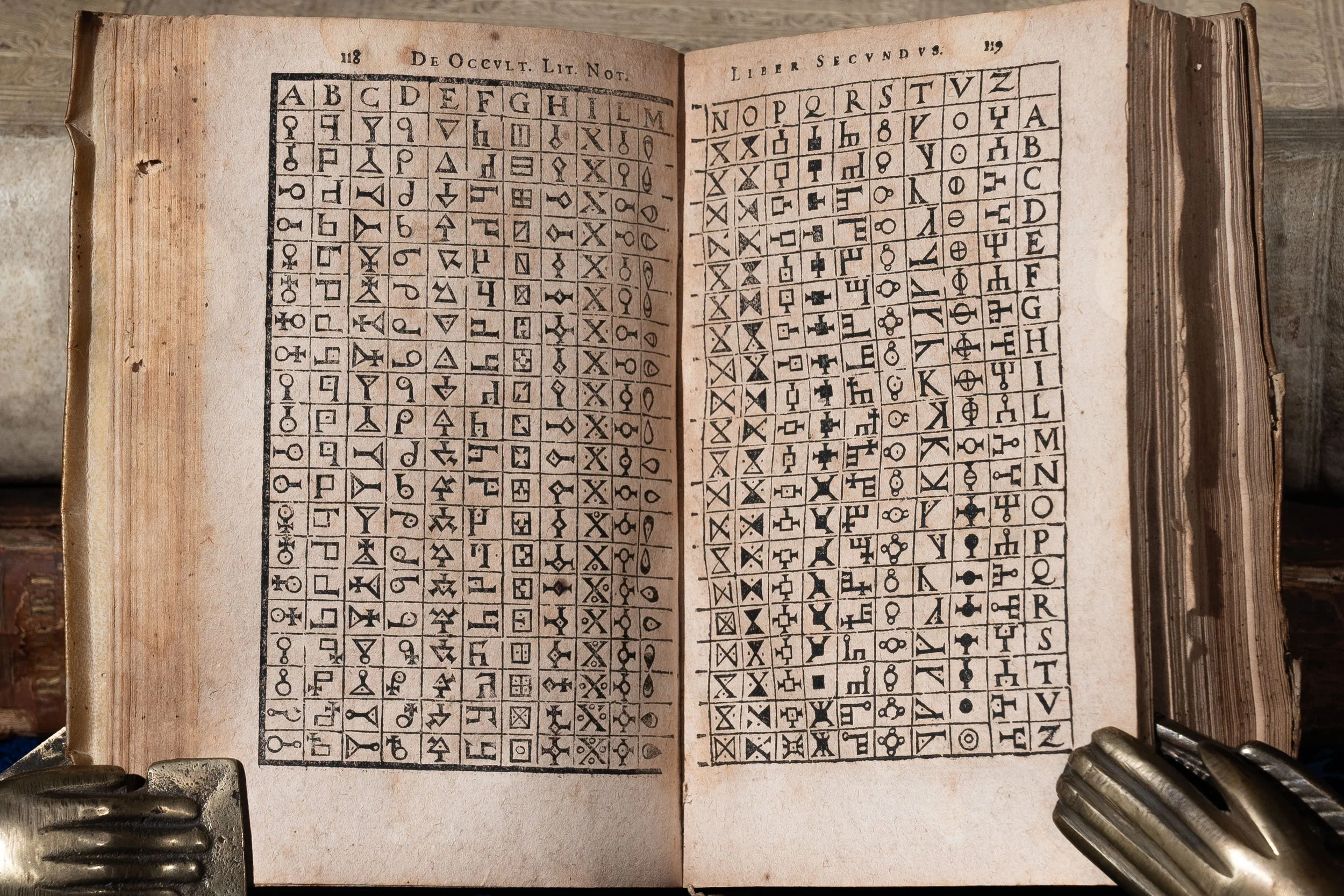 Image 3 of 6
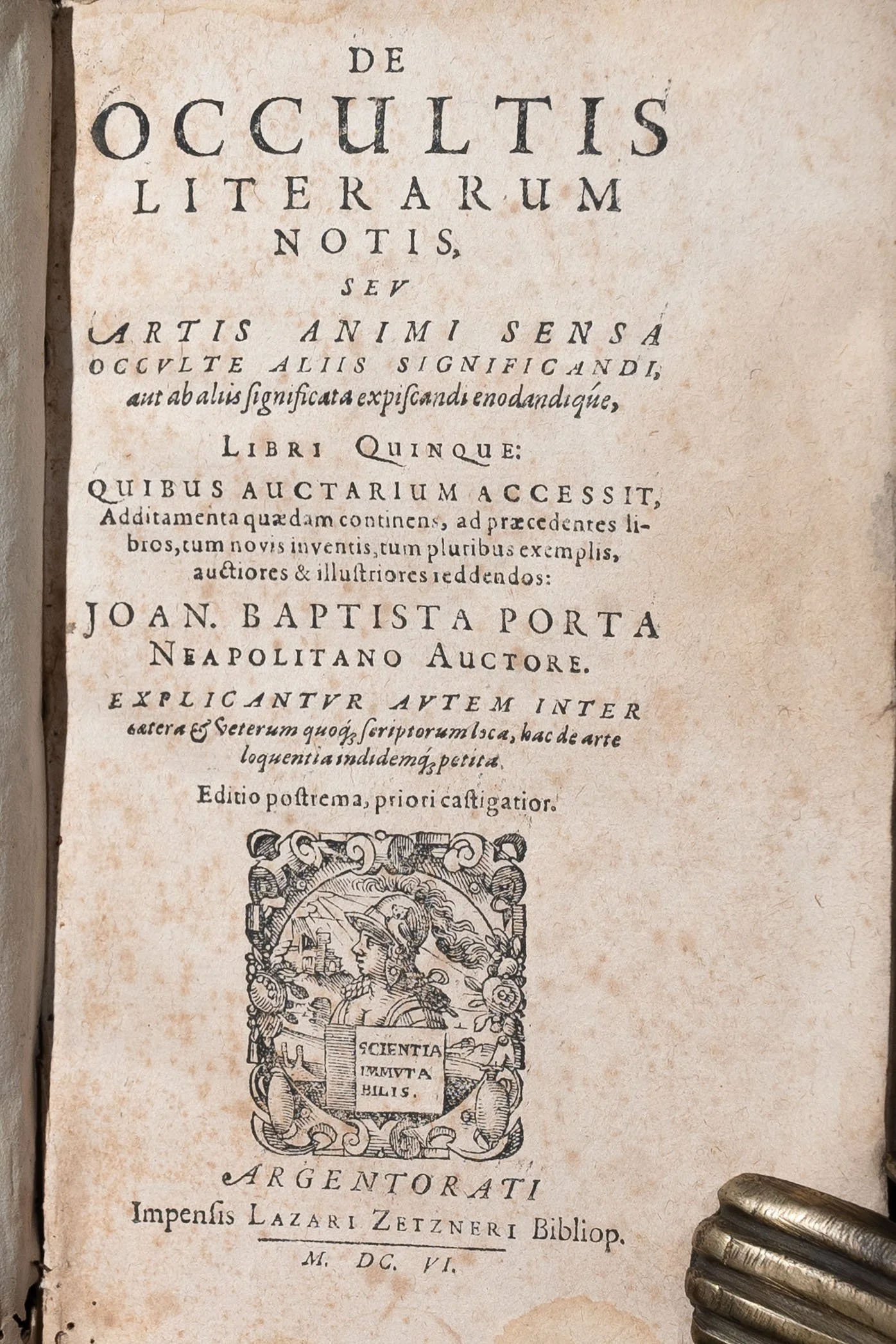 Image 4 of 6
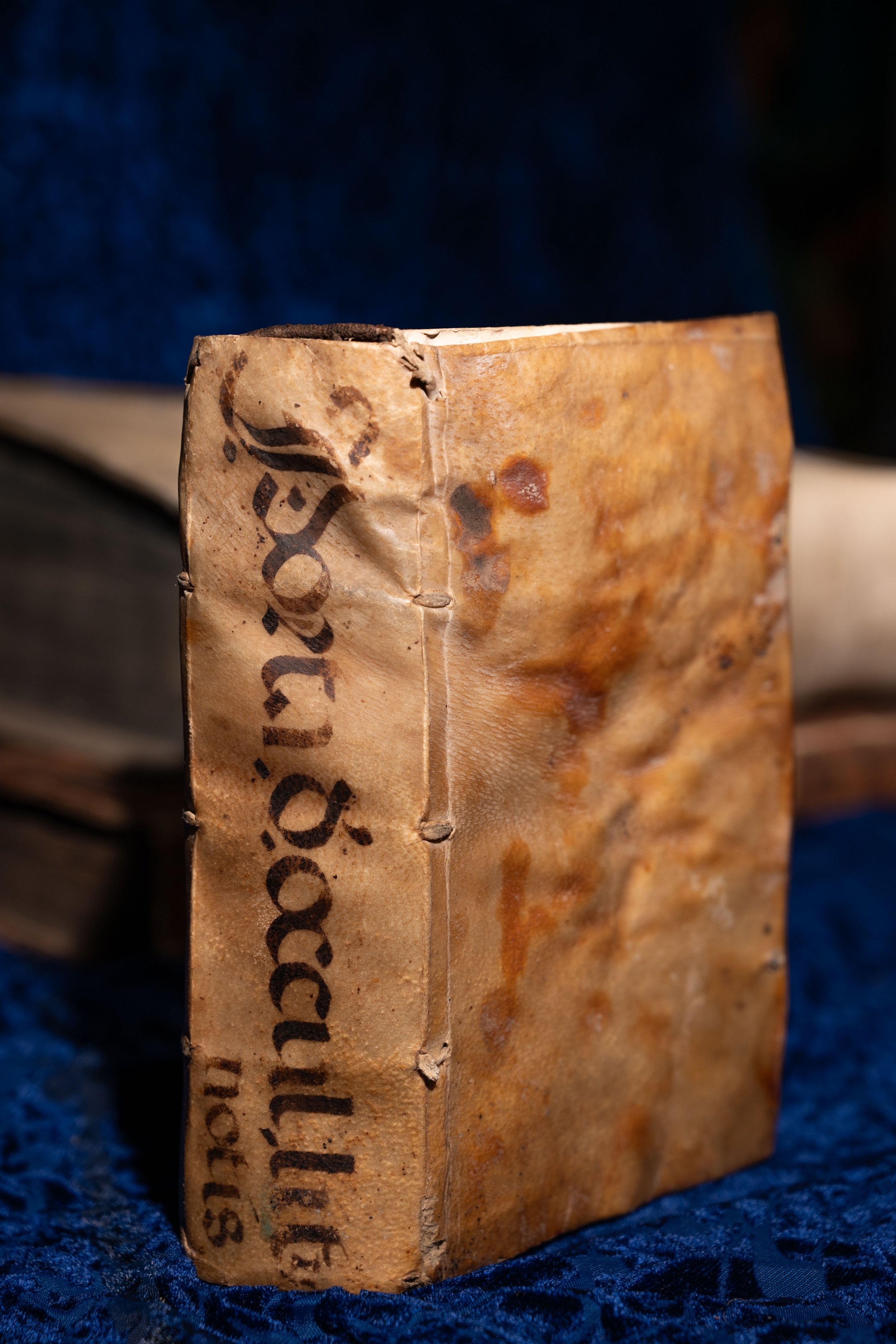 Image 5 of 6
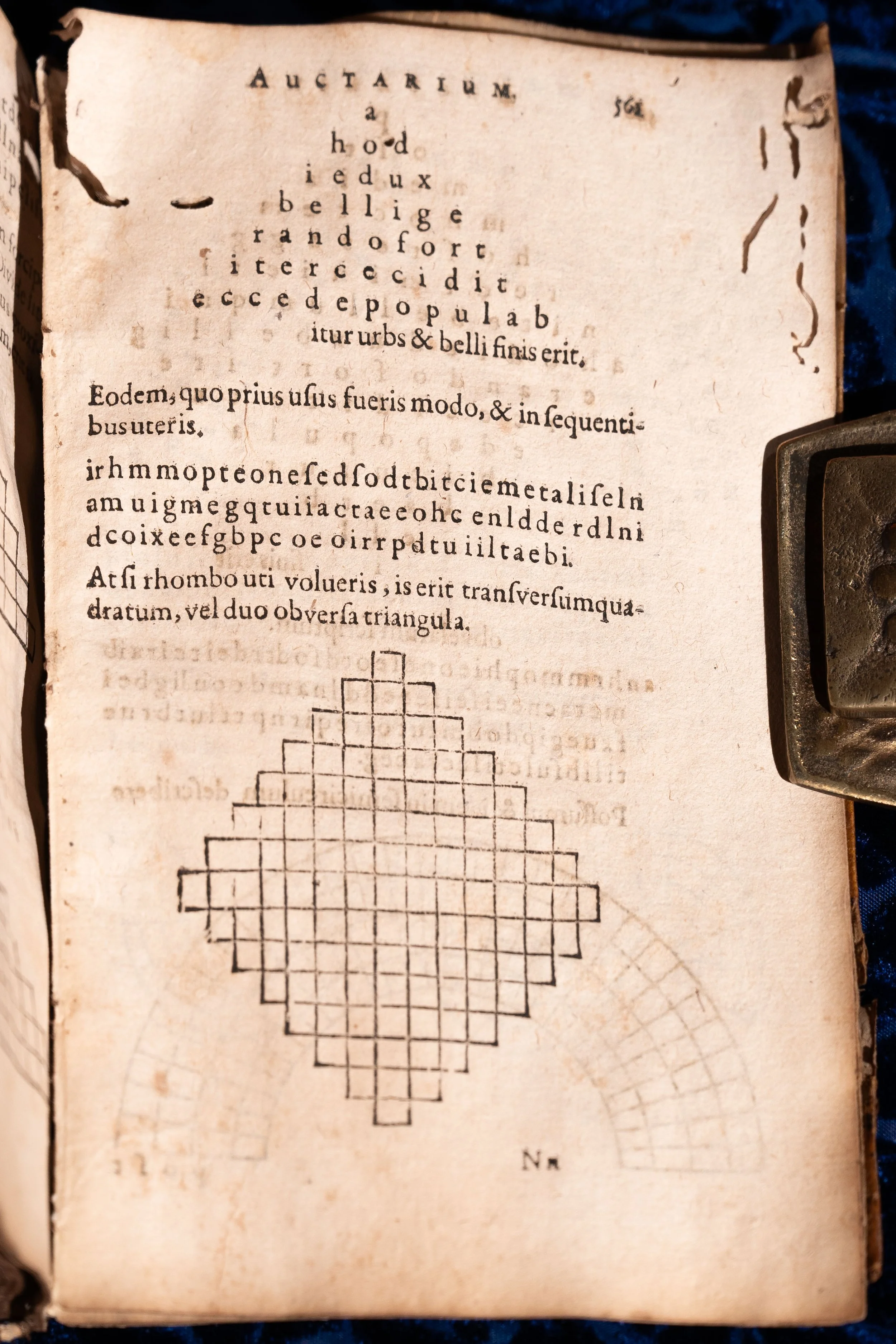 Image 6 of 6