At the head of the first book a serpent bends itself into a circle and swallows its own tail, flanked by a blazing sun and a crescent moon, and some reader long ago has washed the whole scene in orange. The question printed above it, in Greek: how did the Egyptians signify eternity? This is the ouroboros as early modern Europe actually received it, in a schoolbook, with the answer supplied. Nearly every page of this pocket volume carries a little woodcut of this kind, a hawk, a bull, a vulture, an ostrich, and many of them have been colored in by an early hand, more enthusiastic than trained. The pigment has offset onto facing pages.
The text is one of the strangest survivals of the ancient world. The Hieroglyphica passes under the name of Horapollo of the Nile, said to be an Egyptian sage, and claims to explain what the sacred carvings of Egypt mean: a vulture signifies a mother, a goose a son, a hare openness, because its eyes never close. It was compiled in late antiquity, when true knowledge of the script was already guttering out, and it preserves a few authentic memories wrapped in a great deal of allegorical dreaming. A Florentine traveler bought a manuscript of it on a Greek island in 1419, and the effect on Renaissance Europe was electric. Here, the humanists concluded, was proof that Egypt had written in pure symbols, wisdom legible to the initiated without the interference of ordinary language.
That conviction ran for three centuries. Aldus printed the text in 1505; Dürer drew hieroglyphs out of it for the Emperor Maximilian; it influenced the emblem-book tradition, including Alciato, and the baroque Egyptology of Athanasius Kircher. Europe read Egypt through Horapollo until Champollion read Egyptian itself in 1822 and the dream dissolved. It is tempting to call it the most productive wrong book in European history: wrong about the script, and in being wrong it furnished the West's imagination of the symbol for three hundred years.
This is the pocket Greek and Latin selection prepared by Giulio Franceschini for the schoolrooms of Rome, issued in an earlier edition in 1599 and here in the reissue printed by Carlo Vullietti, licensed “with the permission of the superiors.” The imprint is its own period piece: papal Rome had just spent two decades hauling actual obelisks upright in its piazzas, and the city's appetite for things Egyptian was running high. The title page carries a woodcut globe blazoned with the IHS of the Jesuits, the order then busiest reconciling Egyptian wisdom with the Church.
The copy has lived a full life, and wears the evidence. On a front flyleaf an early owner has written a gift inscription entirely in Greek: Ignatius de Porta presents the book to Jo. Franciscus Marx, “μνημης χαριν,” for remembrance's sake, one classicist's keepsake to another. The title bears the oval stamp of the Marx'sche Bibliothek, and a Frankfurt parish library stamp at the rear carried it into the twentieth century, with an old shelf label still clinging to the spine foot. A working copy, priced accordingly: there are repairs and a few small losses within, noted below, and the later gilt calf is rubbed at the extremities. What it offers in exchange is hand color through much of the book and four centuries of readers who plainly could not leave it alone.
Provenance: (1) Greek gift inscription in an early hand to a front flyleaf: Ignatius de Porta to Jo. Franciscus Marx, “μνημης χαριν” (for remembrance's sake). (2) Oval ink stamp “Fl. Marx'sche Bibliothek” to title and front matter. (3) Stamp “Bibl. Ges. Verb. Pfarr. Ffm. a.M.” (a Frankfurt am Main parish federation library) to rear pastedown; paper shelf label “St. Gun. AK” at spine foot; old ink and pencil shelfmarks.
HORAPOLLO (Horapollo Niliacus, fl. later 5th century AD?). Ωρου Απολλωνος Νειλωου ιερογλυφικα εκλεκτα. Hori Apollinis Selecta Hieroglyphica. Rome: Carlo Vullietti, at the expense of Giulio Franceschini, 1606. Reissue of Franceschini's Greek-Latin selection previously published in 1599.
Physical Description: Pocket format (10.5 x 6.5 cm). 272 pp., with index. Woodcut IHS globe device to title and small woodcuts in the text throughout (the emblems of Books I and II), many hand-colored in an early amateur hand, with offsetting of the colors onto facing pages. Page 263 misnumbered 251.
Binding: Later full calf, covers with gilt triple-fillet frames and floral cornerpieces, spine gilt in compartments with red morocco label, blue endpapers. Rubbed, spine ends frayed, front hinge cracked at the foot but holding.
Condition: Library stamps and shelfmarks as under Provenance. Early marginal paper repairs to pp. 3-6; a tear at pp. 53/54; repairs at pp. 63/64 and a small hole at pp. 65/66, each touching a few words; scattered soiling and offsetting from the hand-coloring. Text otherwise clear, the binding solid. A complete working copy, with the faults noted above.
At the head of the first book a serpent bends itself into a circle and swallows its own tail, flanked by a blazing sun and a crescent moon, and some reader long ago has washed the whole scene in orange. The question printed above it, in Greek: how did the Egyptians signify eternity? This is the ouroboros as early modern Europe actually received it, in a schoolbook, with the answer supplied. Nearly every page of this pocket volume carries a little woodcut of this kind, a hawk, a bull, a vulture, an ostrich, and many of them have been colored in by an early hand, more enthusiastic than trained. The pigment has offset onto facing pages.
The text is one of the strangest survivals of the ancient world. The Hieroglyphica passes under the name of Horapollo of the Nile, said to be an Egyptian sage, and claims to explain what the sacred carvings of Egypt mean: a vulture signifies a mother, a goose a son, a hare openness, because its eyes never close. It was compiled in late antiquity, when true knowledge of the script was already guttering out, and it preserves a few authentic memories wrapped in a great deal of allegorical dreaming. A Florentine traveler bought a manuscript of it on a Greek island in 1419, and the effect on Renaissance Europe was electric. Here, the humanists concluded, was proof that Egypt had written in pure symbols, wisdom legible to the initiated without the interference of ordinary language.
That conviction ran for three centuries. Aldus printed the text in 1505; Dürer drew hieroglyphs out of it for the Emperor Maximilian; it influenced the emblem-book tradition, including Alciato, and the baroque Egyptology of Athanasius Kircher. Europe read Egypt through Horapollo until Champollion read Egyptian itself in 1822 and the dream dissolved. It is tempting to call it the most productive wrong book in European history: wrong about the script, and in being wrong it furnished the West's imagination of the symbol for three hundred years.
This is the pocket Greek and Latin selection prepared by Giulio Franceschini for the schoolrooms of Rome, issued in an earlier edition in 1599 and here in the reissue printed by Carlo Vullietti, licensed “with the permission of the superiors.” The imprint is its own period piece: papal Rome had just spent two decades hauling actual obelisks upright in its piazzas, and the city's appetite for things Egyptian was running high. The title page carries a woodcut globe blazoned with the IHS of the Jesuits, the order then busiest reconciling Egyptian wisdom with the Church.
The copy has lived a full life, and wears the evidence. On a front flyleaf an early owner has written a gift inscription entirely in Greek: Ignatius de Porta presents the book to Jo. Franciscus Marx, “μνημης χαριν,” for remembrance's sake, one classicist's keepsake to another. The title bears the oval stamp of the Marx'sche Bibliothek, and a Frankfurt parish library stamp at the rear carried it into the twentieth century, with an old shelf label still clinging to the spine foot. A working copy, priced accordingly: there are repairs and a few small losses within, noted below, and the later gilt calf is rubbed at the extremities. What it offers in exchange is hand color through much of the book and four centuries of readers who plainly could not leave it alone.
Provenance: (1) Greek gift inscription in an early hand to a front flyleaf: Ignatius de Porta to Jo. Franciscus Marx, “μνημης χαριν” (for remembrance's sake). (2) Oval ink stamp “Fl. Marx'sche Bibliothek” to title and front matter. (3) Stamp “Bibl. Ges. Verb. Pfarr. Ffm. a.M.” (a Frankfurt am Main parish federation library) to rear pastedown; paper shelf label “St. Gun. AK” at spine foot; old ink and pencil shelfmarks.
HORAPOLLO (Horapollo Niliacus, fl. later 5th century AD?). Ωρου Απολλωνος Νειλωου ιερογλυφικα εκλεκτα. Hori Apollinis Selecta Hieroglyphica. Rome: Carlo Vullietti, at the expense of Giulio Franceschini, 1606. Reissue of Franceschini's Greek-Latin selection previously published in 1599.
Physical Description: Pocket format (10.5 x 6.5 cm). 272 pp., with index. Woodcut IHS globe device to title and small woodcuts in the text throughout (the emblems of Books I and II), many hand-colored in an early amateur hand, with offsetting of the colors onto facing pages. Page 263 misnumbered 251.
Binding: Later full calf, covers with gilt triple-fillet frames and floral cornerpieces, spine gilt in compartments with red morocco label, blue endpapers. Rubbed, spine ends frayed, front hinge cracked at the foot but holding.
Condition: Library stamps and shelfmarks as under Provenance. Early marginal paper repairs to pp. 3-6; a tear at pp. 53/54; repairs at pp. 63/64 and a small hole at pp. 65/66, each touching a few words; scattered soiling and offsetting from the hand-coloring. Text otherwise clear, the binding solid. A complete working copy, with the faults noted above.

 Image 1 of 22
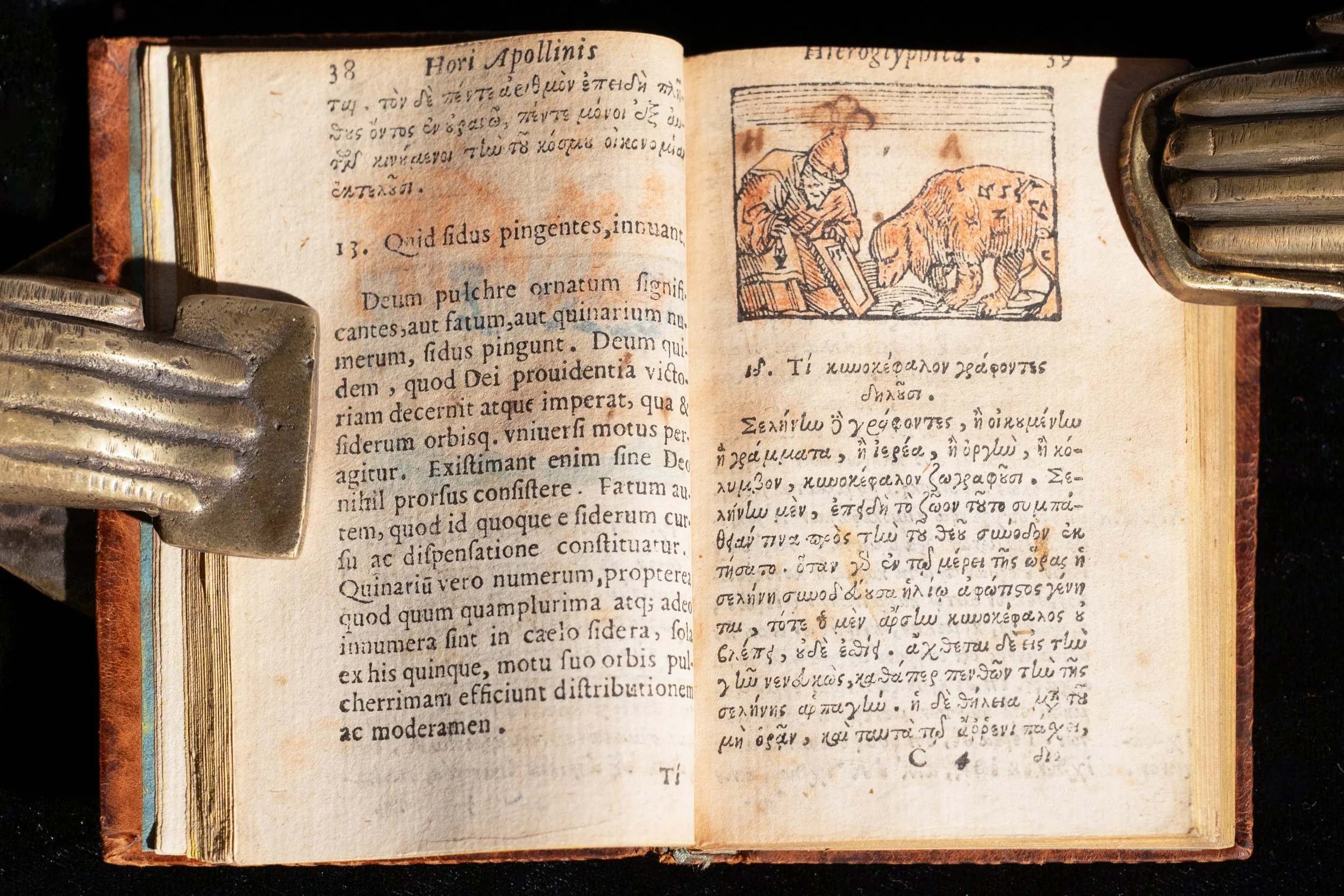 Image 2 of 22
 Image 3 of 22
 Image 4 of 22
 Image 5 of 22
 Image 6 of 22
 Image 7 of 22
 Image 8 of 22
 Image 9 of 22
 Image 10 of 22
 Image 11 of 22
 Image 12 of 22
 Image 13 of 22
 Image 14 of 22
 Image 15 of 22
 Image 16 of 22
 Image 17 of 22
 Image 18 of 22
 Image 19 of 22
 Image 20 of 22
 Image 21 of 22
 Image 22 of 22