
 Image 1 of 4
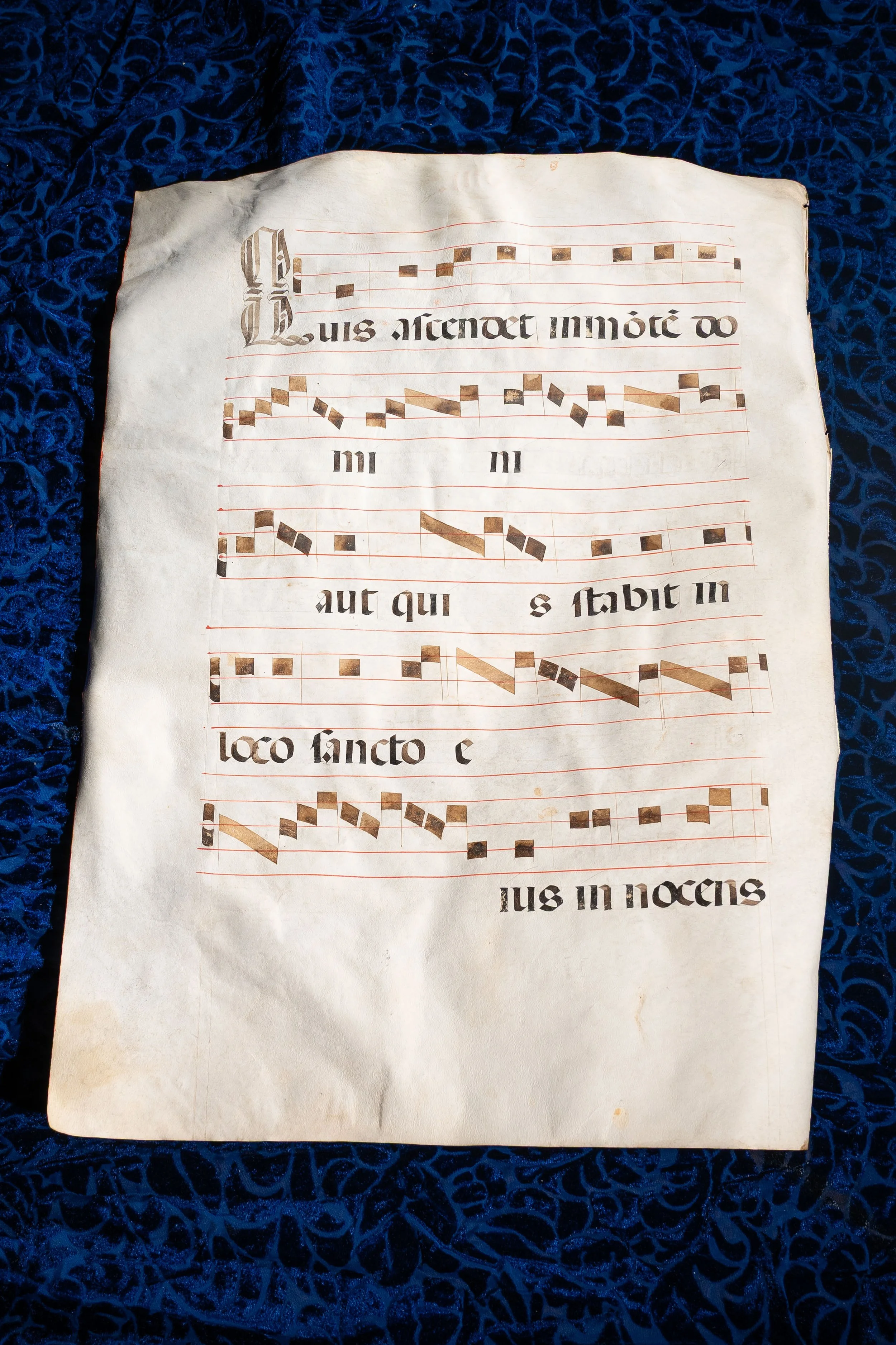 Image 2 of 4
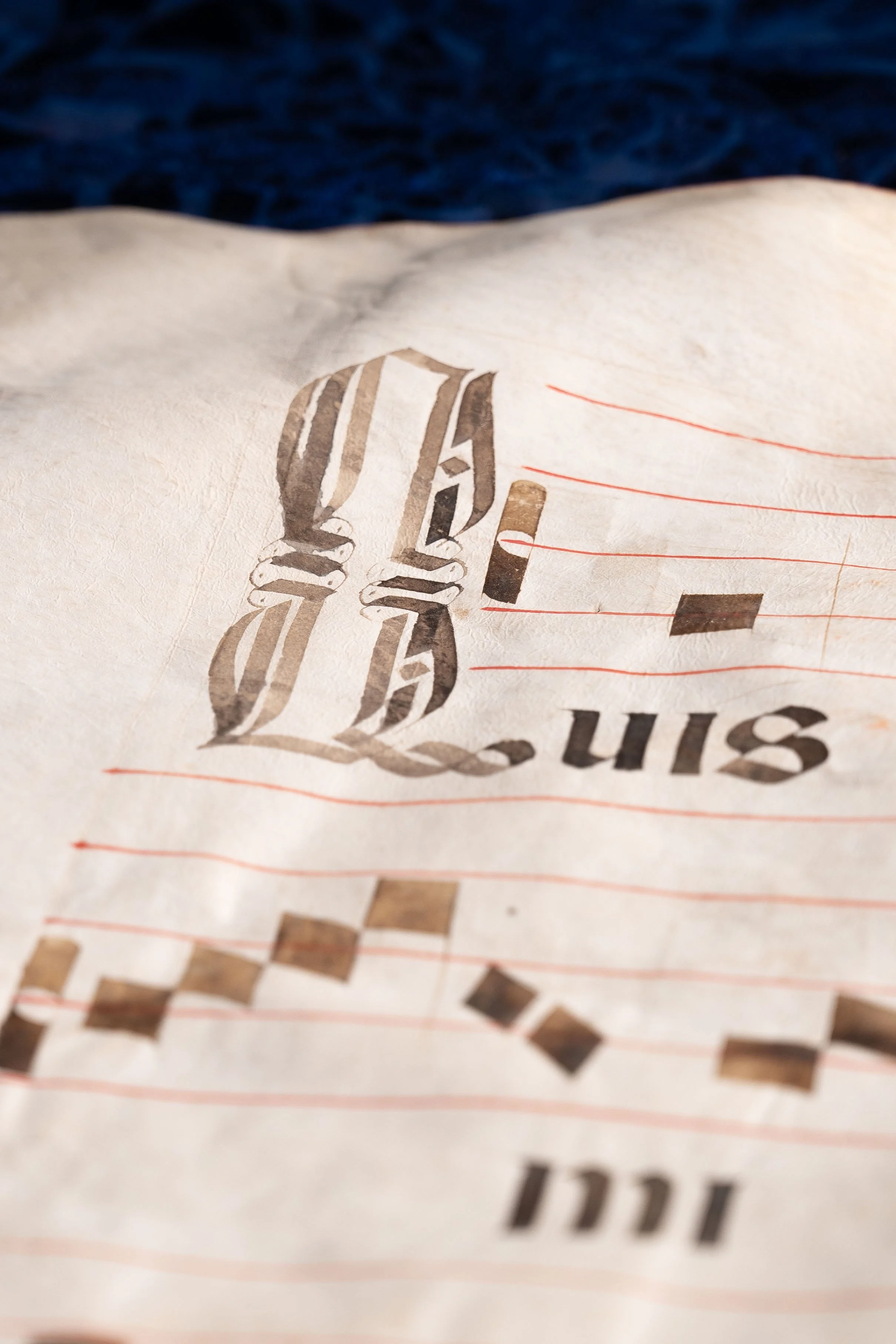 Image 3 of 4
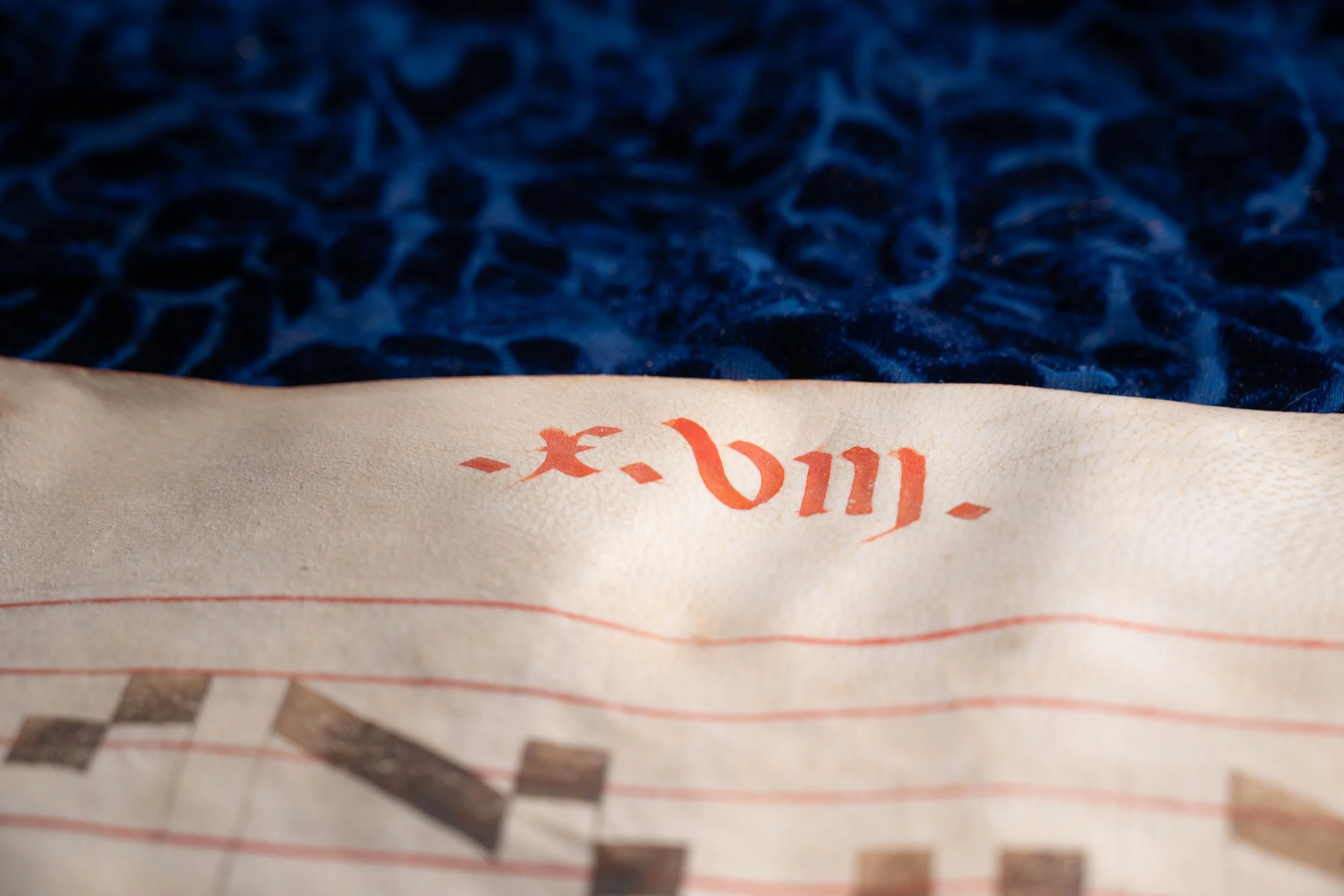 Image 4 of 4
This is the psalm that opens the gates. In liturgical use, Psalm 23/24 served as the processional chant for the Feast of the Ascension and for the dedication of churches, occasions when the assembled faithful enacted, through singing, the opening of heaven itself. The text stages a dialogue between those approaching the gates and those guarding them: “Who is this King of Glory?” The answer, “Dominus virtutum, ipse est Rex gloriae”, resolves the challenge, and the eternal doors swing open. It is among the most dramatically charged passages in the Psalter, and its ritual deployment in medieval liturgy gave it a performative intensity that a leaf like this one was designed to serve.
The psalm also carried a rich afterlife in the esoteric and mystical traditions. Patristic and medieval commentators from Origen through Augustine to the Victorines read the “gates” as figures for the soul’s ascent to God, an interpretation that fed directly into the mystical theology of the later Middle Ages and the Hermetic-Kabbalistic synthesis of the Renaissance. The language of ascent, purity, and the opening of closed portals resonated as readily with Ficino’s Neoplatonic readers as it had with the monks who first chanted these verses. A collector of Western esoterica may appreciate finding, at the root of so many later elaborations, the psalm itself in its working liturgical form: not a text for private contemplation but one that required voices, a choir, and an open book large enough for all of them to read from at once.
The leaf is from a large-format choir antiphonary, the kind of massive volume set on a lectern at the center of the choir, legible to a dozen singers at once. The folio number (.x.viij. = 18) places it near the opening of the parent volume, consistent with a psalter section or the common of feasts early in the sanctoral or temporal cycle. The script is a competent Gothic textura; the notation, square on four red lines, follows the standard practice for plainchant manuscripts of this period. The pen-drawn initial “Q” is modest but well-executed, its decorative flourishes characteristic of a working liturgical book rather than a presentation copy. This is not a luxury manuscript. It is a functional one, and the slight soiling at the lower edge, where singers’ hands would have turned the page, is a reminder that it served the purpose for which it was made.
[MANUSCRIPT LEAF]. [ANTIPHONARY]. “Quis ascendet in montem Domini”: Leaf from a Choir Antiphonary, containing Psalm 23 (Vulgate) with musical notation. [Southern Europe, probably Spain or Italy, 15th or early 16th century].
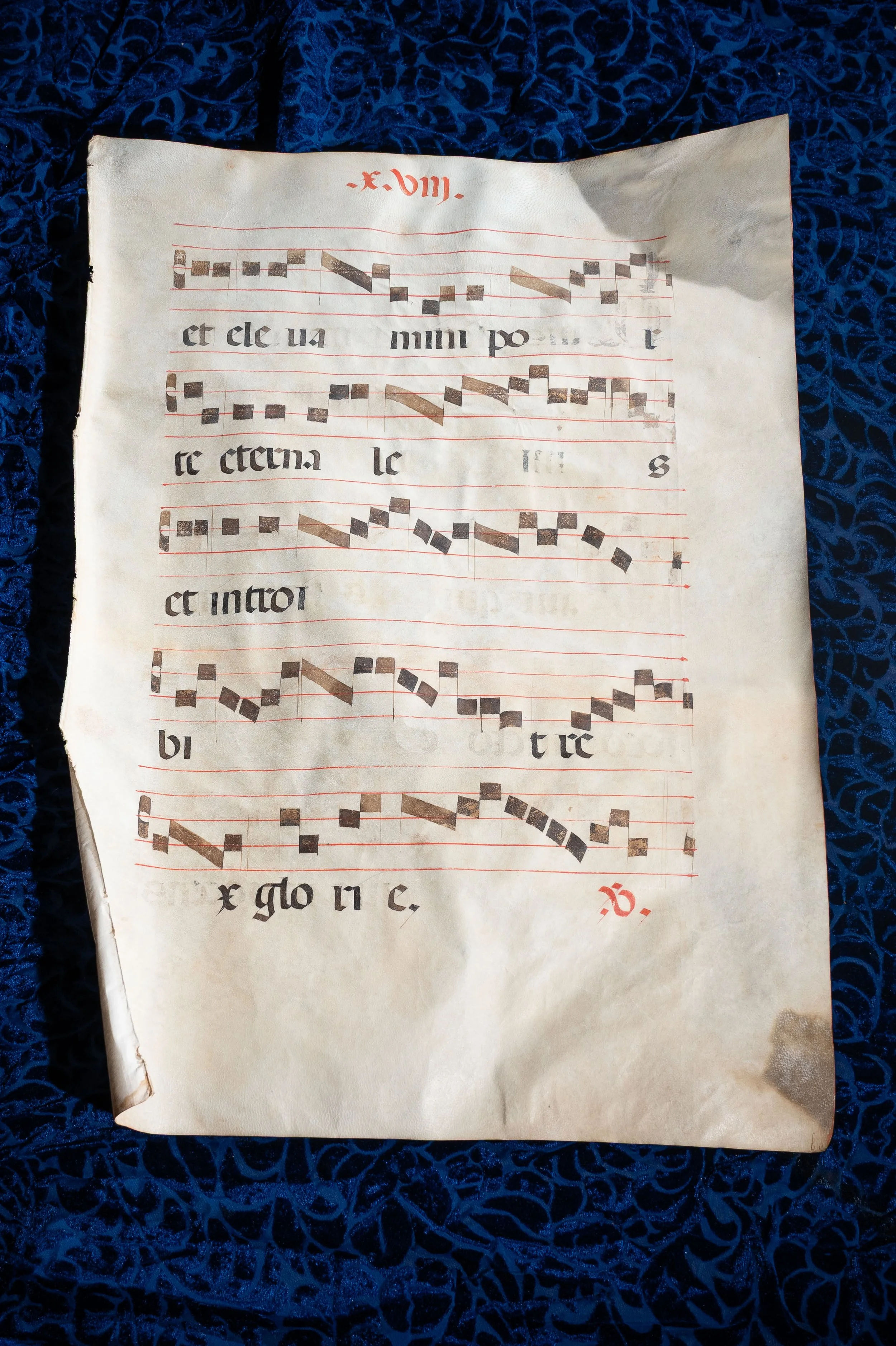
Physical Description: Single vellum leaf, manuscript in Latin. Text in Gothic textura script in black ink, with square notation on four red-line staves, six staves per side. Rubrication in red throughout: folio number “.x.viij.” (i.e. 18) at head of verso; versicle marker “V.” in red at foot of verso. One large pen-drawn initial “Q” on recto, approximately four lines high, executed in brown ink with decorative flourishes. No gold, no polychrome illumination.
Textual Content: The leaf preserves a substantial portion of Psalm 23 in the Vulgate numbering (Psalm 24 in the Hebrew), set to chant. The recto opens with the decorated initial “Q” for “Quis ascendet in montem Domini, aut quis stabit in loco sancto eius? Innocens manibus et mundo corde…” (“Who shall ascend into the mountain of the Lord? or who shall stand in his holy place? He that is innocent in his hands and clean of heart…”). The verso continues through the great processional verses: “et elevamini portae aeternales, et introibit rex gloriae” (“and be ye lifted up, O eternal gates, and the King of Glory shall come in”), concluding with the versicle marker.
Condition: Vellum supple and generally clean, with some creasing and light cockling from age. Minor soiling and a small area of staining at lower right corner of verso, consistent with handling in liturgical use. Inks remain dark and legible throughout; red rubrication bright. Pen-drawn initial well-preserved. Edges show minor wear; no significant losses to text or notation. Overall a solid, representative example in good condition.
Provenance: Not established. Presumably removed from a dismembered choir book at an unknown date.
Dating and Localization: The script, notation style, and layout are consistent with southern European (Spanish or Italian) production of the 15th or early 16th century. The four-line red staves and square notation follow standard plainchant practice of the period.
This is the psalm that opens the gates. In liturgical use, Psalm 23/24 served as the processional chant for the Feast of the Ascension and for the dedication of churches, occasions when the assembled faithful enacted, through singing, the opening of heaven itself. The text stages a dialogue between those approaching the gates and those guarding them: “Who is this King of Glory?” The answer, “Dominus virtutum, ipse est Rex gloriae”, resolves the challenge, and the eternal doors swing open. It is among the most dramatically charged passages in the Psalter, and its ritual deployment in medieval liturgy gave it a performative intensity that a leaf like this one was designed to serve.
The psalm also carried a rich afterlife in the esoteric and mystical traditions. Patristic and medieval commentators from Origen through Augustine to the Victorines read the “gates” as figures for the soul’s ascent to God, an interpretation that fed directly into the mystical theology of the later Middle Ages and the Hermetic-Kabbalistic synthesis of the Renaissance. The language of ascent, purity, and the opening of closed portals resonated as readily with Ficino’s Neoplatonic readers as it had with the monks who first chanted these verses. A collector of Western esoterica may appreciate finding, at the root of so many later elaborations, the psalm itself in its working liturgical form: not a text for private contemplation but one that required voices, a choir, and an open book large enough for all of them to read from at once.
The leaf is from a large-format choir antiphonary, the kind of massive volume set on a lectern at the center of the choir, legible to a dozen singers at once. The folio number (.x.viij. = 18) places it near the opening of the parent volume, consistent with a psalter section or the common of feasts early in the sanctoral or temporal cycle. The script is a competent Gothic textura; the notation, square on four red lines, follows the standard practice for plainchant manuscripts of this period. The pen-drawn initial “Q” is modest but well-executed, its decorative flourishes characteristic of a working liturgical book rather than a presentation copy. This is not a luxury manuscript. It is a functional one, and the slight soiling at the lower edge, where singers’ hands would have turned the page, is a reminder that it served the purpose for which it was made.
[MANUSCRIPT LEAF]. [ANTIPHONARY]. “Quis ascendet in montem Domini”: Leaf from a Choir Antiphonary, containing Psalm 23 (Vulgate) with musical notation. [Southern Europe, probably Spain or Italy, 15th or early 16th century].
Physical Description: Single vellum leaf, manuscript in Latin. Text in Gothic textura script in black ink, with square notation on four red-line staves, six staves per side. Rubrication in red throughout: folio number “.x.viij.” (i.e. 18) at head of verso; versicle marker “V.” in red at foot of verso. One large pen-drawn initial “Q” on recto, approximately four lines high, executed in brown ink with decorative flourishes. No gold, no polychrome illumination.
Textual Content: The leaf preserves a substantial portion of Psalm 23 in the Vulgate numbering (Psalm 24 in the Hebrew), set to chant. The recto opens with the decorated initial “Q” for “Quis ascendet in montem Domini, aut quis stabit in loco sancto eius? Innocens manibus et mundo corde…” (“Who shall ascend into the mountain of the Lord? or who shall stand in his holy place? He that is innocent in his hands and clean of heart…”). The verso continues through the great processional verses: “et elevamini portae aeternales, et introibit rex gloriae” (“and be ye lifted up, O eternal gates, and the King of Glory shall come in”), concluding with the versicle marker.
Condition: Vellum supple and generally clean, with some creasing and light cockling from age. Minor soiling and a small area of staining at lower right corner of verso, consistent with handling in liturgical use. Inks remain dark and legible throughout; red rubrication bright. Pen-drawn initial well-preserved. Edges show minor wear; no significant losses to text or notation. Overall a solid, representative example in good condition.
Provenance: Not established. Presumably removed from a dismembered choir book at an unknown date.
Dating and Localization: The script, notation style, and layout are consistent with southern European (Spanish or Italian) production of the 15th or early 16th century. The four-line red staves and square notation follow standard plainchant practice of the period.