1595 - Malleus Maleficarum, The Hammer of Witches (bound with other witch-hunting and demonology treatises)

$20,000.00

One of the most important collections of Witchhunting and Demonological treaties of the Early-Modern Period, all anchored by the dread Malleus Maleficarum, the Hammer of Witches.

Malleus Maleficarum is widely considered to be one of the most sinister books ever written.  Composed by Heinrich Kramer and published in 1486/7, the Hammer of Witches text details what scholars now call the “Elaborated Theory of Witchcraft” usually including: a pact or covenant entered into with the Devil and thus apostasy from Christianity, sexual relations with the Devil and demons, aerial flight for the purpose of attending an assembly or Sabbat, sometimes synagogue, which is presided over by Satan himself at which initiates entered into said pact, followed by incestous and promiscuous sex, the general practice of maleficent magic, the slaughter of fetuses and babies and various means for preventing human procreation all of this to the end of an elaborate, women-led anti-Christian religion whose aim was to undermine Christendom as part of the devil’s ongoing war with God. 

The Malleus Maleficarum can be divided into several sections: The Apologia, the Papal Bull, the academic Approbation, and the main body of the work in three sections along with an elaborate though not always accurate table of contents:

The Apologia, Defense or Justification, is a small note by Sprenger that he and an associate have prepared this text in light of their realization that the sorcery-sect is playing and will play a widespread role in the final apocalyptic days to come. Thus, combating it must be a central, perhaps the central concern of the church.  Despite this, the inquisitors have been stymied at times in their fight against this sect, even by local bishops. Thus the text also included a papal bull or pronouncement of 1484 by Pope Innocent VIII, secured two years prior to the printing of the Malleus by Institoris, Summis Desiderantes which both espouses his diabolical theory of the sorcery-sect but also calls out various locales in Germany in which local bishops pumped the brakes on the inquisition. Following the Papal Bull, is an official academic document signed by various members of the theology faculty of the prestigious university of Cologne on May 19 1487 which attest to the theological integrity of the Malleus Maleficarum as a whole.  While this document is somewhat procedurally odd - which has caused its authenticity to be doubted, especially in the 19th century - it is unlikely that it is forged though it seems that the professors signed off on the Malleus despite most seeming to have only superficially read it. 

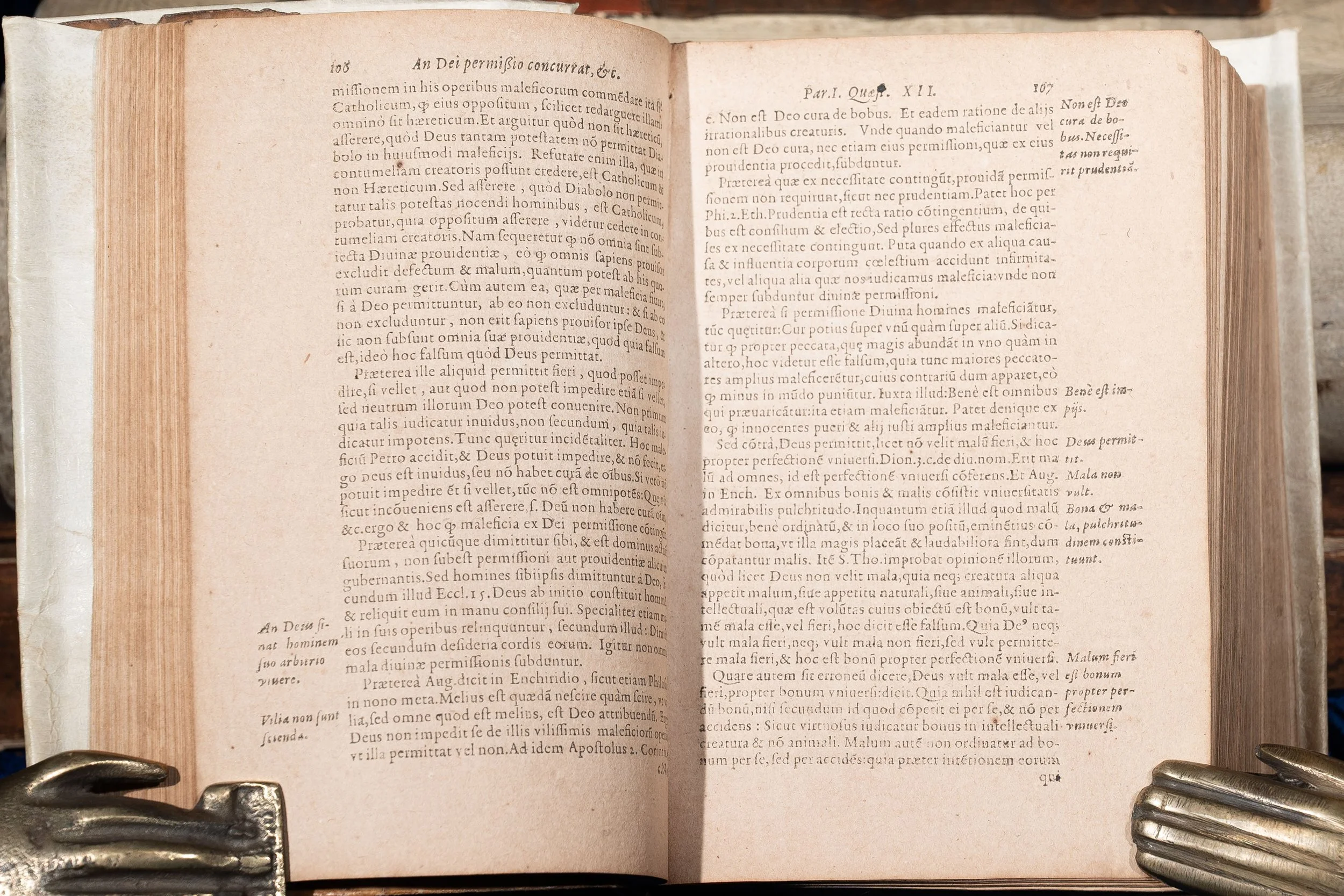
Following this juridical justification material the main body of the text. Book I details the apocalyptic nature of witchcraft in the classic medieval quaestio disputata method.  The first part of the text, seeks to argue that disbelief in this heretical sect and the reality of sorcery is tantamount to playing into it and specifically how demons, the witch and the very permission of God make this sect possible.  Indeed, this section contains lurid details of how people, especially women copulate with demons to produce more witches, how semen is stolen from men and transferred to women during the demonic sex-act, the systematically misogynistic theory of why women are more prone to this heresy including the infamous etymology that ‘femina’ is a contraction of ‘fides’ and ‘minus’ - literally without faith or lacking faith, how sorcery is always accomplished through demonic power rather than the actual charms or implements of the witch, of course how women make penises disappear, turn people into beasts, and sacrifice newborns and fetuses. Finally this section details why God allows sorcery to run rampant and cause the harm it does.  Simply put, sinful human beings deserve what they get, even innocent victims of sorcery just become a kind of collateral damage in the war with the devil.  Indeed, this section details that the sorcery-heresy is far worse than even the rebel Satan himself - I’m not kidding - and Adam, other heretics and even the demons.  Witches are literally just the worst because they are apostates, they actively work with the devil to do evil and they cause material harm to nature, beasts and humans through their evil-doing.  For the Malleus, the Sorcery-heresy is simply the worst and most sinful group in history.

The second part of the text is divided into two sections, the first of which details the various forms of sorcery practiced by the sect and the second recounts various methods by which to legitimately counter-act said sorcery.  Section two leans less heavily on the method of the disputed question and contains a large amount of anecdotes from the years of Institoris’ works as an inquisitor.  Indeed, these sections provide a fascinating insight into the kinds of sorcery that most worried the writers of the malleus - everything from causing people to think they’ve become animals or that their penis has vanished to causing hailstorms, harming various beasts, magical illnesses, plain old demonic possession, various forms of impeded procreation, irregular or otherwise unnatural loves, lusts or hatreds and even just poor weather. The remedies against such sorcery are also spelled out and mostly take the form of intense religious practice in the form of the sacraments or specific exorcistic rituals even invoking one’s guardian angel to provide further protection.  It’s also worth mentioning that this section contains the only reference really to male sorcerers but virtually nothing is written with the exception of those that use magically infused arrows to find their targets.

The third and final book of the Malleus Maleficarum relies on the 1376 Directorium Inquisitorum of Nicholas Eymerich whose work is a bridge between the anti-heresy work during the Albigensian crusade and the ‘elaborated theory of witchcraft’ found in the Malleus. This section recounts the Inquisitorial procedure for the detention, interrogation with torture, and relaxing of the convicted heretic over the secular arm for execution. A few specific elements of this process are worth mentioning in the scope of the Malleus Maleficarum. The first is that, generally speaking, Institoris found the accepted evidentiary bar both too high and too low: too high because the crime of heretical sorcery left behind very little evidence and was often done in secret but too low because conviction of such a crime would automatically result in the death penalty. Further, the Malleus holds that members of the diabolical sect are often impervious to torture because of the maleficium taciturnitatis or the sorcery of silence whereby the devil magically prevents the accused from crying out in pain.  Indeed, the Malleus infamously warns would-be torturers that suspected witches will daub spittle or urine on their faces to simulate crying and to be careful to note exactly where such tears emerge. All of this has a truly horrifying effect, the inquisitor must rely on conjecture of a kind of witch-hunting intuition by which everything from sustained torture to literally just lying to the suspect can be used to extract a confession.  

This conjecture is informed by three elements:  the reputation of the accused, indications of the deed - e.g., especially recently made threats, something the Malleus thinks the devil compels witches to engage in - and testimony of other witnesses, including testimony arrived at by other tortures. Guided by their intuition and these three evidentiary elements, the Inquisitor comes to a judgement - the considerations of which form a spectrum of elements in the Malleus - and if guilty, unrepentant or relapsed, and having caused material harm the convicted person is relaxed to the secular authorities and then, in all likelihood, burned alive. If one were of any means it was customary to bribe the executioner such that one was strangled before being set alight.

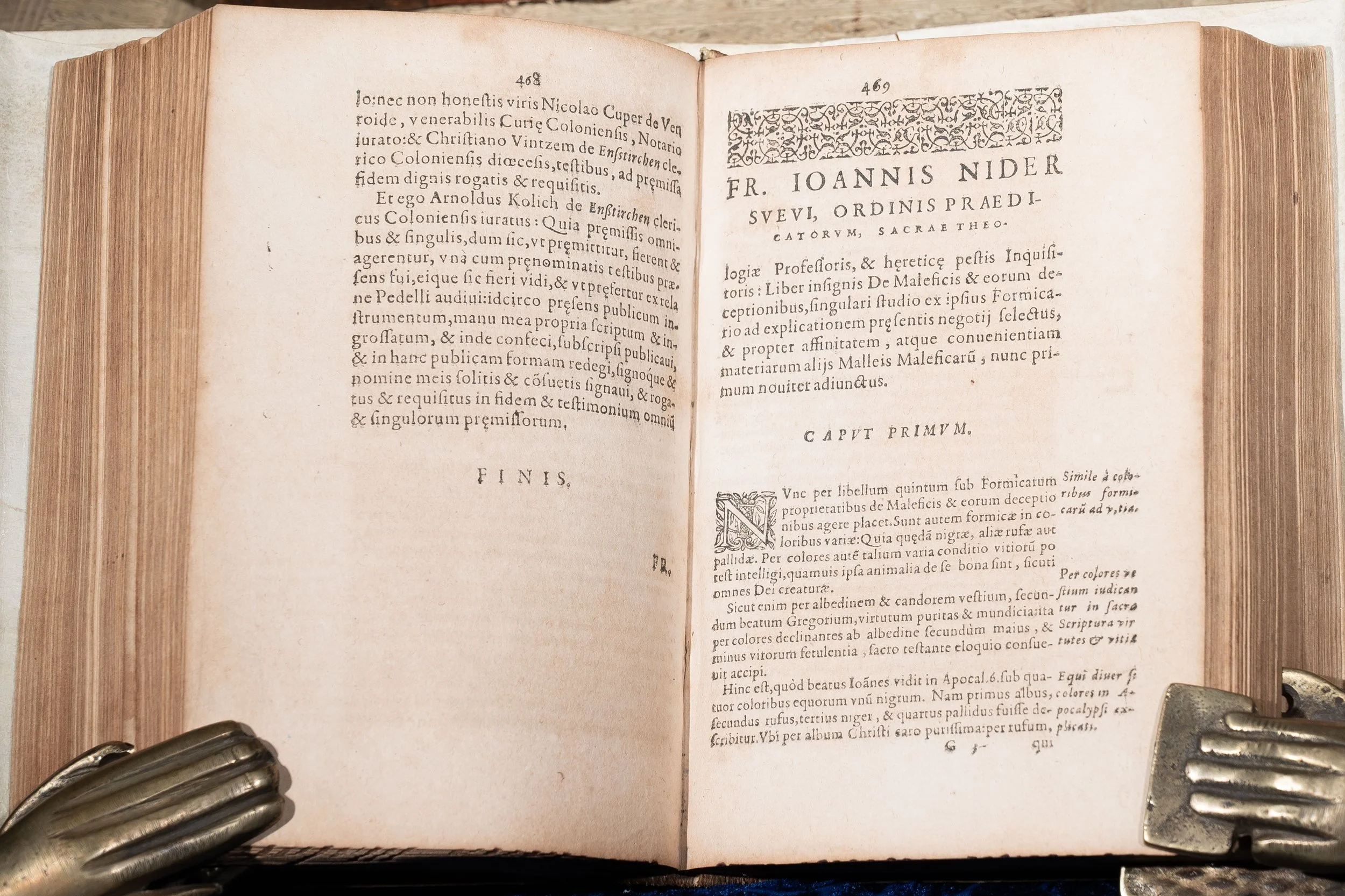
Thus, the Malleus Maleficarum would become the central theoretical and practical work informing the early modern witch-trials, leading some 60,000 people to their deaths with tens of thousands further imprisoned, tortured, humiliated and otherwise punished. But, as the 16th century gave way to the 17th - and the trials were reaching their apex - the Malleus was being viewed with increased scrutiny.  The church would even place the book on the Index Prohibitorum in 1600 but not before editions would appear featuring extensive compilations of demonological material.  Thus, just as the trials were reaching their terrible crescendo, volumes like this were portable libraries for the would-be Inquisitor and Witch-hunter.  Volume I contains the foundational work on witchcraft, the Formicarius of Nider, the first work to detail the alleged existence of the witch heresy in Europe.  

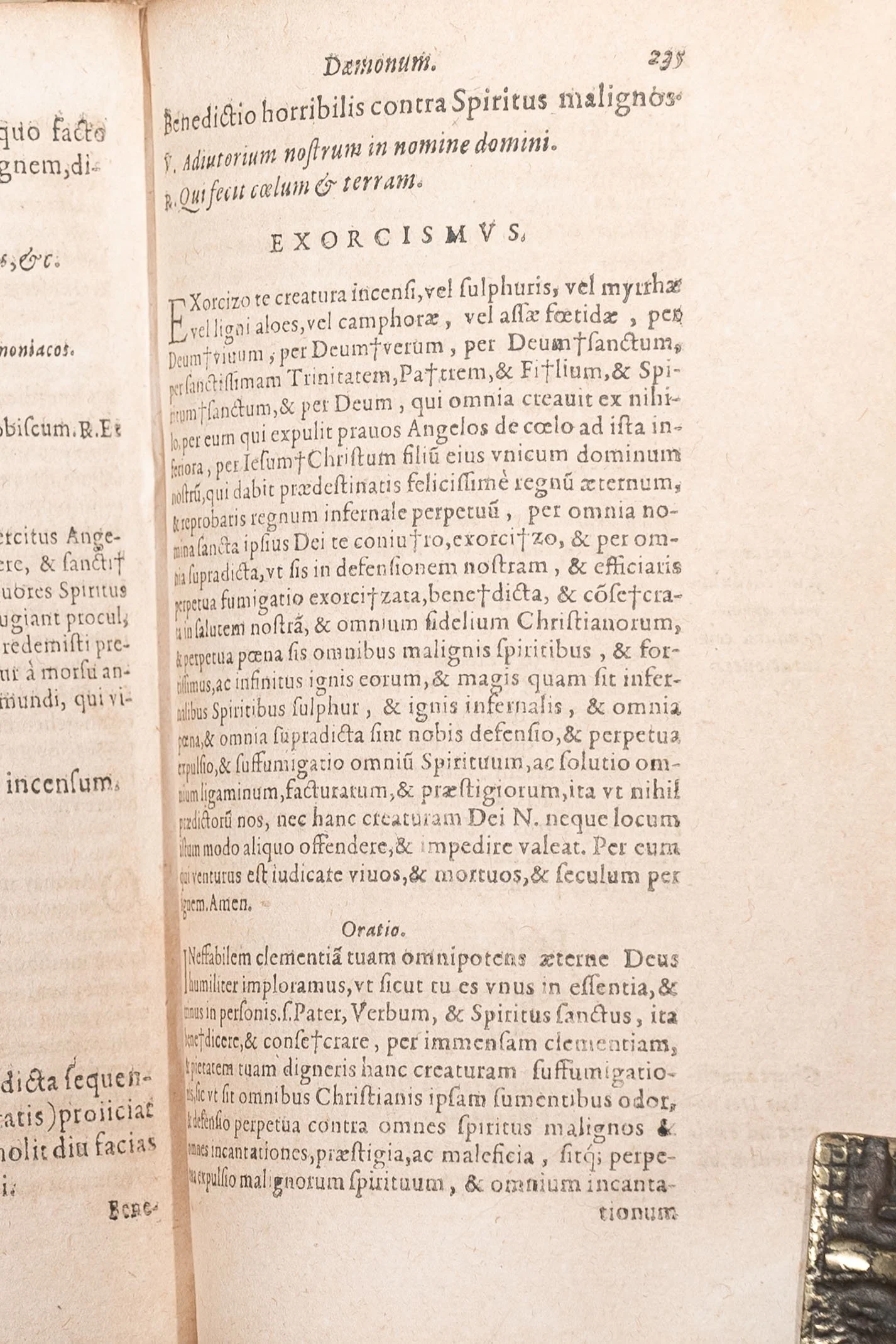
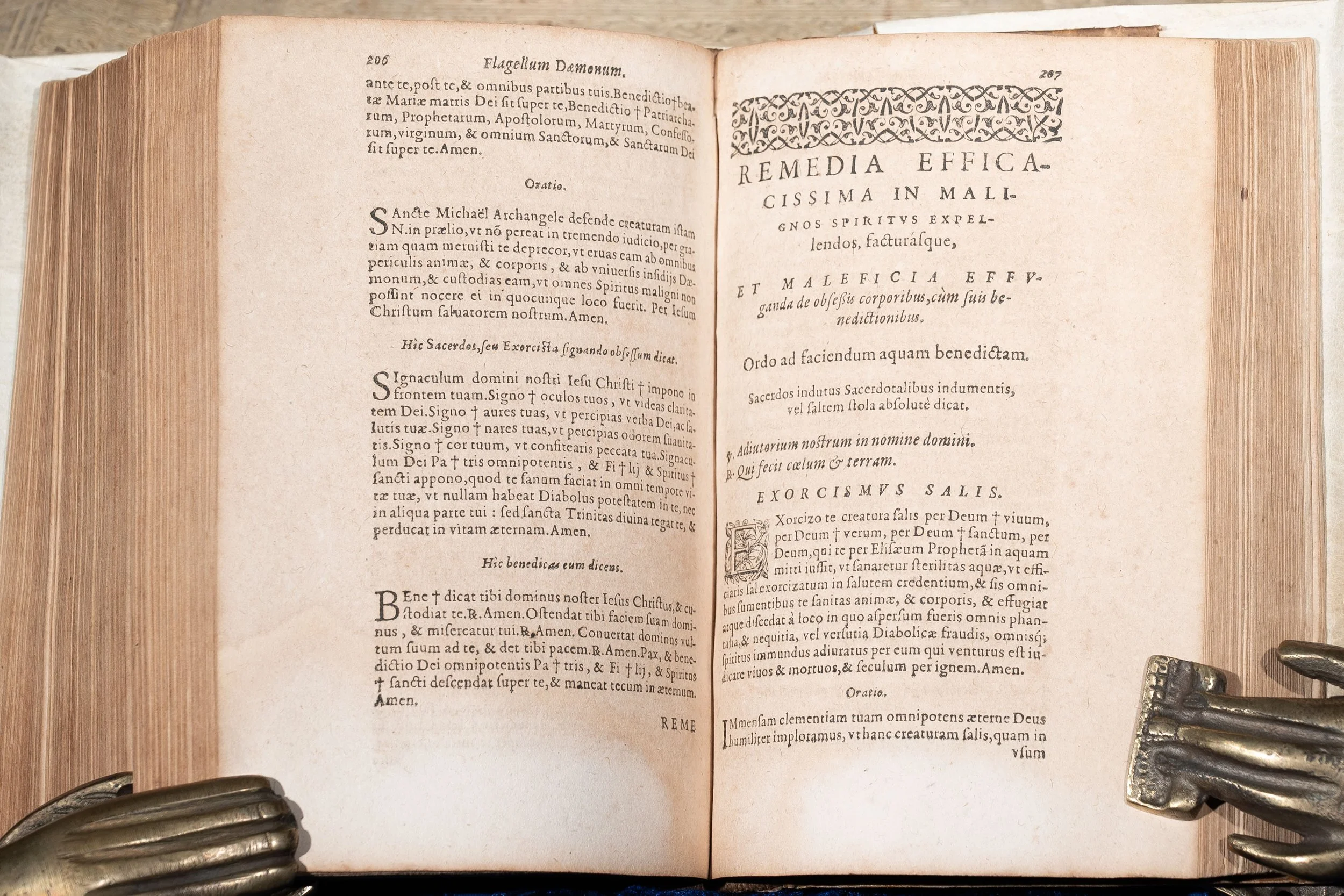
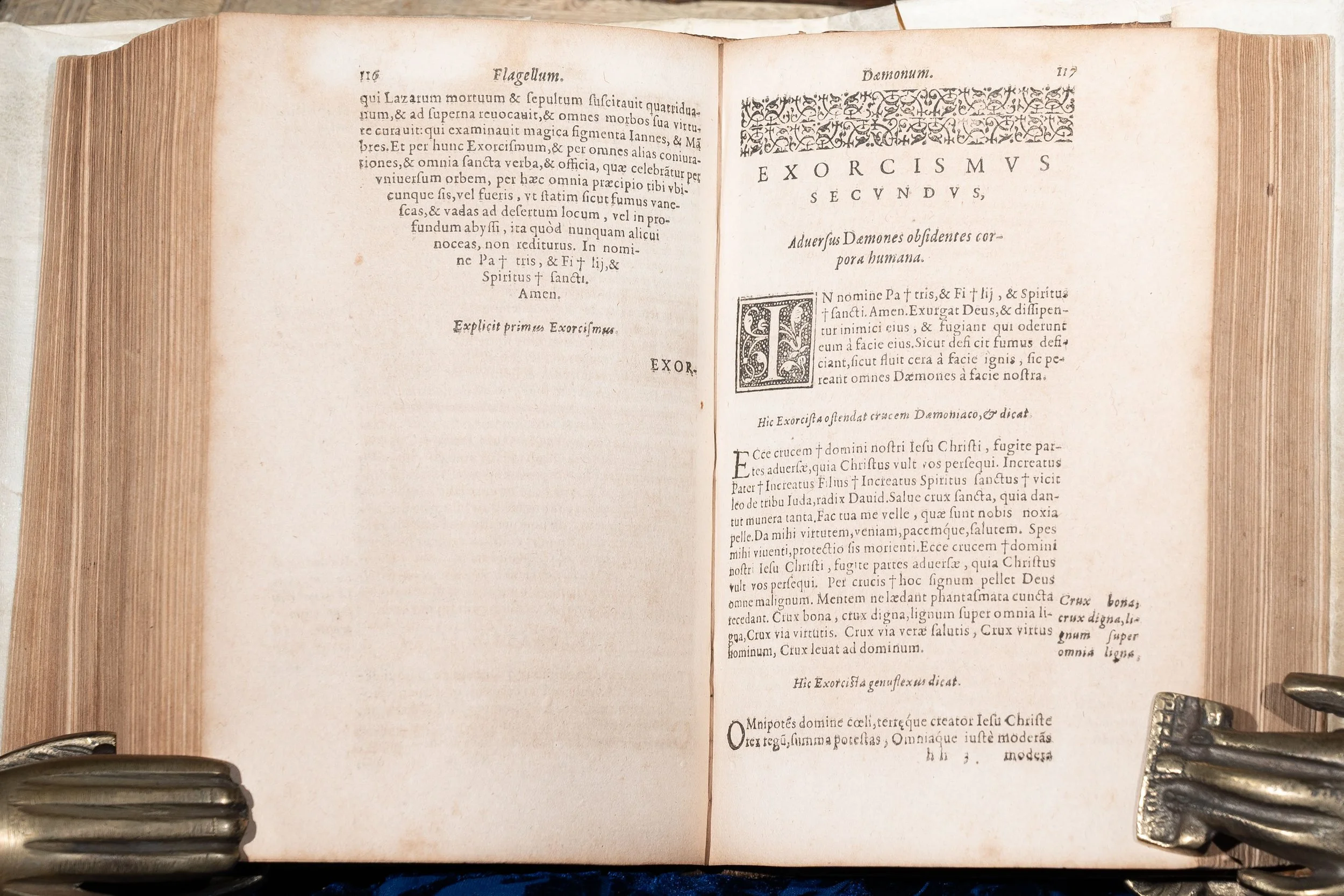
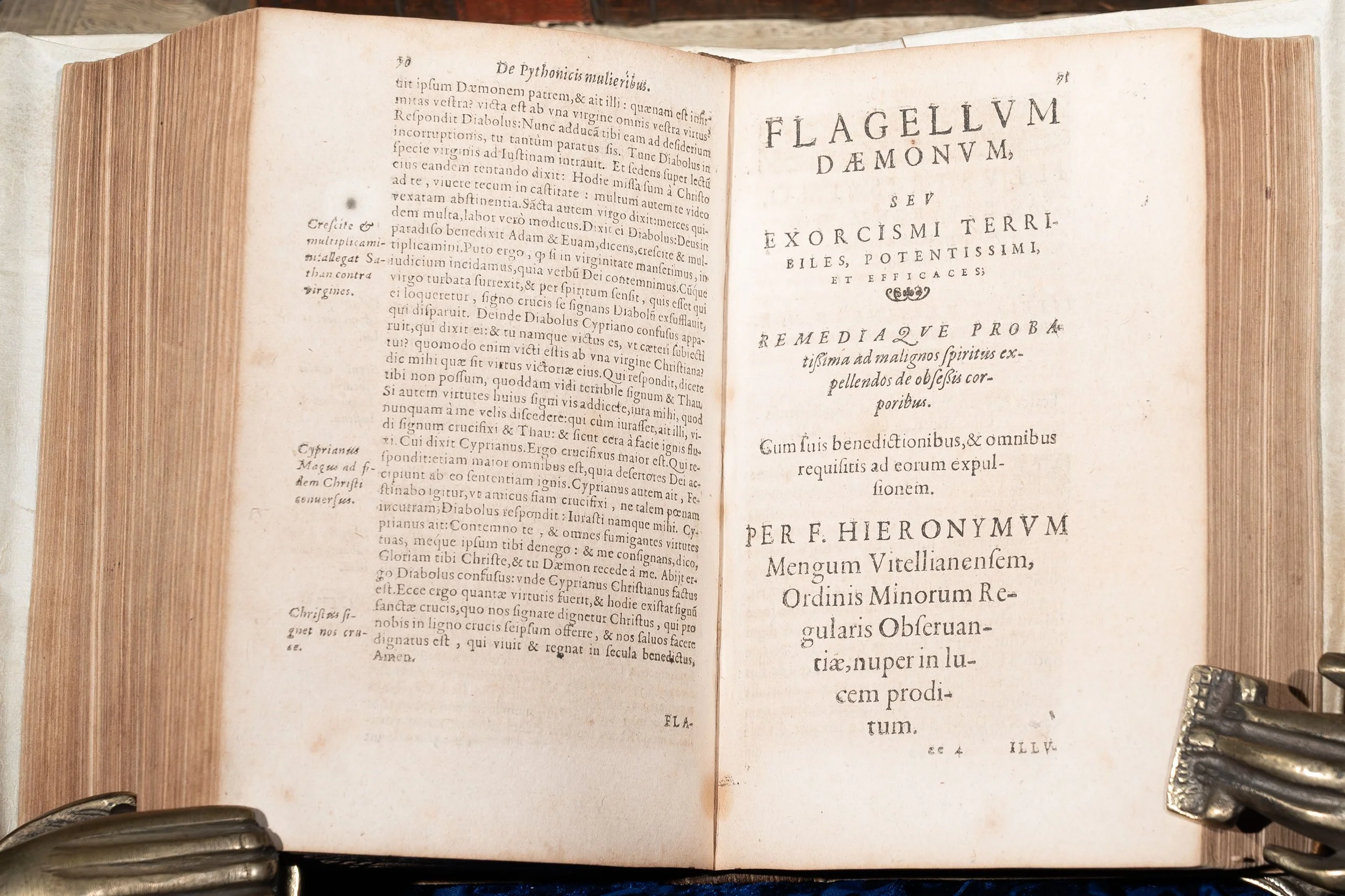
Volume two of this collection further features various important manuals on demonology and witchcraft thus ‘updating’ the Malleus. Here we find Molitor’s description of witches and demons,  Menghi’s classic work on exorcisms, along with further essays on witches, demonic pacts, testing spirits, and so forth.  All these works would come under some suspicion from church officials with most of them eventually ending up on the Index Prohibitorum. Indeed, these volumes represent the exorcist to necromancer pipeline whereby control over demons via exorcism was used to bind them for other uses, e.g., causing illusions, finding treasure, making people’s penises disappear, etc. All in all, a fantastic assortment of Medieval and Renaissance demonological and exorcistic literature. Curiously enough, one text is censored and removed.  Malleolus’ Tractatus duo excorcissmorum (Two Treatises on Exorcisms) was thought to flit too close to criminal necromancy rather than mere exorcism and was often censored.  Here, the essay was removed and the remaining pages glued together by the printer. Thus, we have in the censorship a curious reminder that witchhunters themselves could even be accused of sorcery.

Altogether one of the greatest compilations of Witchcraft and Demonological texts from the period of the Witch Trials anchored by the dread Malleus Maleficarum.  

Contents:

Volume I

Institoris (Kramer), Heinrich [attr. also to Sprenger, Jacob]. Malleus Maleficarum (The Hammer of Witches).

Nider, Johannes. Formicarius (The Anthill; selections on witchcraft).

Volume II

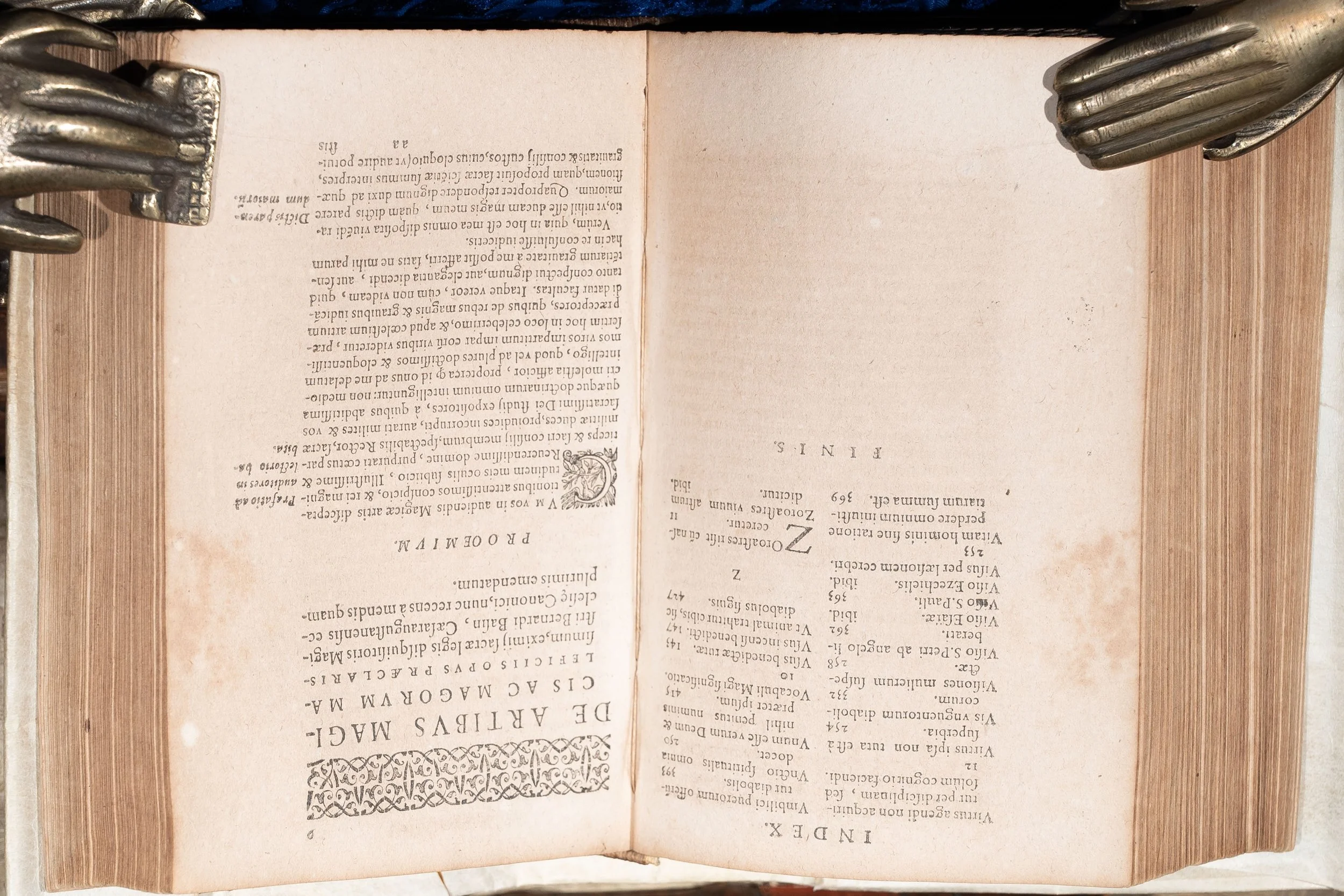
Basin, Bernhard. De Artibus Magicis, ac Magorum Maleficiis (On the Magical Arts and the Sorcery of Magicians).

Molitor, Ulrich. De Lamiis et Pythonicis Mulieribus (On Witches and Diviner Women).

Menghi, Girolamo. Flagellum Daemonum (Scourge of Demons).

Gerson, Johannes. De Probatione Spirituum (On the Testing of Spirits).

Murner, Thomas. De Pythonico Contractu (On Pacts with Diviners).

Malleolus (Hemmerlin), Felix. Tractatus duo Exorcismorum (Two Treatises on Exorcisms).

CENSORED AND ABSENT: suppressed at printing, leaves glued, chapter struck from index.

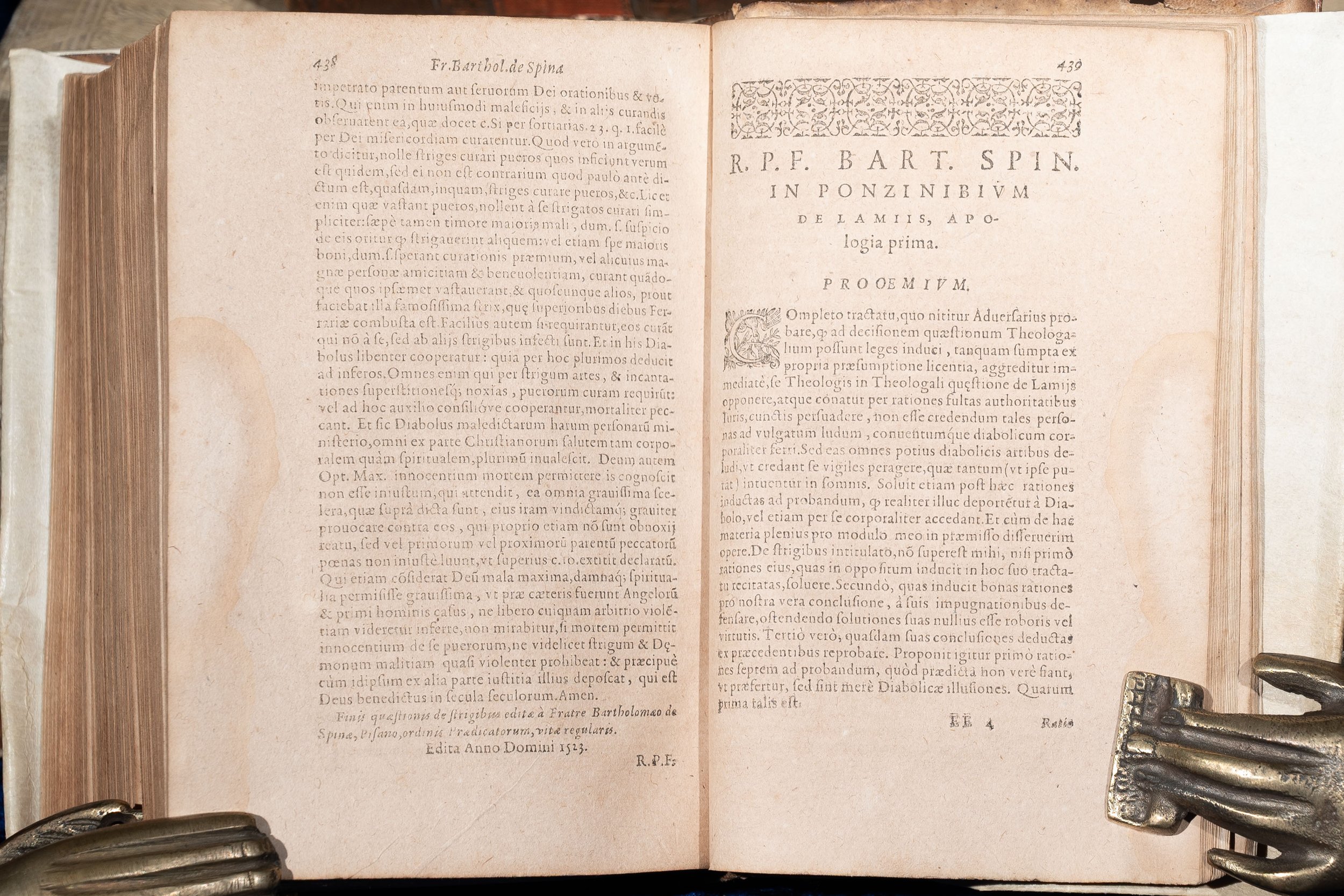
Spina, Bartholomeo de. Quaestio de Strigibus (Questions on Witches); with Apologia Quadruplex de Lamiis (The Fourfold Defense of [the Existence of] Witches).

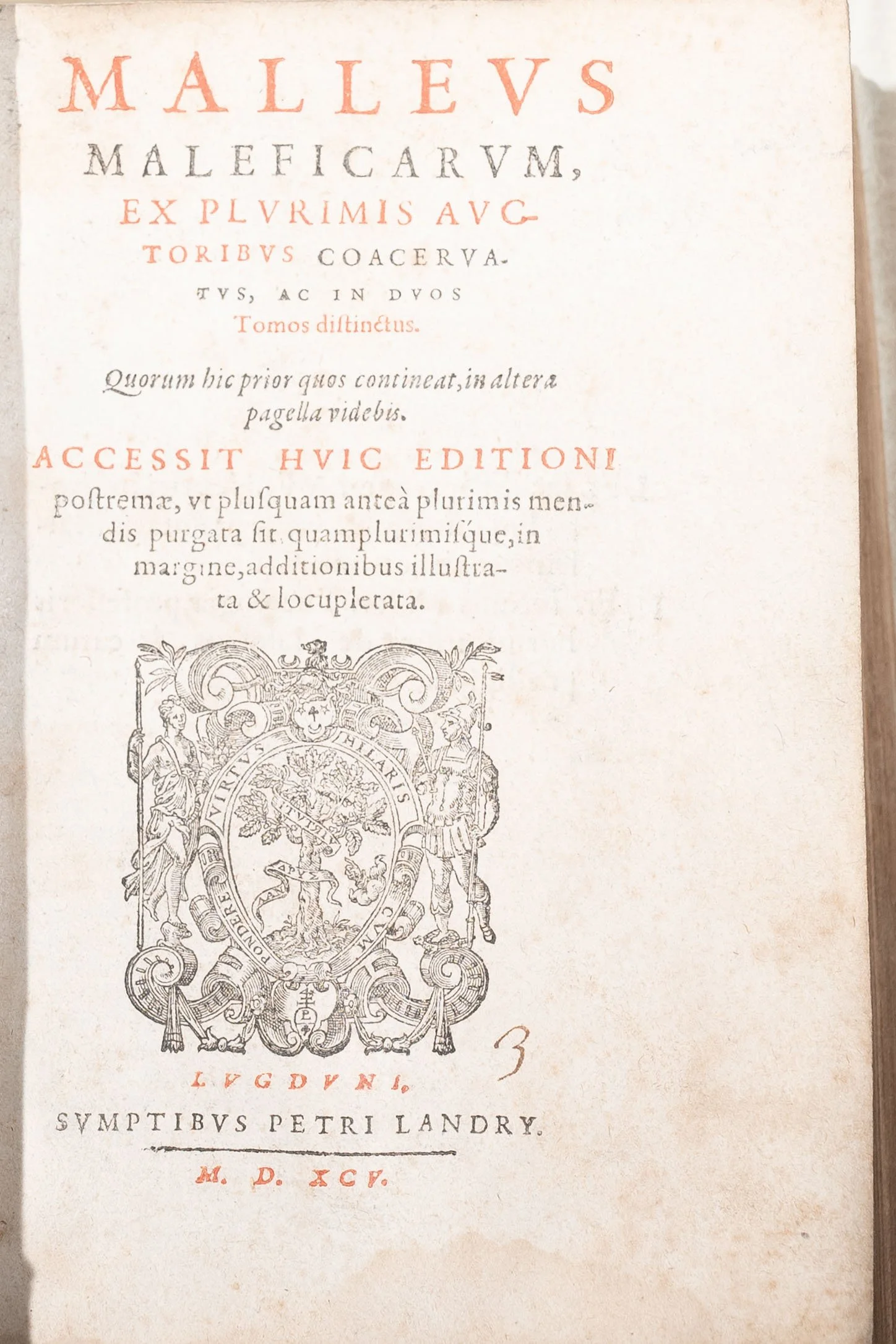
INSTITORIS (KRAMER), Heinrich. Malleus Maleficarum [The Hammer of Witches]. With: Mallei Maleficarum... Tomus Secundus [a companion compendium of demonological and exorcistic treatises]. Lyon: Apud Petrum Landry, 1595.

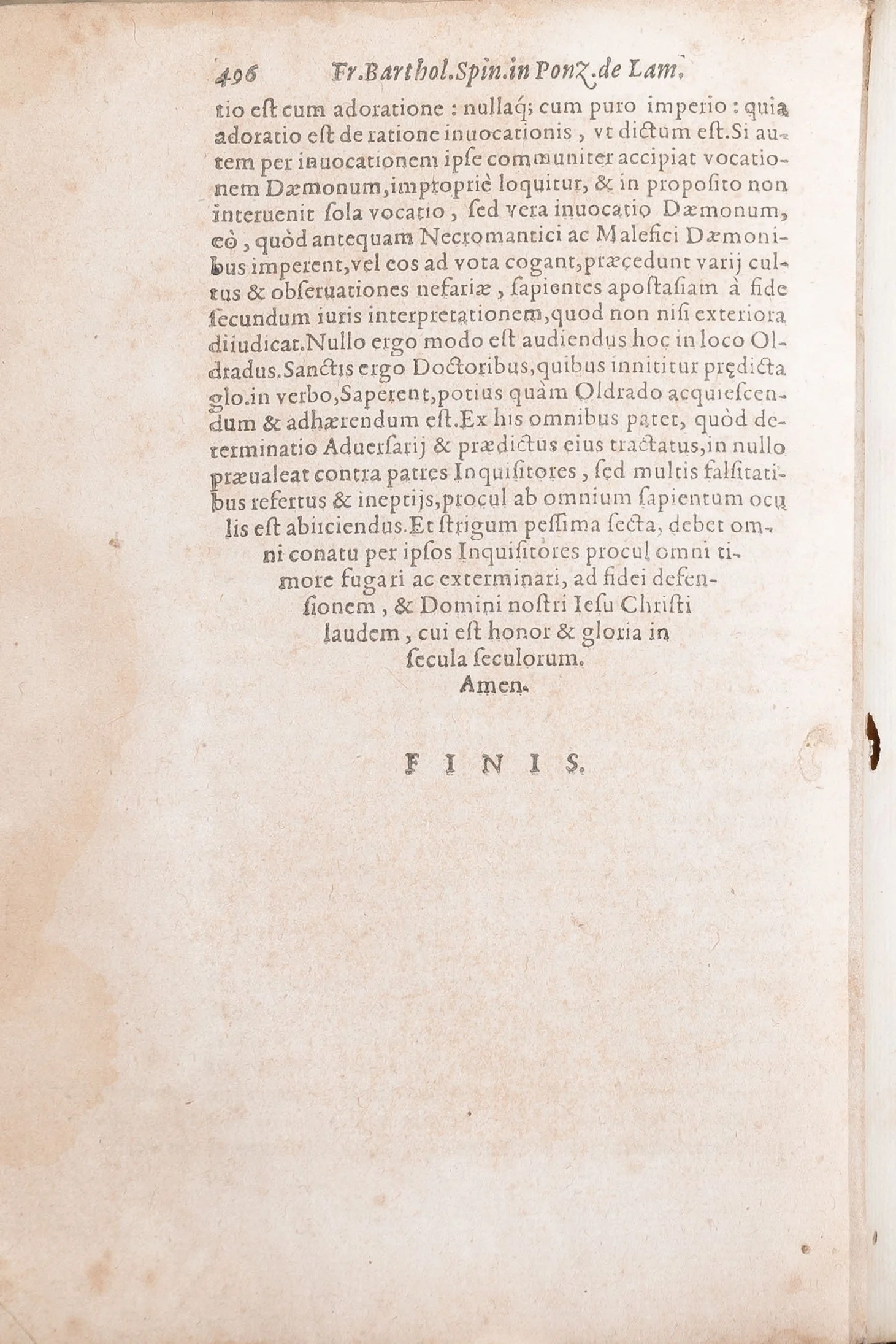
Physical Description: Two volumes in one. 8vo (169 × 110 mm). Vol. I: [48], 544 pp. Vol. II: [24], 9–496 pp. Title pages printed in red and black with woodcut printer’s device; woodcut initials and decorations throughout.

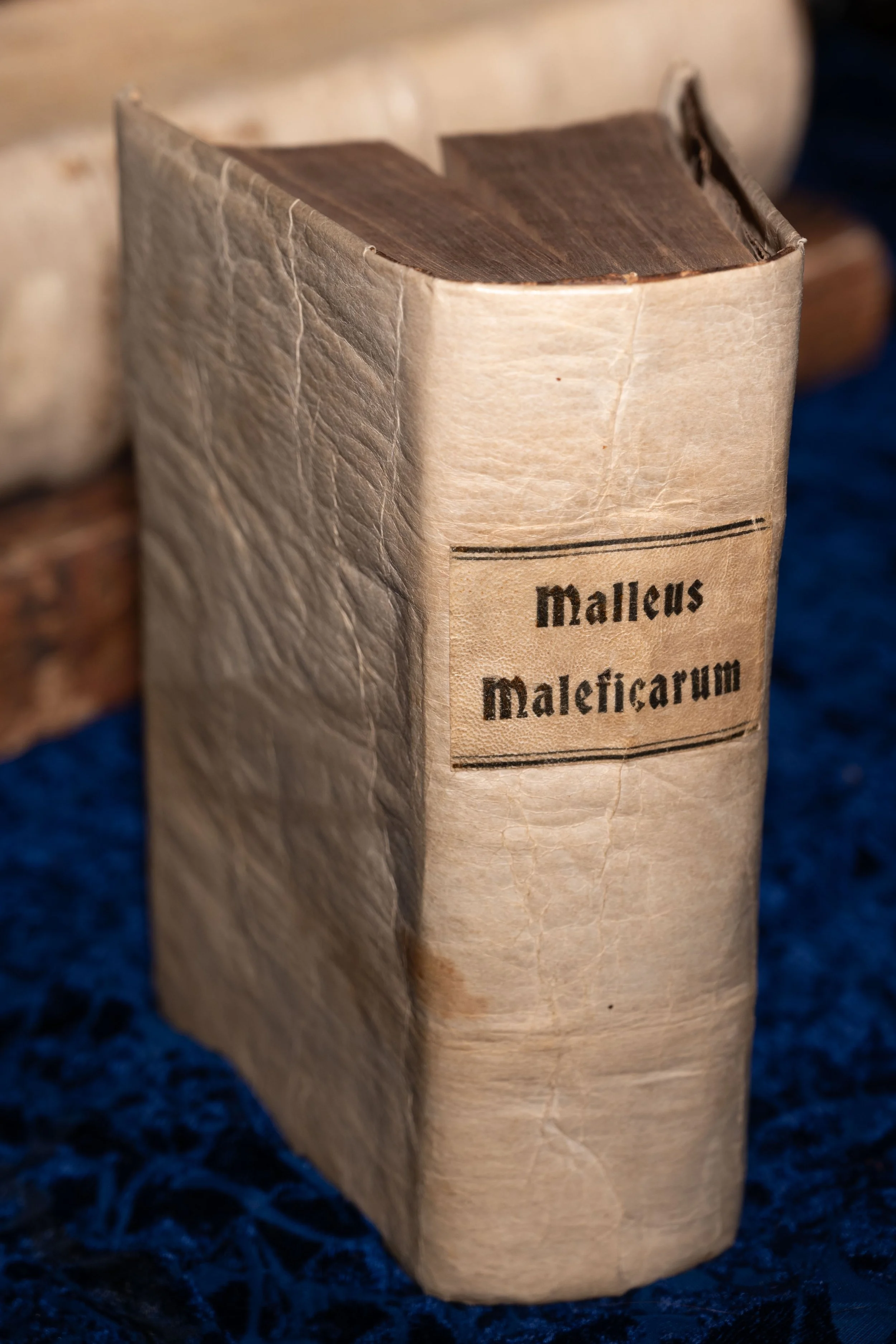
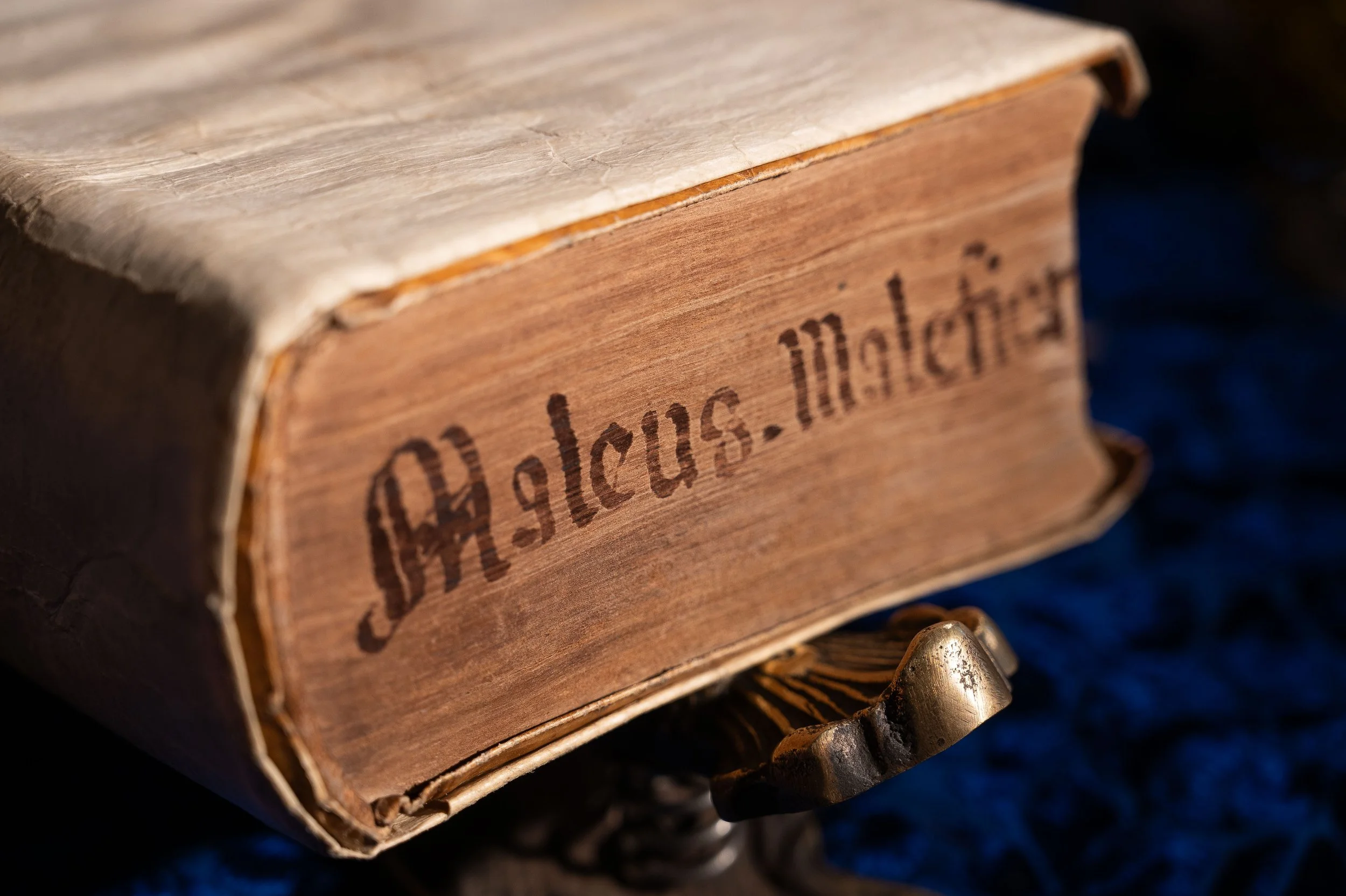
Binding: Contemporary full parchment with handwritten author’s name on spine and title on the lower edge. Modern parchment dust jacket with titles on a tag on the spine.

Condition: Leaves uniformly aged, some palely browned, with sporadic foxing. Fascicle 2Z shows light stains. Small woodworm hole on the internal margin of the colophon and on the rear flyleaves. In Vol. II, chapter VI (Malleolus, Tractatus duo Exorcismorum, pp. 280–325) is censored and absent: leaf 2S4 is glued to 2X3 to suppress the contents at printing; the chapter is also crossed out in the index and table of contents.

Censorship: A significant feature of this copy: Felix Malleolus’s (Felix Hemmerlin’s) Tractatus duo Exorcismorum seu Adiurationum (pp. 280–325 of Vol. II) has been physically suppressed at the time of printing. The leaves have been glued together and the chapter struck from both the index and table of contents. The text was considered to cross the line from legitimate exorcism into criminal necromancy, a pointed reminder that the line between commanding demons in Christ’s name and binding them for other purposes was, even for contemporary authorities, perilously thin.

One of the most important collections of Witchhunting and Demonological treaties of the Early-Modern Period, all anchored by the dread Malleus Maleficarum, the Hammer of Witches.

Malleus Maleficarum is widely considered to be one of the most sinister books ever written.  Composed by Heinrich Kramer and published in 1486/7, the Hammer of Witches text details what scholars now call the “Elaborated Theory of Witchcraft” usually including: a pact or covenant entered into with the Devil and thus apostasy from Christianity, sexual relations with the Devil and demons, aerial flight for the purpose of attending an assembly or Sabbat, sometimes synagogue, which is presided over by Satan himself at which initiates entered into said pact, followed by incestous and promiscuous sex, the general practice of maleficent magic, the slaughter of fetuses and babies and various means for preventing human procreation all of this to the end of an elaborate, women-led anti-Christian religion whose aim was to undermine Christendom as part of the devil’s ongoing war with God. 

The Malleus Maleficarum can be divided into several sections: The Apologia, the Papal Bull, the academic Approbation, and the main body of the work in three sections along with an elaborate though not always accurate table of contents:

The Apologia, Defense or Justification, is a small note by Sprenger that he and an associate have prepared this text in light of their realization that the sorcery-sect is playing and will play a widespread role in the final apocalyptic days to come. Thus, combating it must be a central, perhaps the central concern of the church.  Despite this, the inquisitors have been stymied at times in their fight against this sect, even by local bishops. Thus the text also included a papal bull or pronouncement of 1484 by Pope Innocent VIII, secured two years prior to the printing of the Malleus by Institoris, Summis Desiderantes which both espouses his diabolical theory of the sorcery-sect but also calls out various locales in Germany in which local bishops pumped the brakes on the inquisition. Following the Papal Bull, is an official academic document signed by various members of the theology faculty of the prestigious university of Cologne on May 19 1487 which attest to the theological integrity of the Malleus Maleficarum as a whole.  While this document is somewhat procedurally odd - which has caused its authenticity to be doubted, especially in the 19th century - it is unlikely that it is forged though it seems that the professors signed off on the Malleus despite most seeming to have only superficially read it. 

Following this juridical justification material the main body of the text. Book I details the apocalyptic nature of witchcraft in the classic medieval quaestio disputata method.  The first part of the text, seeks to argue that disbelief in this heretical sect and the reality of sorcery is tantamount to playing into it and specifically how demons, the witch and the very permission of God make this sect possible.  Indeed, this section contains lurid details of how people, especially women copulate with demons to produce more witches, how semen is stolen from men and transferred to women during the demonic sex-act, the systematically misogynistic theory of why women are more prone to this heresy including the infamous etymology that ‘femina’ is a contraction of ‘fides’ and ‘minus’ - literally without faith or lacking faith, how sorcery is always accomplished through demonic power rather than the actual charms or implements of the witch, of course how women make penises disappear, turn people into beasts, and sacrifice newborns and fetuses. Finally this section details why God allows sorcery to run rampant and cause the harm it does.  Simply put, sinful human beings deserve what they get, even innocent victims of sorcery just become a kind of collateral damage in the war with the devil.  Indeed, this section details that the sorcery-heresy is far worse than even the rebel Satan himself - I’m not kidding - and Adam, other heretics and even the demons.  Witches are literally just the worst because they are apostates, they actively work with the devil to do evil and they cause material harm to nature, beasts and humans through their evil-doing.  For the Malleus, the Sorcery-heresy is simply the worst and most sinful group in history.

The second part of the text is divided into two sections, the first of which details the various forms of sorcery practiced by the sect and the second recounts various methods by which to legitimately counter-act said sorcery.  Section two leans less heavily on the method of the disputed question and contains a large amount of anecdotes from the years of Institoris’ works as an inquisitor.  Indeed, these sections provide a fascinating insight into the kinds of sorcery that most worried the writers of the malleus - everything from causing people to think they’ve become animals or that their penis has vanished to causing hailstorms, harming various beasts, magical illnesses, plain old demonic possession, various forms of impeded procreation, irregular or otherwise unnatural loves, lusts or hatreds and even just poor weather. The remedies against such sorcery are also spelled out and mostly take the form of intense religious practice in the form of the sacraments or specific exorcistic rituals even invoking one’s guardian angel to provide further protection.  It’s also worth mentioning that this section contains the only reference really to male sorcerers but virtually nothing is written with the exception of those that use magically infused arrows to find their targets.

The third and final book of the Malleus Maleficarum relies on the 1376 Directorium Inquisitorum of Nicholas Eymerich whose work is a bridge between the anti-heresy work during the Albigensian crusade and the ‘elaborated theory of witchcraft’ found in the Malleus. This section recounts the Inquisitorial procedure for the detention, interrogation with torture, and relaxing of the convicted heretic over the secular arm for execution. A few specific elements of this process are worth mentioning in the scope of the Malleus Maleficarum. The first is that, generally speaking, Institoris found the accepted evidentiary bar both too high and too low: too high because the crime of heretical sorcery left behind very little evidence and was often done in secret but too low because conviction of such a crime would automatically result in the death penalty. Further, the Malleus holds that members of the diabolical sect are often impervious to torture because of the maleficium taciturnitatis or the sorcery of silence whereby the devil magically prevents the accused from crying out in pain.  Indeed, the Malleus infamously warns would-be torturers that suspected witches will daub spittle or urine on their faces to simulate crying and to be careful to note exactly where such tears emerge. All of this has a truly horrifying effect, the inquisitor must rely on conjecture of a kind of witch-hunting intuition by which everything from sustained torture to literally just lying to the suspect can be used to extract a confession.  

This conjecture is informed by three elements:  the reputation of the accused, indications of the deed - e.g., especially recently made threats, something the Malleus thinks the devil compels witches to engage in - and testimony of other witnesses, including testimony arrived at by other tortures. Guided by their intuition and these three evidentiary elements, the Inquisitor comes to a judgement - the considerations of which form a spectrum of elements in the Malleus - and if guilty, unrepentant or relapsed, and having caused material harm the convicted person is relaxed to the secular authorities and then, in all likelihood, burned alive. If one were of any means it was customary to bribe the executioner such that one was strangled before being set alight.

Thus, the Malleus Maleficarum would become the central theoretical and practical work informing the early modern witch-trials, leading some 60,000 people to their deaths with tens of thousands further imprisoned, tortured, humiliated and otherwise punished. But, as the 16th century gave way to the 17th - and the trials were reaching their apex - the Malleus was being viewed with increased scrutiny.  The church would even place the book on the Index Prohibitorum in 1600 but not before editions would appear featuring extensive compilations of demonological material.  Thus, just as the trials were reaching their terrible crescendo, volumes like this were portable libraries for the would-be Inquisitor and Witch-hunter.  Volume I contains the foundational work on witchcraft, the Formicarius of Nider, the first work to detail the alleged existence of the witch heresy in Europe.  

Volume two of this collection further features various important manuals on demonology and witchcraft thus ‘updating’ the Malleus. Here we find Molitor’s description of witches and demons,  Menghi’s classic work on exorcisms, along with further essays on witches, demonic pacts, testing spirits, and so forth.  All these works would come under some suspicion from church officials with most of them eventually ending up on the Index Prohibitorum. Indeed, these volumes represent the exorcist to necromancer pipeline whereby control over demons via exorcism was used to bind them for other uses, e.g., causing illusions, finding treasure, making people’s penises disappear, etc. All in all, a fantastic assortment of Medieval and Renaissance demonological and exorcistic literature. Curiously enough, one text is censored and removed.  Malleolus’ Tractatus duo excorcissmorum (Two Treatises on Exorcisms) was thought to flit too close to criminal necromancy rather than mere exorcism and was often censored.  Here, the essay was removed and the remaining pages glued together by the printer. Thus, we have in the censorship a curious reminder that witchhunters themselves could even be accused of sorcery.

Altogether one of the greatest compilations of Witchcraft and Demonological texts from the period of the Witch Trials anchored by the dread Malleus Maleficarum.  

Contents:

Volume I

Institoris (Kramer), Heinrich [attr. also to Sprenger, Jacob]. Malleus Maleficarum (The Hammer of Witches).

Nider, Johannes. Formicarius (The Anthill; selections on witchcraft).

Volume II

Basin, Bernhard. De Artibus Magicis, ac Magorum Maleficiis (On the Magical Arts and the Sorcery of Magicians).

Molitor, Ulrich. De Lamiis et Pythonicis Mulieribus (On Witches and Diviner Women).

Menghi, Girolamo. Flagellum Daemonum (Scourge of Demons).

Gerson, Johannes. De Probatione Spirituum (On the Testing of Spirits).

Murner, Thomas. De Pythonico Contractu (On Pacts with Diviners).

Malleolus (Hemmerlin), Felix. Tractatus duo Exorcismorum (Two Treatises on Exorcisms).

CENSORED AND ABSENT: suppressed at printing, leaves glued, chapter struck from index.

Spina, Bartholomeo de. Quaestio de Strigibus (Questions on Witches); with Apologia Quadruplex de Lamiis (The Fourfold Defense of [the Existence of] Witches).

INSTITORIS (KRAMER), Heinrich. Malleus Maleficarum [The Hammer of Witches]. With: Mallei Maleficarum... Tomus Secundus [a companion compendium of demonological and exorcistic treatises]. Lyon: Apud Petrum Landry, 1595.

Physical Description: Two volumes in one. 8vo (169 × 110 mm). Vol. I: [48], 544 pp. Vol. II: [24], 9–496 pp. Title pages printed in red and black with woodcut printer’s device; woodcut initials and decorations throughout.

Binding: Contemporary full parchment with handwritten author’s name on spine and title on the lower edge. Modern parchment dust jacket with titles on a tag on the spine.

Condition: Leaves uniformly aged, some palely browned, with sporadic foxing. Fascicle 2Z shows light stains. Small woodworm hole on the internal margin of the colophon and on the rear flyleaves. In Vol. II, chapter VI (Malleolus, Tractatus duo Exorcismorum, pp. 280–325) is censored and absent: leaf 2S4 is glued to 2X3 to suppress the contents at printing; the chapter is also crossed out in the index and table of contents.

Censorship: A significant feature of this copy: Felix Malleolus’s (Felix Hemmerlin’s) Tractatus duo Exorcismorum seu Adiurationum (pp. 280–325 of Vol. II) has been physically suppressed at the time of printing. The leaves have been glued together and the chapter struck from both the index and table of contents. The text was considered to cross the line from legitimate exorcism into criminal necromancy, a pointed reminder that the line between commanding demons in Christ’s name and binding them for other purposes was, even for contemporary authorities, perilously thin.