The Hermeneutics of Intent in the Age of Trent. While nominally a legal treatise, this 1557 Venetian printing occupies a vital space in the intellectual history of the Renaissance. Bartolomeo Cipolla (d. 1475) was one of the defining jurists of the 15th century and a leading figure in the "Bartolist" tradition, a school of thought following Bartolus de Saxoferrato that emphasized the ratio legis (the inner reason and spirit of the law) over rigid literalism.
Published in Venice during the turbulent intermission of the Council of Trent (1545–1563), and just two years before the first Roman Index of Prohibited Books, this text appears at the precise moment when the definition of "Interpretation" was tearing Europe apart. Edited by the Veronese humanist Gabriel Sarayna (fl. 1540s), the work rigorously outlines the interpretatio extensiva: the power to extend the authority of a text to cover situations the original author never foresaw.
For the student of Esoterica, Cipolla's treatise can be read as an early-modern meditation on performative language, the power of declared words to alter reality. Just as figures like Cornelius Agrippa (himself a Doctor of Law) explored how ritual words could bind spiritual forces, Cipolla explores how "Legal Fictions" (Fictio Iuris) use language to reshape social reality. His work examines the mechanism by which the jurist, through careful interpretation and extension, transforms the meaning and application of law—a process not unlike the magus's use of operative words to effect change in the world.
Includes the Aureas Tractatus of Matteo Mattesillani (Matthaeo de Matthesillanis), a 14th-century Italian jurist whose work on succession law (De successionibus ab intestato) was widely influential in medieval and early modern legal education.
CIPOLLA, Bartolomeo (1420–1475); SARAYNA, Gabriel (Ed.). De interpretatione legis extensiva... [bound with] De Matthaei Mathesilani... aureas tractatus. Venice: Comin da Trino, 1557.
Bibliographic Details: Small 8vo (155 x 105 mm). Collation: *^8, A-H^8, I^4. Complete. [16], 67, [1] leaves (pagination counts each leaf as one number, with both recto and verso under the same numeral). Title page features the printer's woodcut device of the Fountain of Truth (putti bathing in a basin), repeated on the verso of the final leaf. Decorated with historiated woodcut initials throughout, including a fine 'Q' depicting a mounted soldier and an 'N' depicting a scholar.
Condition: Bound in contemporary limp vellum with contemporary ink titling on the spine. The binding is sound but shows honest wear: the vellum exhibits characteristic age-toning and crinkling, and there is a loss of material on the spine (approx. 1-2 cm) which exposes the underlying binding cord. The text block is crisp, with light marginal dampstaining visible on the final signatures (Register/Colophon). Free of worming.
Provenance: Contemporary ownership inscription on the recto of the final blank leaf: "Ex Librij Soprani Aloysii." This likely indicates ownership by a member of the prominent Soprani family of Genoa, a patrician dynasty that produced notable figures including the art historian Raffaele Soprani (1612-1672), author of Le vite de' pittori, scoltori, ed architetti genovesi (1674). The specific identity of "Aloysii" (Aloysius/Luigi Soprani) and the date of this inscription remain to be determined, though the paleography suggests a contemporary or near-contemporary hand.
The Hermeneutics of Intent in the Age of Trent. While nominally a legal treatise, this 1557 Venetian printing occupies a vital space in the intellectual history of the Renaissance. Bartolomeo Cipolla (d. 1475) was one of the defining jurists of the 15th century and a leading figure in the "Bartolist" tradition, a school of thought following Bartolus de Saxoferrato that emphasized the ratio legis (the inner reason and spirit of the law) over rigid literalism.
Published in Venice during the turbulent intermission of the Council of Trent (1545–1563), and just two years before the first Roman Index of Prohibited Books, this text appears at the precise moment when the definition of "Interpretation" was tearing Europe apart. Edited by the Veronese humanist Gabriel Sarayna (fl. 1540s), the work rigorously outlines the interpretatio extensiva: the power to extend the authority of a text to cover situations the original author never foresaw.
For the student of Esoterica, Cipolla's treatise can be read as an early-modern meditation on performative language, the power of declared words to alter reality. Just as figures like Cornelius Agrippa (himself a Doctor of Law) explored how ritual words could bind spiritual forces, Cipolla explores how "Legal Fictions" (Fictio Iuris) use language to reshape social reality. His work examines the mechanism by which the jurist, through careful interpretation and extension, transforms the meaning and application of law—a process not unlike the magus's use of operative words to effect change in the world.
Includes the Aureas Tractatus of Matteo Mattesillani (Matthaeo de Matthesillanis), a 14th-century Italian jurist whose work on succession law (De successionibus ab intestato) was widely influential in medieval and early modern legal education.
CIPOLLA, Bartolomeo (1420–1475); SARAYNA, Gabriel (Ed.). De interpretatione legis extensiva... [bound with] De Matthaei Mathesilani... aureas tractatus. Venice: Comin da Trino, 1557.
Bibliographic Details: Small 8vo (155 x 105 mm). Collation: *^8, A-H^8, I^4. Complete. [16], 67, [1] leaves (pagination counts each leaf as one number, with both recto and verso under the same numeral). Title page features the printer's woodcut device of the Fountain of Truth (putti bathing in a basin), repeated on the verso of the final leaf. Decorated with historiated woodcut initials throughout, including a fine 'Q' depicting a mounted soldier and an 'N' depicting a scholar.
Condition: Bound in contemporary limp vellum with contemporary ink titling on the spine. The binding is sound but shows honest wear: the vellum exhibits characteristic age-toning and crinkling, and there is a loss of material on the spine (approx. 1-2 cm) which exposes the underlying binding cord. The text block is crisp, with light marginal dampstaining visible on the final signatures (Register/Colophon). Free of worming.
Provenance: Contemporary ownership inscription on the recto of the final blank leaf: "Ex Librij Soprani Aloysii." This likely indicates ownership by a member of the prominent Soprani family of Genoa, a patrician dynasty that produced notable figures including the art historian Raffaele Soprani (1612-1672), author of Le vite de' pittori, scoltori, ed architetti genovesi (1674). The specific identity of "Aloysii" (Aloysius/Luigi Soprani) and the date of this inscription remain to be determined, though the paleography suggests a contemporary or near-contemporary hand.

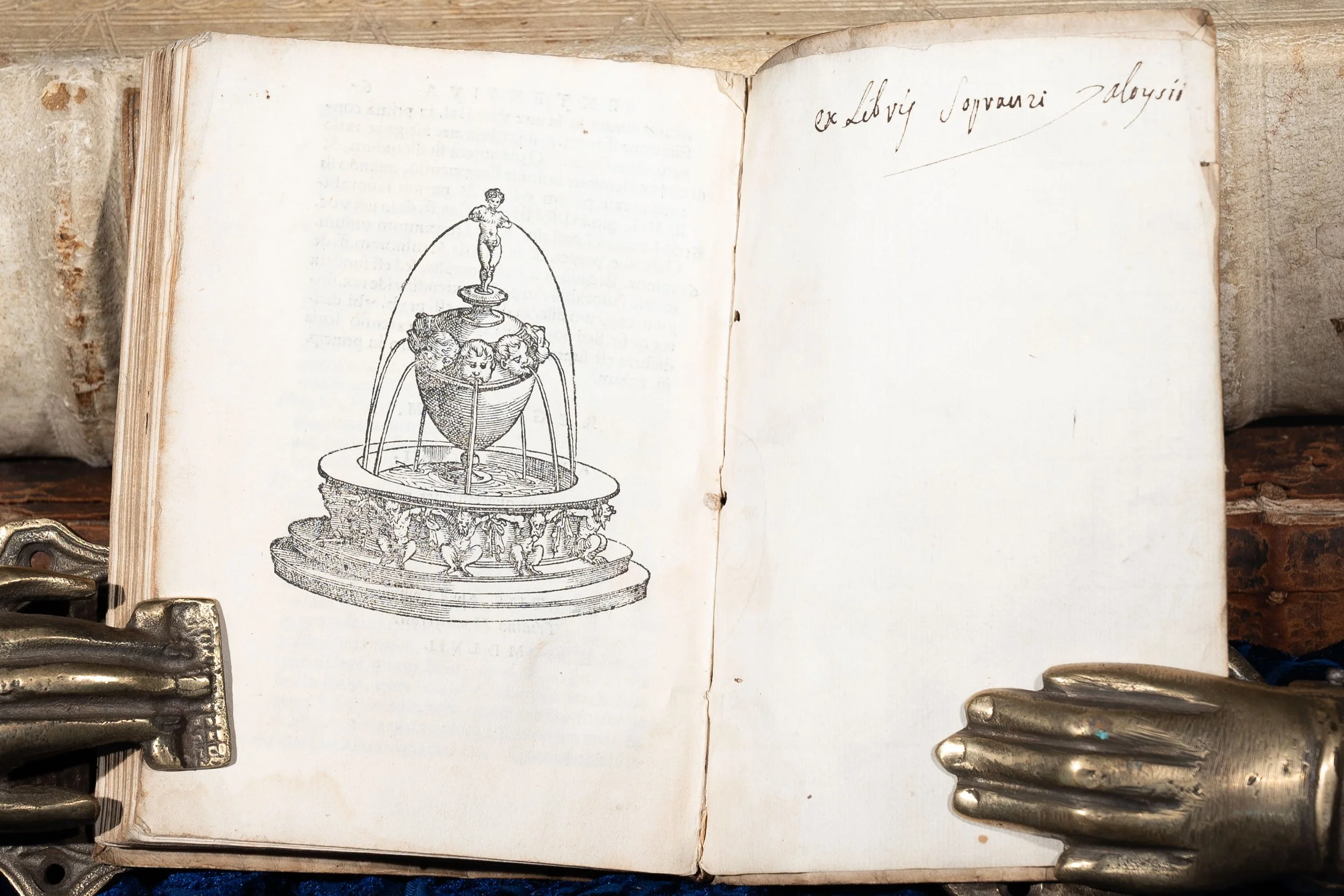 Image 1 of 7
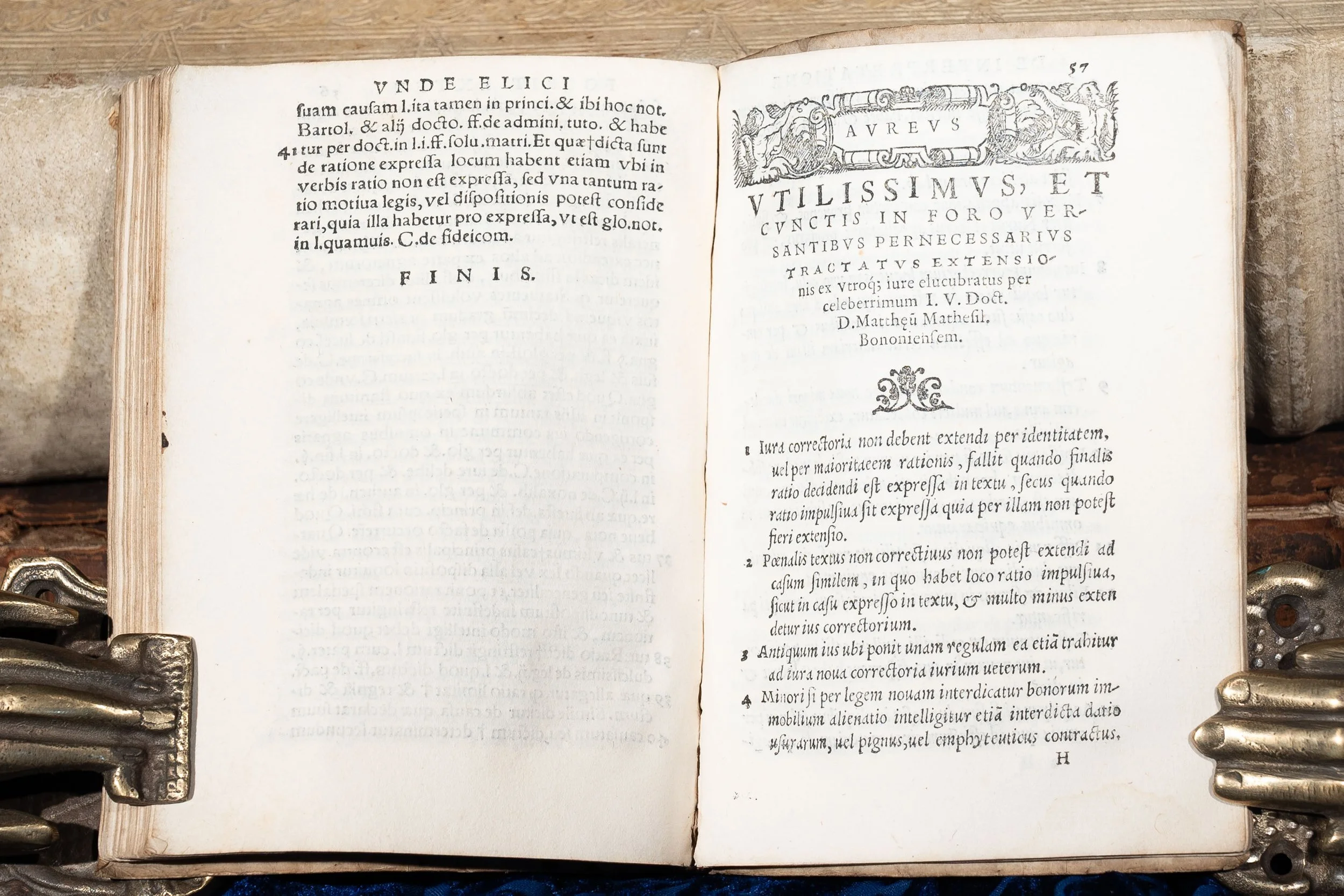 Image 2 of 7
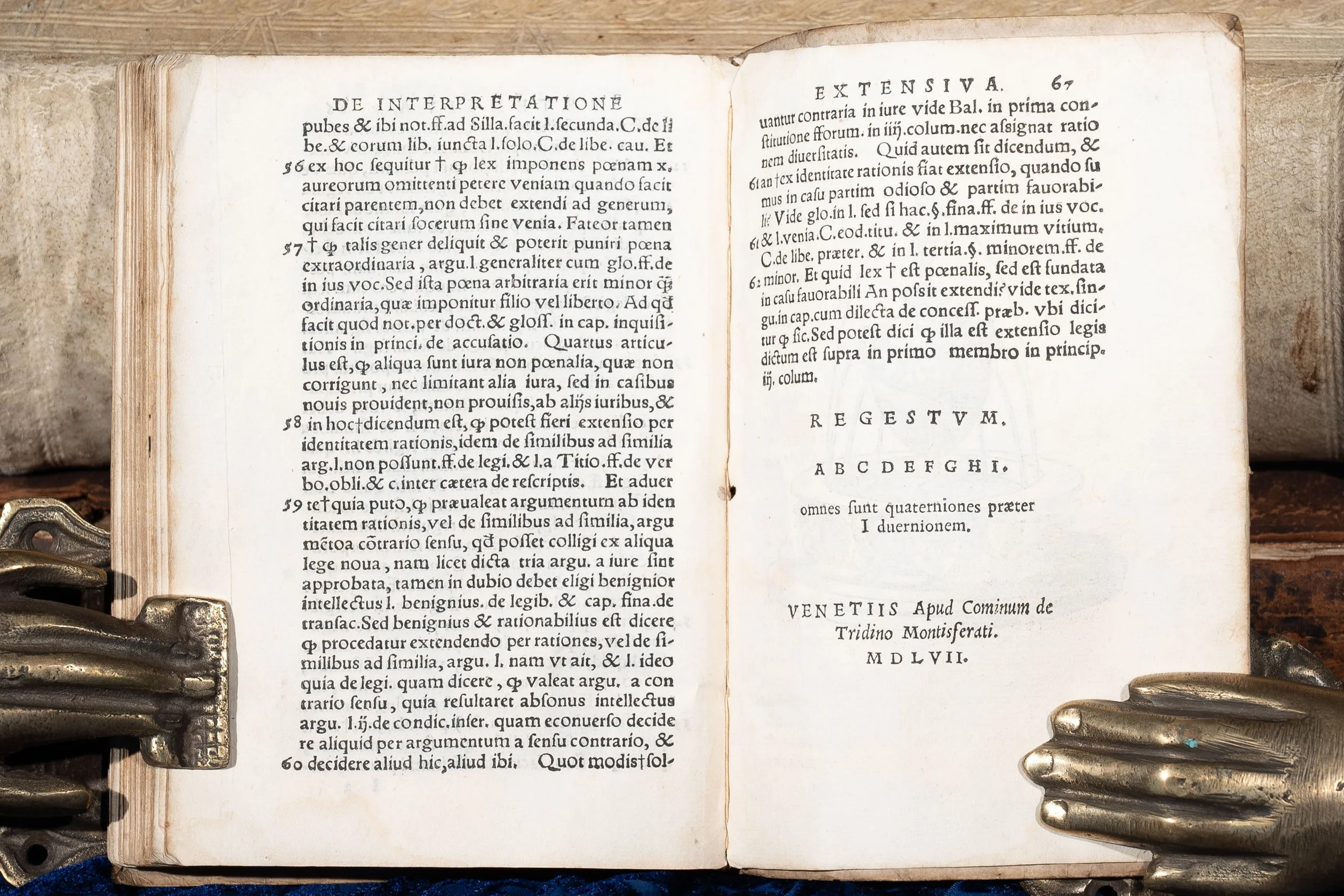 Image 3 of 7
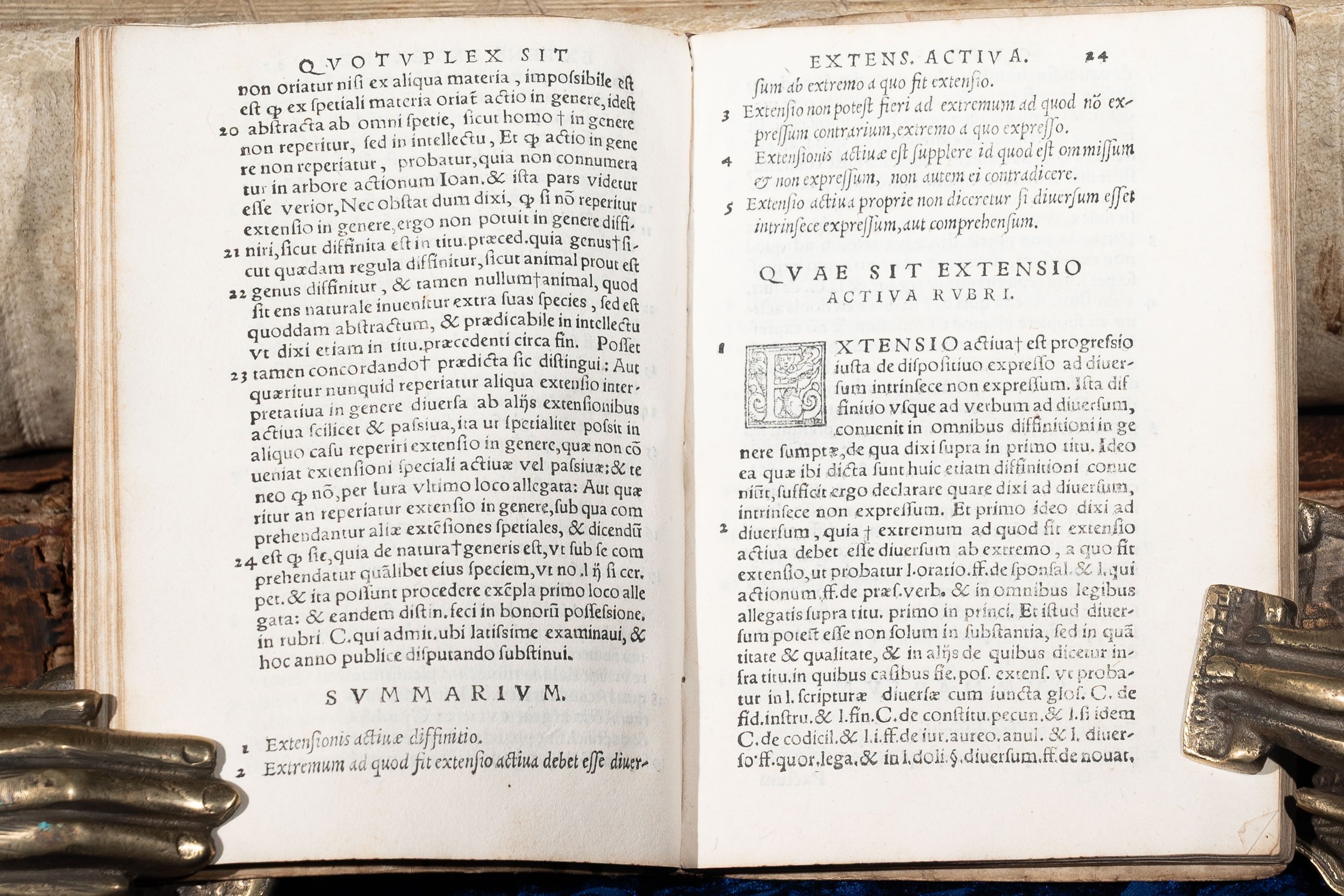 Image 4 of 7
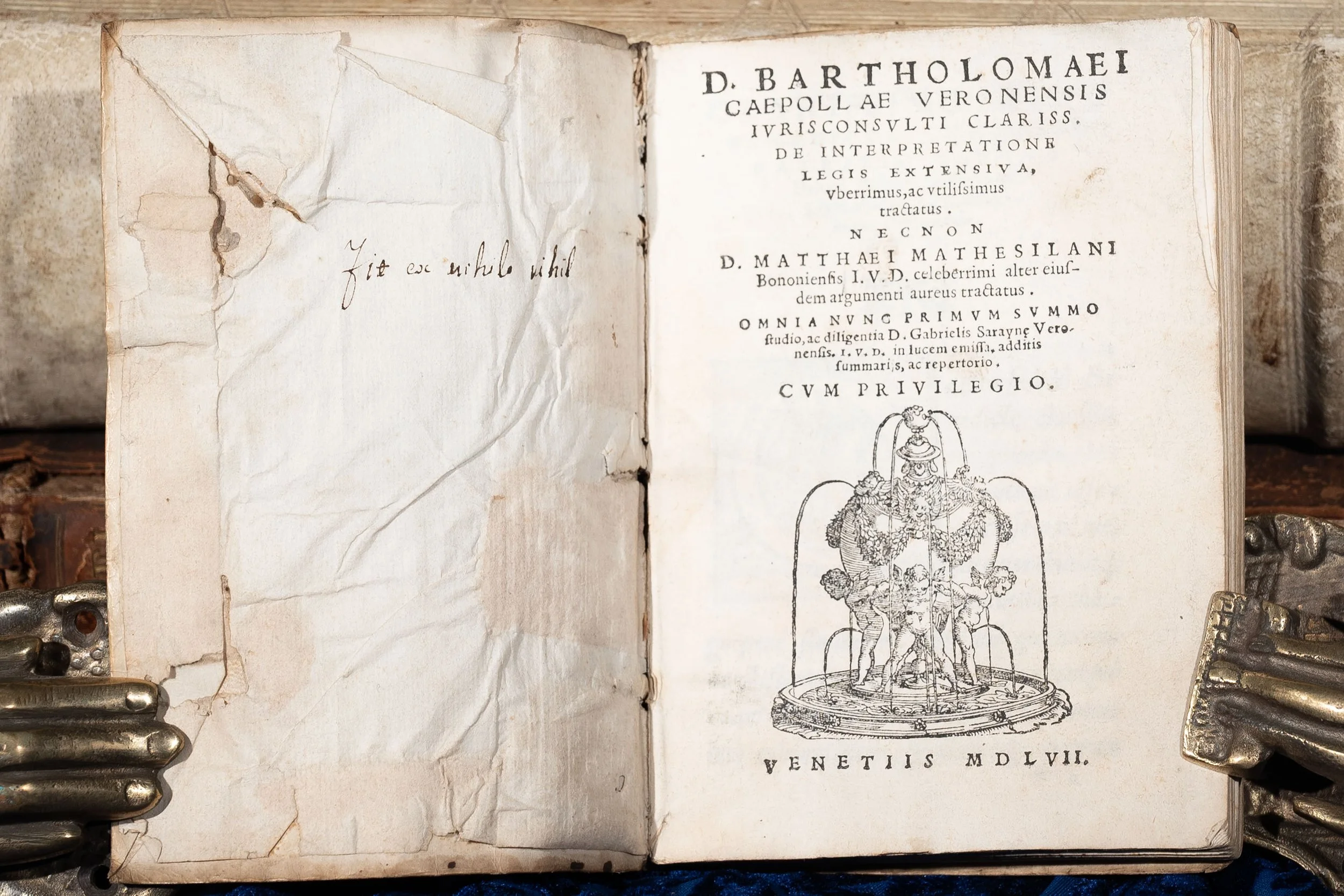 Image 5 of 7
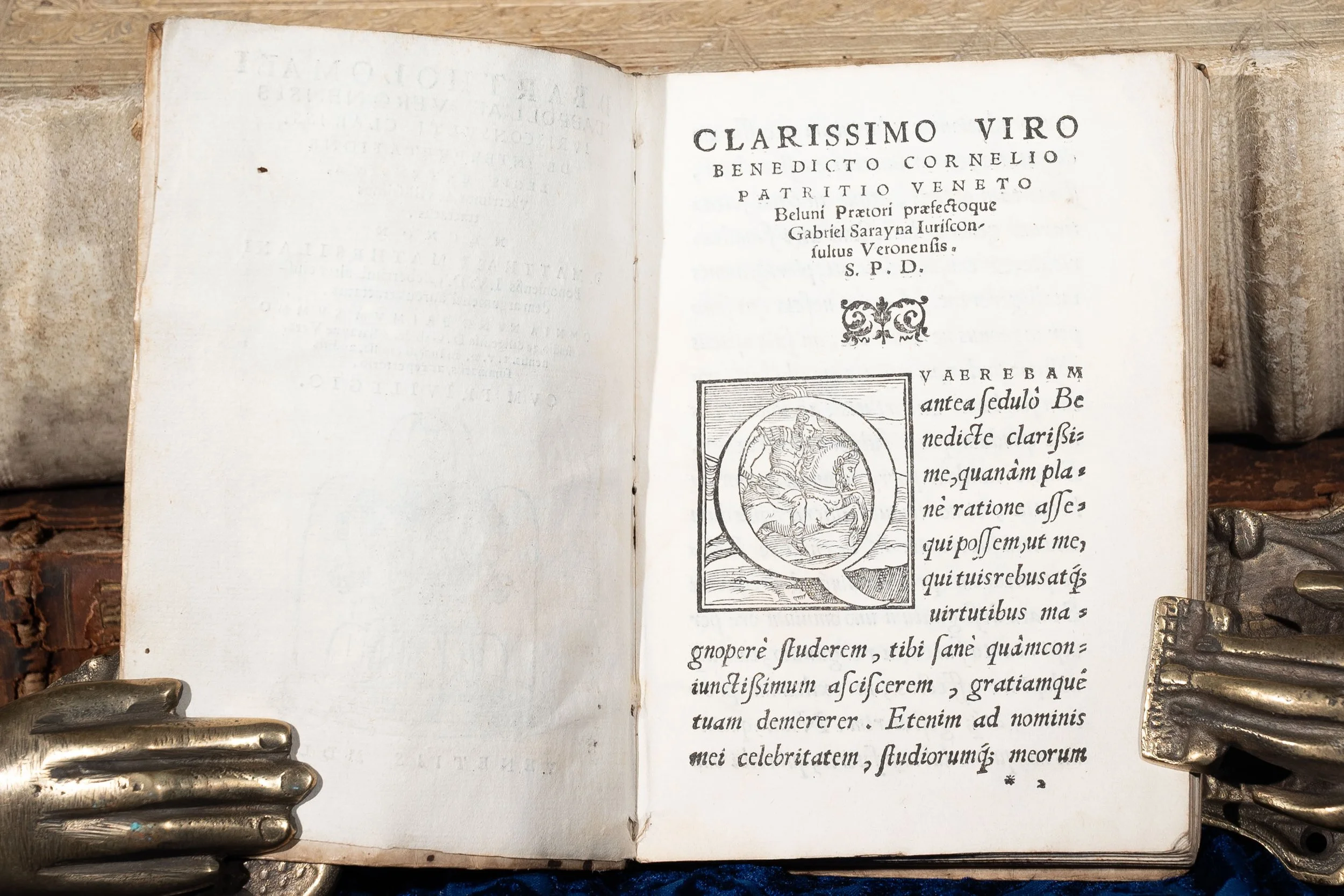 Image 6 of 7
 Image 7 of 7