In the 1510s the Holy Roman Empire fought a paper war over whether the Talmud, the collection of Jewish law and commentary, should burn. The convert Johannes Pfefferkorn and the Cologne inquisitor Jacob Hoogstraten said yes; the scholar of Hebrew Johann Reuchlin said no. This 1550 folio brings two works from that controversy together. Galatino frames his defense as a conversation among three living men: himself, Reuchlin, and Hoogstraten. Bound at the back is Reuchlin's own De Arte Cabalistica, first published in 1517, during the controversy.
Galatino, a Franciscan scholar of Hebrew from Apulia, argues that the deepest truths of Christianity, the Trinity included, lie hidden in Jewish learning, including the Talmud and Kabbalah, waiting to be read correctly. So the books must be preserved and studied. It's an argument for saving a literature made by a man convinced its owners misread it. Along the way Galatino works through the secret names of God, and he is the writer usually credited with putting the form “Jehovah” into circulation. Scholars have long noted how much of his learning was quarried from Ramón Martí's medieval Pugio Fidei; the borrowing did nothing to slow the book down. It was first printed in 1518 by Gershom Soncino, the greatest Hebrew printer of the age, a Jewish master printer setting the type of a book about the conversion of the Jews.
Reuchlin's De Arte Cabalistica, first published in 1517 with a dedication to Pope Leo X, is the other pole of the volume and, arguably, the founding book of Christian Kabbalah, the Christian interpretation of Jewish mystical teaching. It stages its own conversation, this time at Frankfurt: Simon the Jew, Philolaus the Pythagorean, and Marranus the Muslim, comparing traditions until the Kabbalah emerges as the oldest revelation of all, the source from which Pythagoras himself drank. Reuchlin discusses divine names and seventy-two angels, alongside ways of interpreting Hebrew words through their numbers, initials and rearranged letters. Agrippa's Third Book of Occult Philosophy leans on it openly.
The 1550 Basel edition is the one that joined the two texts, printed in the shop of Johannes Herwagen, whose device, a three-headed herm on a column, stands guard on the title and again at the end. The double index promised on the title is present, and it makes good browsing: it opens under A with Agla, a name of God, and proceeds through the angels, the alphabets, and Alexander the Great bowing to the high priest of the Jews. The final leaf prints a register of the gatherings, the folded sections from which the book was assembled. It even specifies the exception to the usual gathering size. The book tells you, helpfully, how to collate it.
Our copy is a tall, clean one, the text fresh and wide-margined, the Hebrew crisp. It survives in a sober nineteenth-century binding of dark grained leather, the spine gilt-lettered, with marbled endpapers, rubbed at the joints and extremities. Across the head of the title an early hand has written “Societatis Jesu” with the name of the house washed nearly away: a Jesuit library owned this book. The title carries some old staining besides, and a previous owner has penciled the standard references on the flyleaf. Complete through the final register leaf.
GALATINO, Pietro Colonna (c. 1465-1540); with Johann REUCHLIN (1455-1522). Petri Galatini Opus de Arcanis Catholicae Veritatis. Hoc est, In omnia difficilia loca Veteris Testamenti, ex Talmud, aliisque Hebraicis libris... absolutissimus Commentarius. Ad haec, Ioannis Reuchlini Phorcensis LL. Doctoris de Arte Cabalistica Libri tres, omnigena eruditione pleni. Basel: [Johannes Herwagen], 1550 (colophon: Basileae excudebat Ioannes Hervagius, Anno Domini 1550). Second edition of Galatino (first Ortona, 1518), here with Reuchlin's De arte cabalistica (first 1517) and the double index.
Physical Description: Folio. Galatino's text to p. 718, Reuchlin's De arte cabalistica following in continuous pagination from p. 719, with the double index; Hebrew, Greek, and Latin; woodcut three-headed herm device of Herwagen to title and terminal leaf; final leaf with colophon and the printed register of gatherings (“all ternions except yy, which is a duernion”). Collated complete against the printed register.
Binding: Nineteenth-century dark grained leather, spine with raised bands, gilt-lettered direct, marbled endpapers. Rubbed at joints and extremities, spine ends worn.
Condition: Title with old staining; scattered spotting and occasional light dampstaining; the text otherwise clean, fresh, and wide-margined. Complete with the terminal register leaf.
Provenance: (1) Early ink ownership inscription of a Jesuit house at head of title, “Societatis Jesu [...],” the name of the house washed and not confidently legible. (2) Pencil bibliographical notes of a previous owner, in a German hand, on the front flyleaf (Benzing, STC, Adams, Rosenthal).
In the 1510s the Holy Roman Empire fought a paper war over whether the Talmud, the collection of Jewish law and commentary, should burn. The convert Johannes Pfefferkorn and the Cologne inquisitor Jacob Hoogstraten said yes; the scholar of Hebrew Johann Reuchlin said no. This 1550 folio brings two works from that controversy together. Galatino frames his defense as a conversation among three living men: himself, Reuchlin, and Hoogstraten. Bound at the back is Reuchlin's own De Arte Cabalistica, first published in 1517, during the controversy.
Galatino, a Franciscan scholar of Hebrew from Apulia, argues that the deepest truths of Christianity, the Trinity included, lie hidden in Jewish learning, including the Talmud and Kabbalah, waiting to be read correctly. So the books must be preserved and studied. It's an argument for saving a literature made by a man convinced its owners misread it. Along the way Galatino works through the secret names of God, and he is the writer usually credited with putting the form “Jehovah” into circulation. Scholars have long noted how much of his learning was quarried from Ramón Martí's medieval Pugio Fidei; the borrowing did nothing to slow the book down. It was first printed in 1518 by Gershom Soncino, the greatest Hebrew printer of the age, a Jewish master printer setting the type of a book about the conversion of the Jews.
Reuchlin's De Arte Cabalistica, first published in 1517 with a dedication to Pope Leo X, is the other pole of the volume and, arguably, the founding book of Christian Kabbalah, the Christian interpretation of Jewish mystical teaching. It stages its own conversation, this time at Frankfurt: Simon the Jew, Philolaus the Pythagorean, and Marranus the Muslim, comparing traditions until the Kabbalah emerges as the oldest revelation of all, the source from which Pythagoras himself drank. Reuchlin discusses divine names and seventy-two angels, alongside ways of interpreting Hebrew words through their numbers, initials and rearranged letters. Agrippa's Third Book of Occult Philosophy leans on it openly.
The 1550 Basel edition is the one that joined the two texts, printed in the shop of Johannes Herwagen, whose device, a three-headed herm on a column, stands guard on the title and again at the end. The double index promised on the title is present, and it makes good browsing: it opens under A with Agla, a name of God, and proceeds through the angels, the alphabets, and Alexander the Great bowing to the high priest of the Jews. The final leaf prints a register of the gatherings, the folded sections from which the book was assembled. It even specifies the exception to the usual gathering size. The book tells you, helpfully, how to collate it.
Our copy is a tall, clean one, the text fresh and wide-margined, the Hebrew crisp. It survives in a sober nineteenth-century binding of dark grained leather, the spine gilt-lettered, with marbled endpapers, rubbed at the joints and extremities. Across the head of the title an early hand has written “Societatis Jesu” with the name of the house washed nearly away: a Jesuit library owned this book. The title carries some old staining besides, and a previous owner has penciled the standard references on the flyleaf. Complete through the final register leaf.
GALATINO, Pietro Colonna (c. 1465-1540); with Johann REUCHLIN (1455-1522). Petri Galatini Opus de Arcanis Catholicae Veritatis. Hoc est, In omnia difficilia loca Veteris Testamenti, ex Talmud, aliisque Hebraicis libris... absolutissimus Commentarius. Ad haec, Ioannis Reuchlini Phorcensis LL. Doctoris de Arte Cabalistica Libri tres, omnigena eruditione pleni. Basel: [Johannes Herwagen], 1550 (colophon: Basileae excudebat Ioannes Hervagius, Anno Domini 1550). Second edition of Galatino (first Ortona, 1518), here with Reuchlin's De arte cabalistica (first 1517) and the double index.
Physical Description: Folio. Galatino's text to p. 718, Reuchlin's De arte cabalistica following in continuous pagination from p. 719, with the double index; Hebrew, Greek, and Latin; woodcut three-headed herm device of Herwagen to title and terminal leaf; final leaf with colophon and the printed register of gatherings (“all ternions except yy, which is a duernion”). Collated complete against the printed register.
Binding: Nineteenth-century dark grained leather, spine with raised bands, gilt-lettered direct, marbled endpapers. Rubbed at joints and extremities, spine ends worn.
Condition: Title with old staining; scattered spotting and occasional light dampstaining; the text otherwise clean, fresh, and wide-margined. Complete with the terminal register leaf.
Provenance: (1) Early ink ownership inscription of a Jesuit house at head of title, “Societatis Jesu [...],” the name of the house washed and not confidently legible. (2) Pencil bibliographical notes of a previous owner, in a German hand, on the front flyleaf (Benzing, STC, Adams, Rosenthal).

 Image 1 of 25
 Image 2 of 25
 Image 3 of 25
 Image 4 of 25
 Image 5 of 25
 Image 6 of 25
 Image 7 of 25
 Image 8 of 25
 Image 9 of 25
 Image 10 of 25
 Image 11 of 25
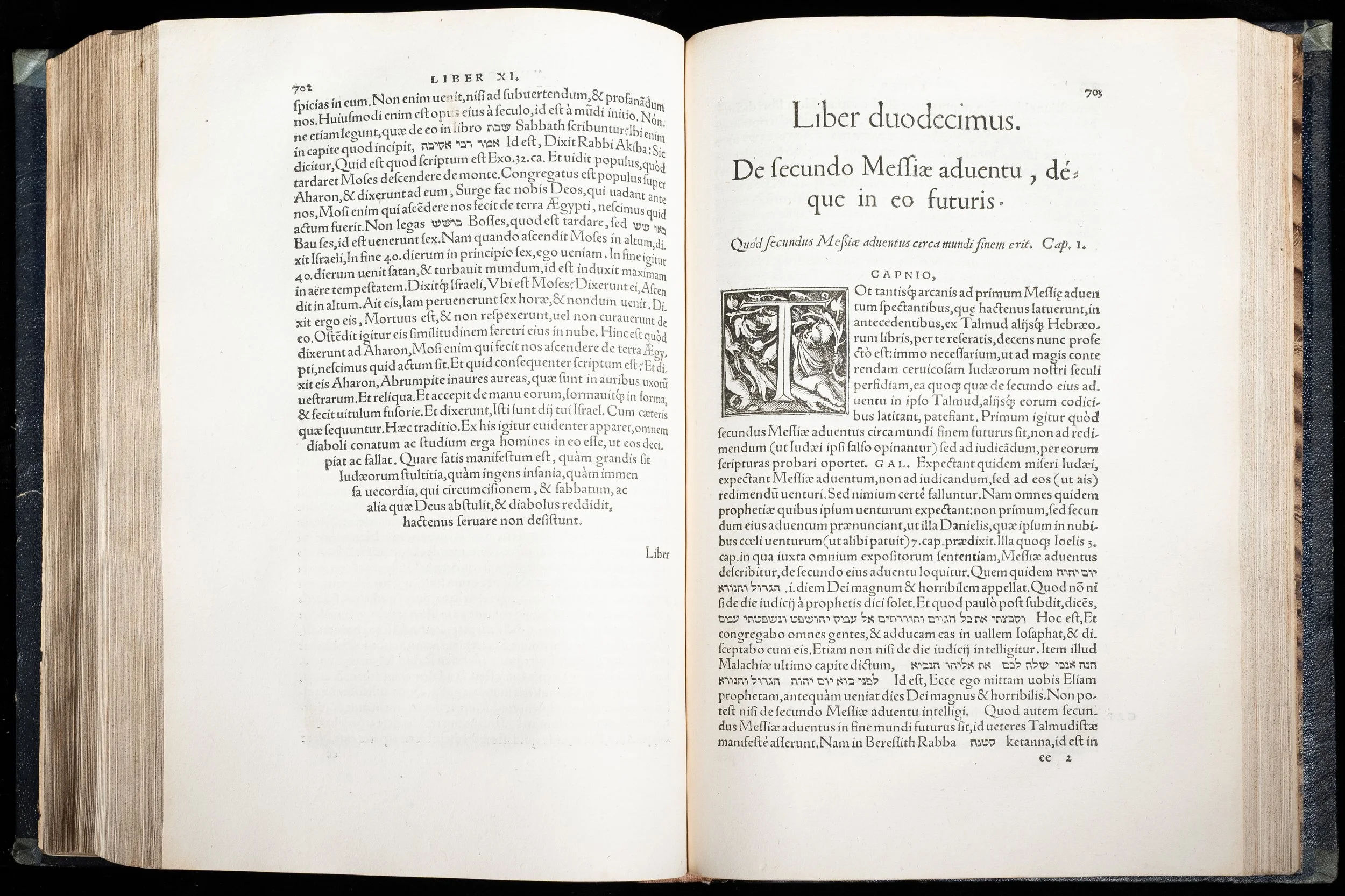 Image 12 of 25
 Image 13 of 25
 Image 14 of 25
 Image 15 of 25
 Image 16 of 25
 Image 17 of 25
 Image 18 of 25
 Image 19 of 25
 Image 20 of 25
 Image 21 of 25
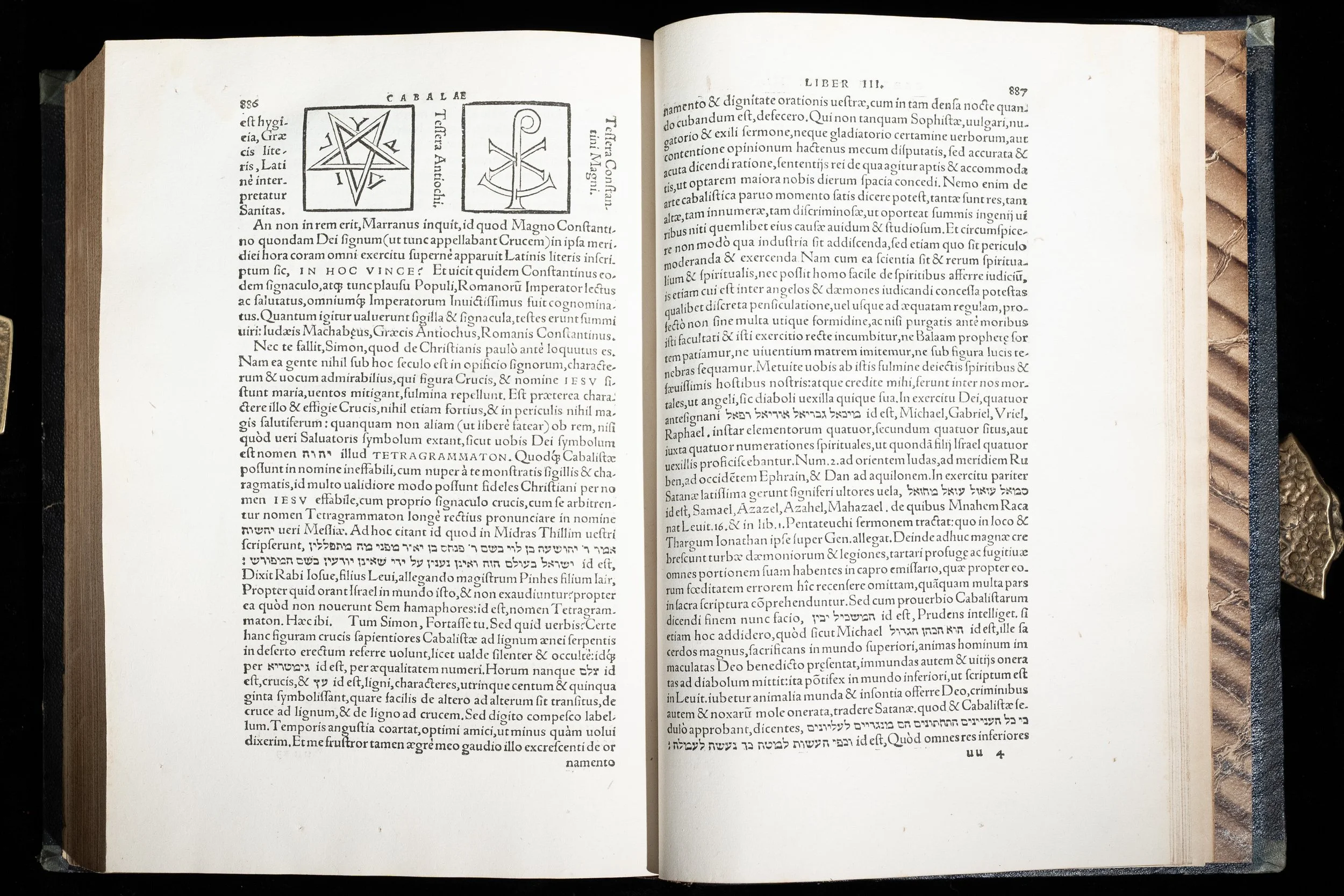 Image 22 of 25
 Image 23 of 25
 Image 24 of 25
 Image 25 of 25