This Basel folio brings together Pietro Galatino’s Opus de arcanis catholicae veritatis and Johann Reuchlin’s De arte cabalistica, two influential Christian readings of Jewish mystical texts. The copy bears stamps of the Dominican convent of Saint-Romain in Toulouse. Given the role of Reuchlin’s Dominican opponents in the earlier controversy over Jewish books, that is an ownership mark worth pausing over. The later stamps establish the convent’s possession, though they do not tell us what its readers thought of the argument.
Reuchlin’s work takes the form of a conversation in Frankfurt. Simon, a Jewish exile from Spain, discusses Kabbalah with Marranus, a Christian convert, and Philolaus, a Pythagorean. Simon has a great deal to teach his companions. Reuchlin connects Jewish mystical learning with ancient philosophy, interpreting both through Christian belief. The historian François Secret called the book “la Bible de la Kabbale Chrétienne,” the Bible of Christian Kabbalah. The phrase catches something of its ambition.
That attention to Jewish learning was central to the controversy in which Reuchlin opposed demands for the confiscation and destruction of Jewish books. Galatino, a Franciscan, also draws on Jewish sources, assembling arguments that they support Christian doctrine. Read together, the works show different methods within Christian Kabbalah, the adaptation of Jewish mystical traditions to Christian theological purposes. The dialogue allows the reader to follow the discussion; Galatino builds his case at considerable length, occupying the first 718 pages before Reuchlin begins.
This copy has accumulated marks of several readers and institutions. The title-page inscription names a religious house whose identification remains uncertain. There are the Toulouse stamps and a separate inscription naming Franz Haberland, as well as gilt initials on the covers that have not been identified. Early marginal notes include cross-references on page 602. These are useful traces of attention in a book made for sustained study.
The French calf binding retains period boards and has a restored spine. A second copy of the same edition is listed separately at $6,500, with different ownership marks and copy details. This $7,000 copy is the one with the Toulouse Dominican stamps.
Provenance
(1) Early manuscript inscription on the title page: “Ex Libris Beatae Mariae [Vallis?] Scholasticae.” The reading and institution remain unidentified.
(2) Two stamps of the Couvent des Dominicains Saint-Romain, Toulouse: blue oval stamp ("Couvent des Dominicains / St Romain / Toulouse") and purple circular stamp with Dominican cross ("Couvent Dominicaine des P.P. / 3, Rue Espinasse / Toulouse"). Repeated on BB4 and BB6. Small circular shelf label with manuscript number "55."
(3) Manuscript ownership inscription: “Eigentum de[s] Franz Haberland.”
(4) Pencil bibliographic notes on the pastedown.
REUCHLIN, Johannes (1455-1522) & GALATINO, Pietro (Petrus Galatinus, ca. 1460-1540) De Arte Cabalistica libri tres, bound with Galatino's Opus de Arcanis Catholicae Veritatis. Basel: Johann Herwagen, 1550. Folio (32.4 x 21.6 cm). [24], 891 [i.e. 791], [33] pp.; pagination irregular due to misnumbering, complete. Text in Latin with extensive Hebrew passages throughout. Woodcut printer's device on title page; woodcut historiated initials. Reuchlin's De arte cabalistica begins at p. 719. Occasional early marginal annotations in a scholarly hand, including cross-references on p. 602.
An attractive French calf binding over original boards, the spine sympathetically restored. Boards with blind-ruled triple fillet border and gilt-stamped central lozenge device enclosing a quatrefoil pattern, flanked by the initials "C" and "P" on the upper board, "C," "F," and "P" on the lower (former owner?). Small gilt fleurons at corners. Spine with raised bands forming six compartments, gilt-lettered "P. GALATINI / DE ARCANIS / CATHOL. VERITATI" and decorated with gilt fleur-de-lis stamps in each compartment. Hinges secure.
Text block tight and complete. Chip to upper right corner of title page (not affecting text). Light water staining to outer margins throughout, not affecting legibility. Moderate toning throughout with occasional foxing. Additional institutional stamps on BB4 and BB6 (same provenance as title page). A sound, unsophisticated copy in an appealing period binding.
This Basel folio brings together Pietro Galatino’s Opus de arcanis catholicae veritatis and Johann Reuchlin’s De arte cabalistica, two influential Christian readings of Jewish mystical texts. The copy bears stamps of the Dominican convent of Saint-Romain in Toulouse. Given the role of Reuchlin’s Dominican opponents in the earlier controversy over Jewish books, that is an ownership mark worth pausing over. The later stamps establish the convent’s possession, though they do not tell us what its readers thought of the argument.
Reuchlin’s work takes the form of a conversation in Frankfurt. Simon, a Jewish exile from Spain, discusses Kabbalah with Marranus, a Christian convert, and Philolaus, a Pythagorean. Simon has a great deal to teach his companions. Reuchlin connects Jewish mystical learning with ancient philosophy, interpreting both through Christian belief. The historian François Secret called the book “la Bible de la Kabbale Chrétienne,” the Bible of Christian Kabbalah. The phrase catches something of its ambition.
That attention to Jewish learning was central to the controversy in which Reuchlin opposed demands for the confiscation and destruction of Jewish books. Galatino, a Franciscan, also draws on Jewish sources, assembling arguments that they support Christian doctrine. Read together, the works show different methods within Christian Kabbalah, the adaptation of Jewish mystical traditions to Christian theological purposes. The dialogue allows the reader to follow the discussion; Galatino builds his case at considerable length, occupying the first 718 pages before Reuchlin begins.
This copy has accumulated marks of several readers and institutions. The title-page inscription names a religious house whose identification remains uncertain. There are the Toulouse stamps and a separate inscription naming Franz Haberland, as well as gilt initials on the covers that have not been identified. Early marginal notes include cross-references on page 602. These are useful traces of attention in a book made for sustained study.
The French calf binding retains period boards and has a restored spine. A second copy of the same edition is listed separately at $6,500, with different ownership marks and copy details. This $7,000 copy is the one with the Toulouse Dominican stamps.
Provenance
(1) Early manuscript inscription on the title page: “Ex Libris Beatae Mariae [Vallis?] Scholasticae.” The reading and institution remain unidentified.
(2) Two stamps of the Couvent des Dominicains Saint-Romain, Toulouse: blue oval stamp ("Couvent des Dominicains / St Romain / Toulouse") and purple circular stamp with Dominican cross ("Couvent Dominicaine des P.P. / 3, Rue Espinasse / Toulouse"). Repeated on BB4 and BB6. Small circular shelf label with manuscript number "55."
(3) Manuscript ownership inscription: “Eigentum de[s] Franz Haberland.”
(4) Pencil bibliographic notes on the pastedown.
REUCHLIN, Johannes (1455-1522) & GALATINO, Pietro (Petrus Galatinus, ca. 1460-1540) De Arte Cabalistica libri tres, bound with Galatino's Opus de Arcanis Catholicae Veritatis. Basel: Johann Herwagen, 1550. Folio (32.4 x 21.6 cm). [24], 891 [i.e. 791], [33] pp.; pagination irregular due to misnumbering, complete. Text in Latin with extensive Hebrew passages throughout. Woodcut printer's device on title page; woodcut historiated initials. Reuchlin's De arte cabalistica begins at p. 719. Occasional early marginal annotations in a scholarly hand, including cross-references on p. 602.
An attractive French calf binding over original boards, the spine sympathetically restored. Boards with blind-ruled triple fillet border and gilt-stamped central lozenge device enclosing a quatrefoil pattern, flanked by the initials "C" and "P" on the upper board, "C," "F," and "P" on the lower (former owner?). Small gilt fleurons at corners. Spine with raised bands forming six compartments, gilt-lettered "P. GALATINI / DE ARCANIS / CATHOL. VERITATI" and decorated with gilt fleur-de-lis stamps in each compartment. Hinges secure.
Text block tight and complete. Chip to upper right corner of title page (not affecting text). Light water staining to outer margins throughout, not affecting legibility. Moderate toning throughout with occasional foxing. Additional institutional stamps on BB4 and BB6 (same provenance as title page). A sound, unsophisticated copy in an appealing period binding.

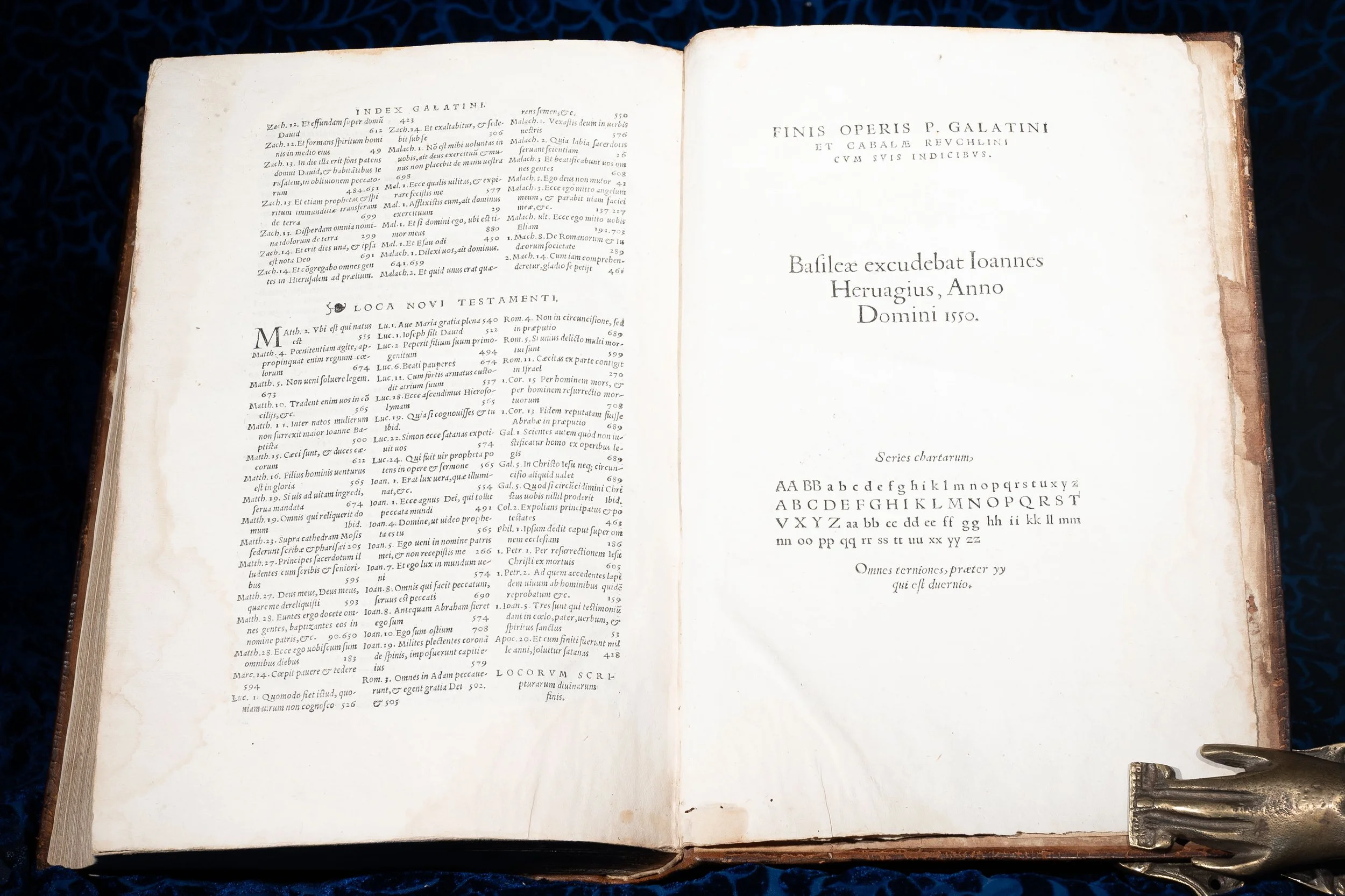 Image 1 of 12
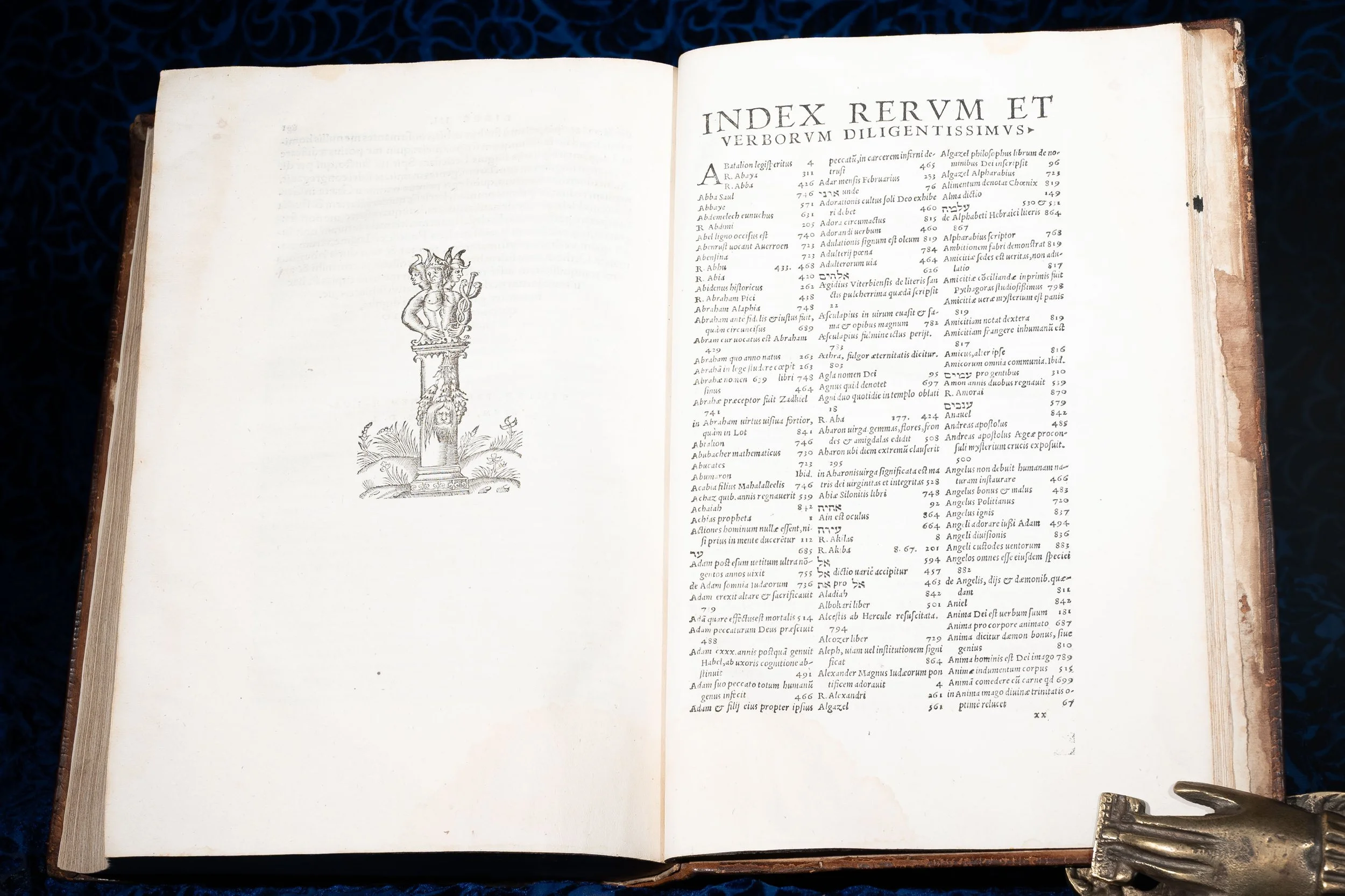 Image 2 of 12
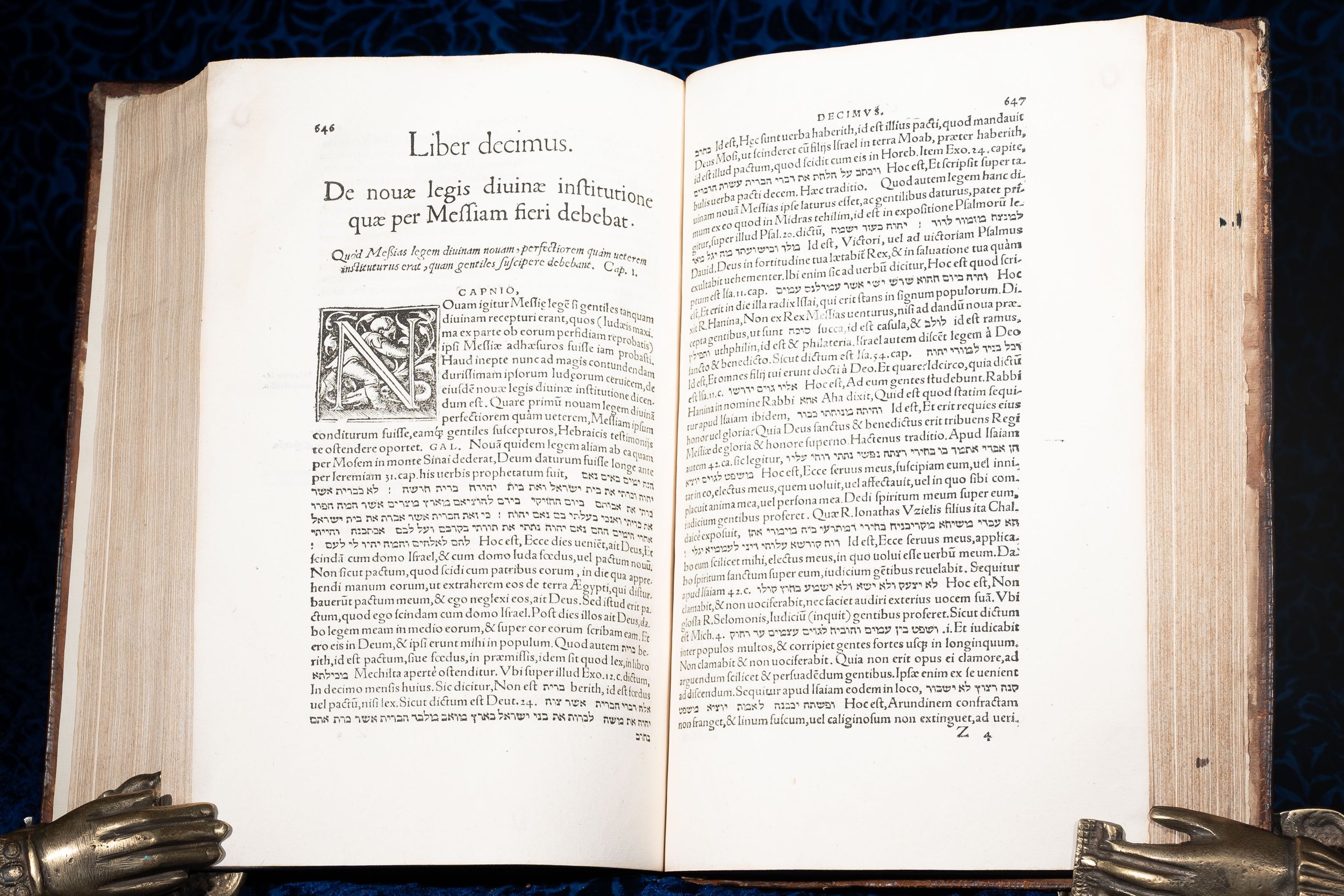 Image 3 of 12
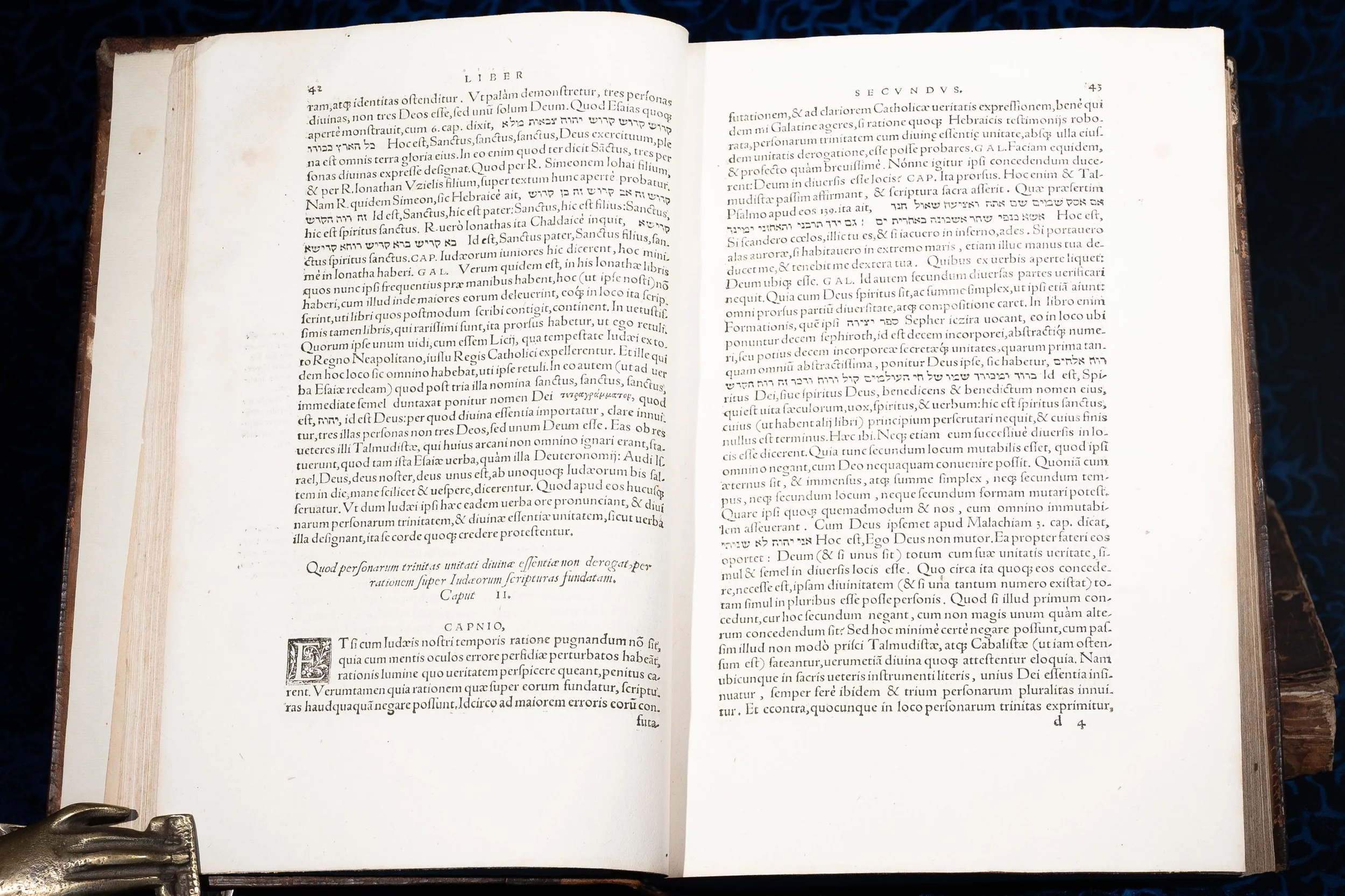 Image 4 of 12
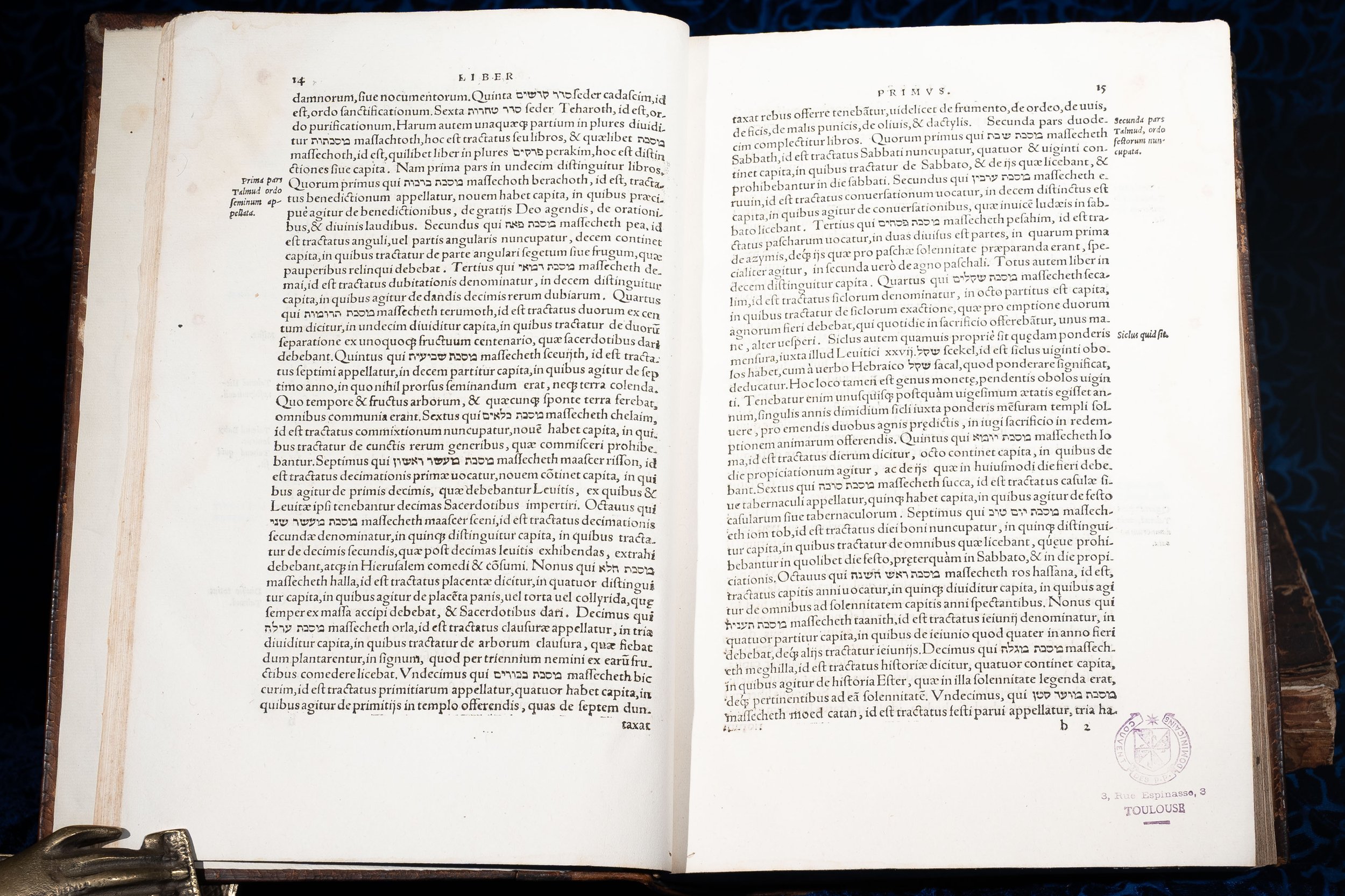 Image 5 of 12
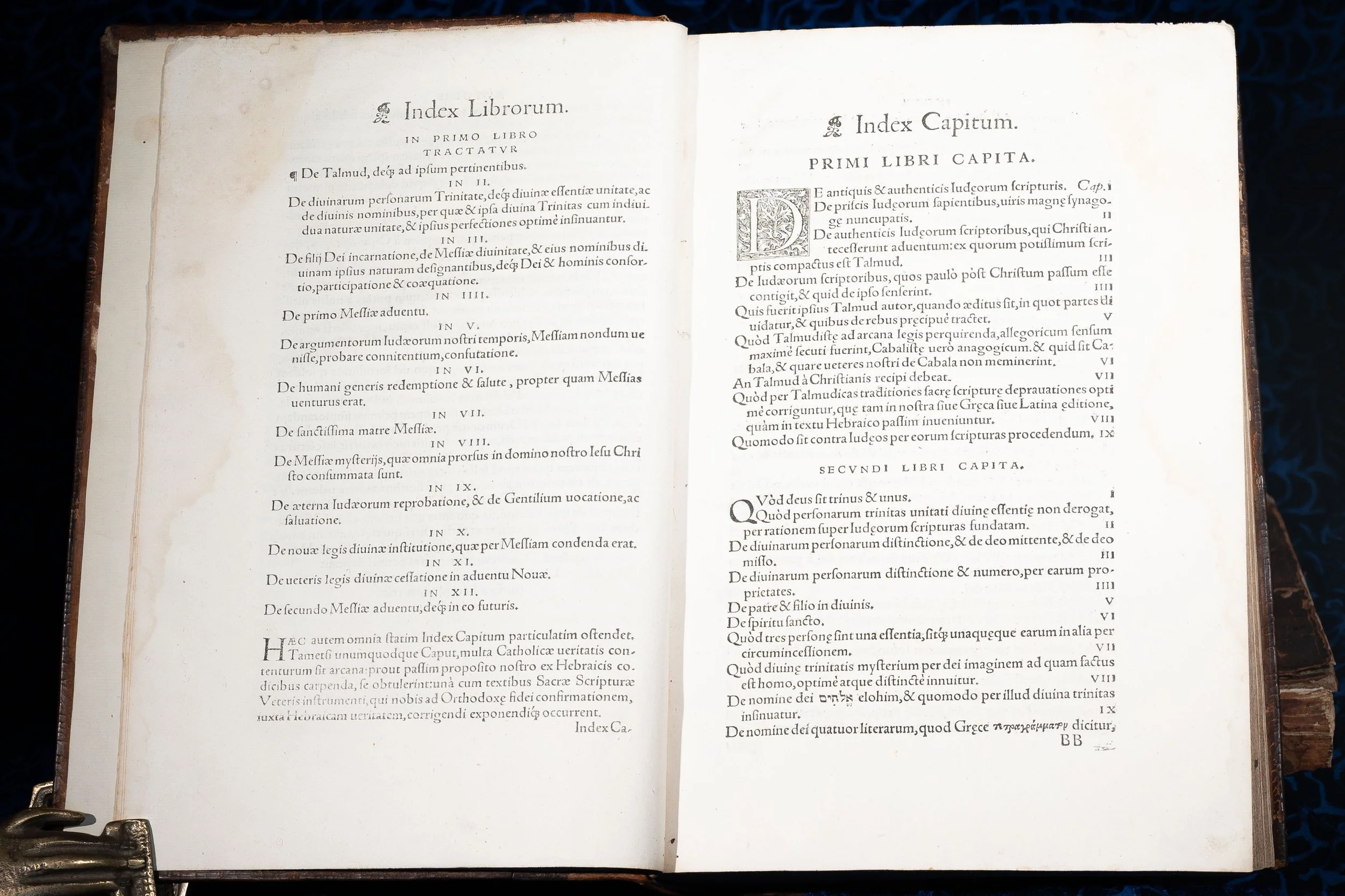 Image 6 of 12
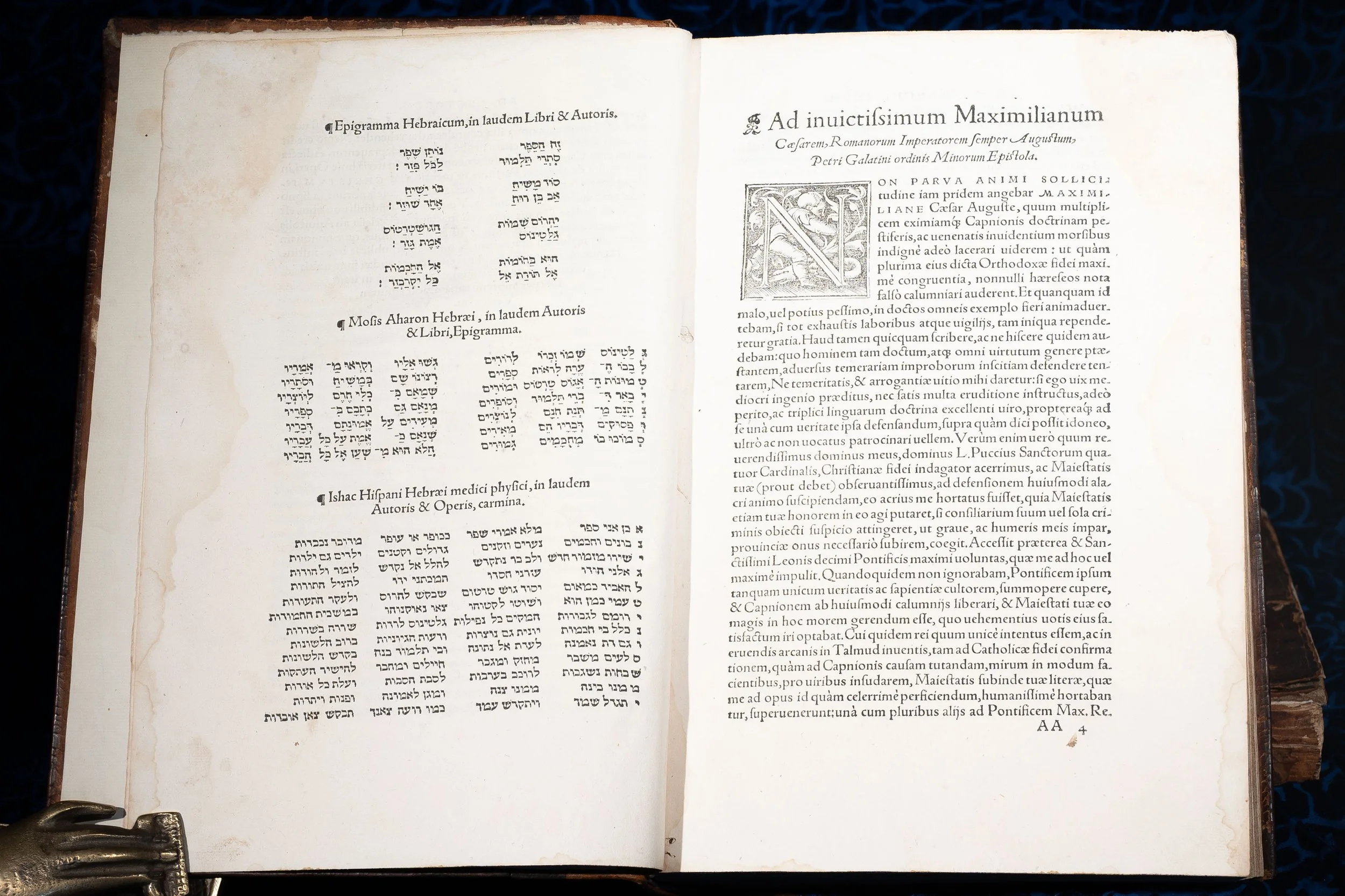 Image 7 of 12
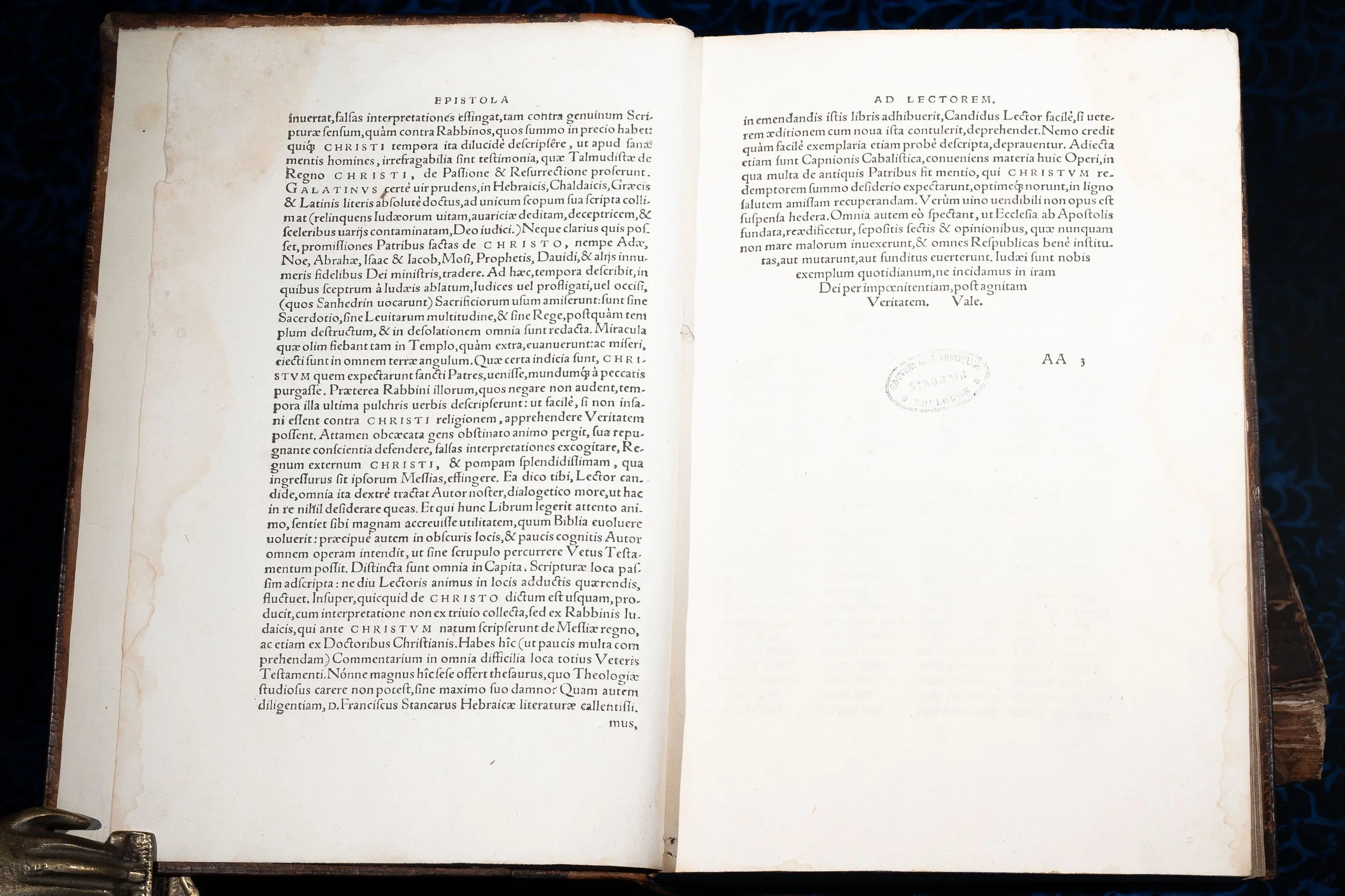 Image 8 of 12
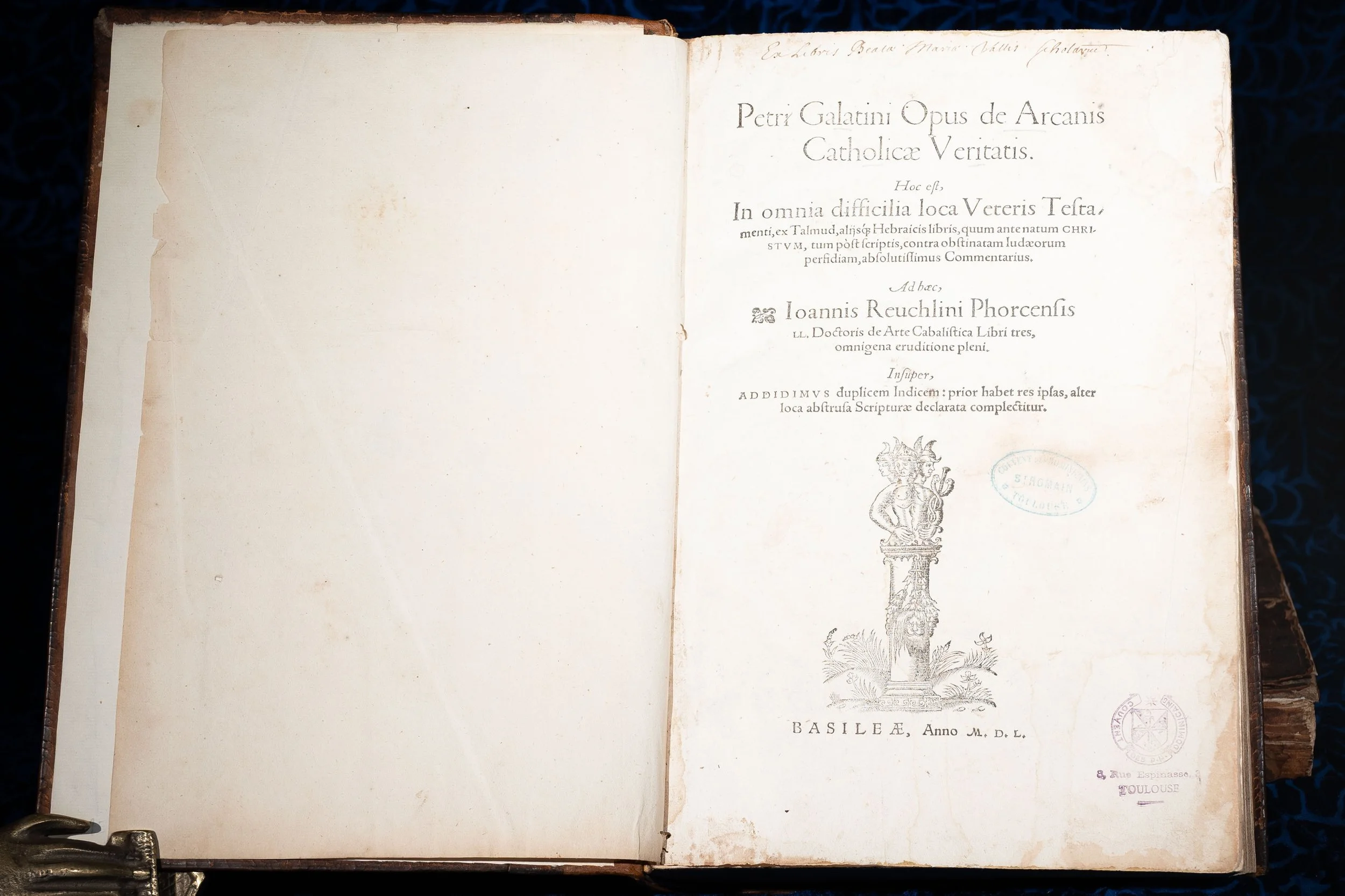 Image 9 of 12
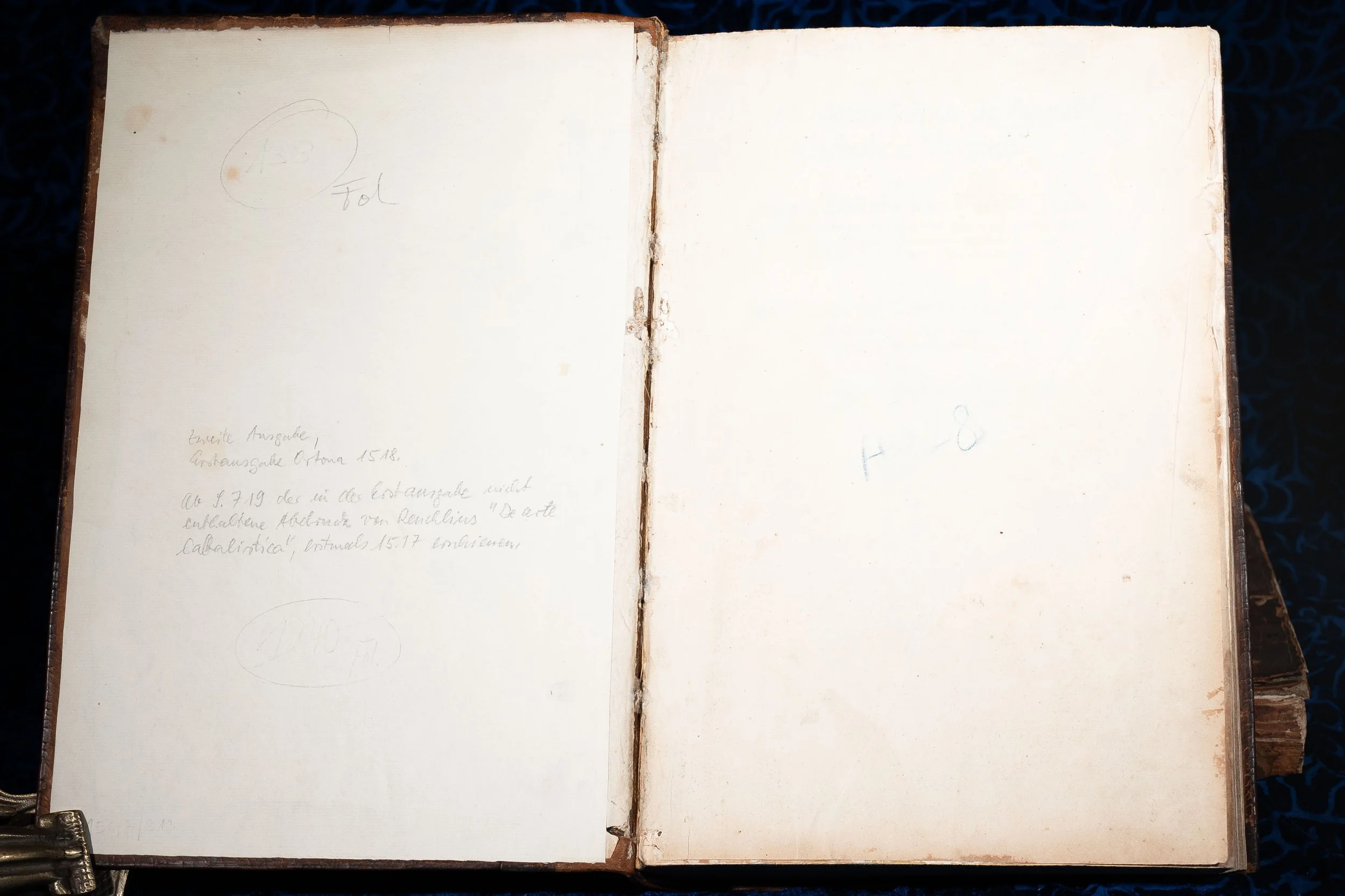 Image 10 of 12
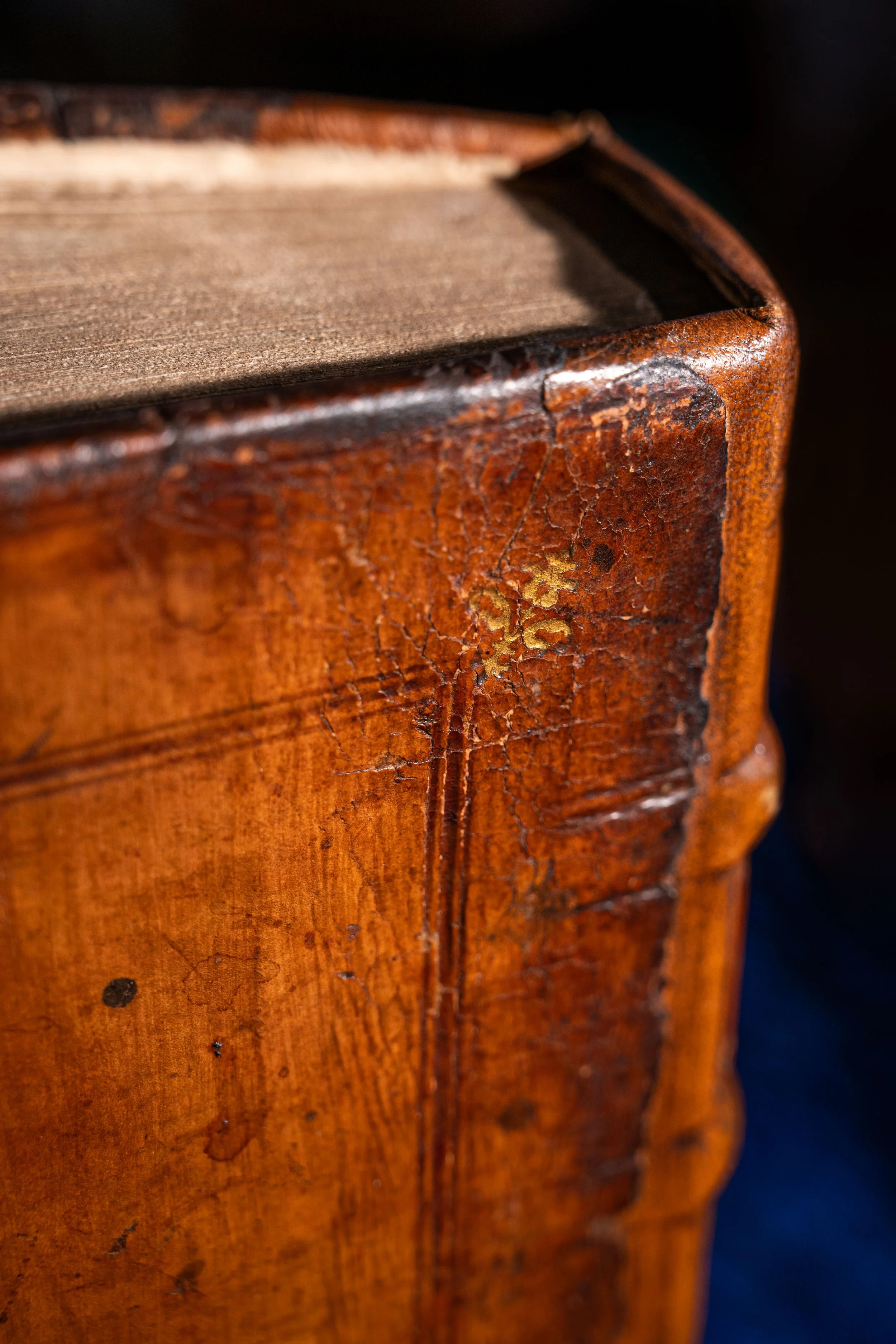 Image 11 of 12
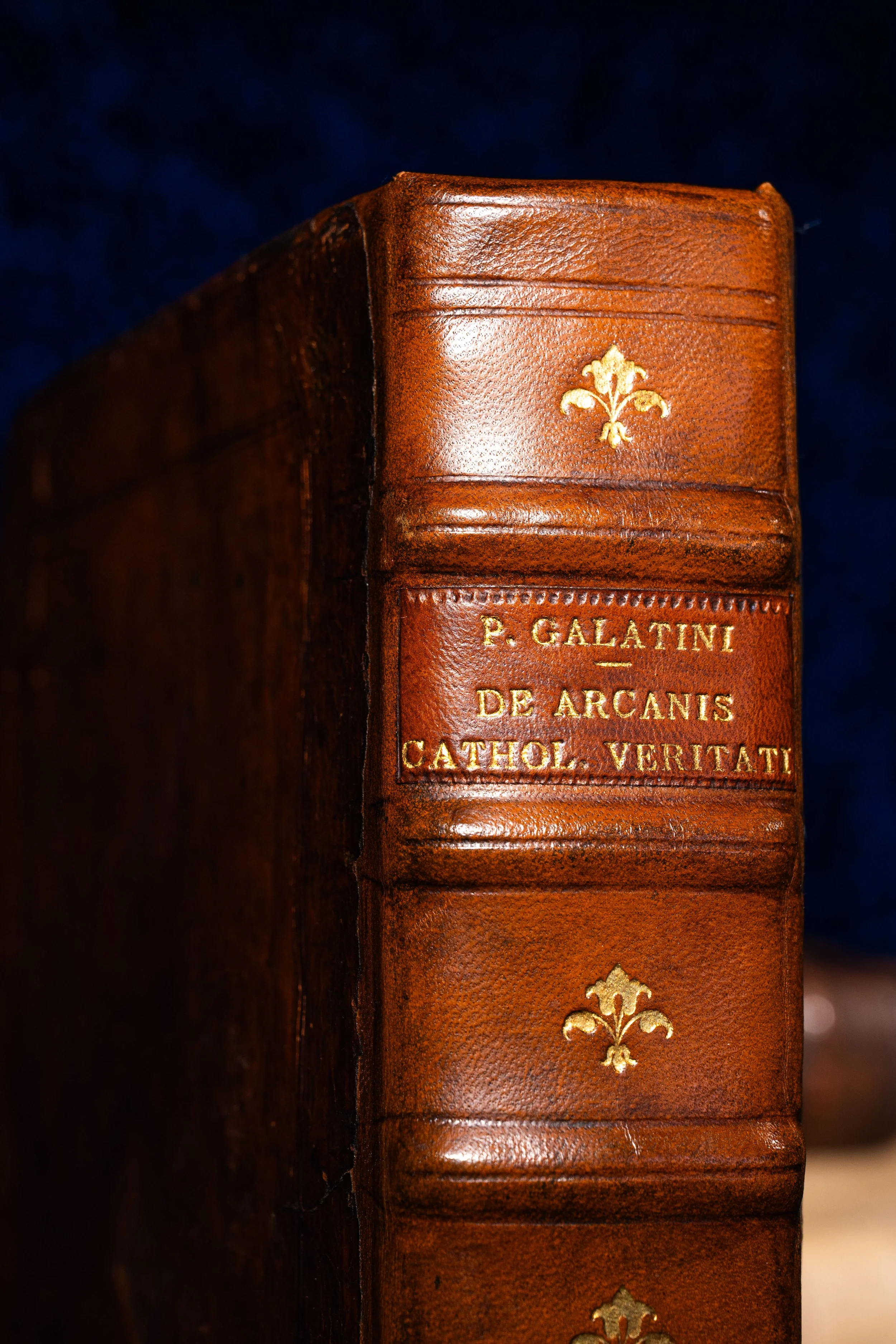 Image 12 of 12