Joachim of Fiore, abbot of a mountain monastery in Calabria, died in 1202 believing he had found the key to history. Time, he taught, unfolds in three great ages: the age of the Father, under the law; the age of the Son, under the gospel; and a coming age of the Holy Spirit, when the letter would give way to freedom and the world would be ruled by contemplatives. It was the most influential prophetic system of the Middle Ages. The Franciscan radicals built their hopes on it, the Church condemned pieces of it, and Dante placed the abbot in Paradise, "endowed with prophetic spirit." The Liber Concordie is his master-work: a vast concordance running the histories of the two Testaments side by side, generation against generation, to show where the pattern was heading.
It waited three centuries for a printer. This is the first edition, produced at Venice in 1519, the title page announcing the work of "the divine prophet Abbot Joachim, now first printed and brought into the light." The book opens with the letters of two popes urging Joachim to finish his writings, and with the abbot's own testament humbly submitting everything to Rome's correction. Then come the famous diagrams, cut in wood for the first time: the great branching tree of the two dispensations; the three interlocking circles of the ages, labeled the time of circumcision, the time of the cross, and the time of quiet and peace; the zigzag chain of the seven seals; and the long genealogical tables marching from Adam toward the end of days, with a blazing star set among the generations.
The copy carries early readers’ annotations. An early hand has left inked pointing-strokes through the chapters on Antichrist, and beside the great reckoning of generations stands a longer note in a hand of the later sixteenth century, doing the arithmetic on the abbot: "See, here the prophet failed: for since then three hundred and eighty-six years have passed…" Count 386 years from Joachim's death and you land at about 1588: a reader auditing the end of the world and finding it overdue. The later provenance answers him across the centuries. At the head of the front endpaper is inked the name and Rome address of P. Henri Denifle O.P.: Heinrich Denifle, sub-archivist of the Vatican, the great Dominican historian of medieval thought, whose 1885 study of the Everlasting Gospel published the records of the papal commission that had examined Joachim's teaching in 1255. The title page carries the stamp of the Dominican convent of Graz, where Denifle entered the order as a young man. Denifle’s copy brings this first edition together with the later scholarly study of Joachim’s teaching.
The book is a post-incunable quarto, printed in double columns of round gothic letter with printed side-notes, the leaves foliated rather than paginated, closing with the printer's register for the binder: quires a to z and aa to mm, "all of them duernions," and the colophon dated at Venice the 13th of April 1519. The binding is modern half vellum with speckled paper sides and vellum tips, the spine with six raised bands, the boards with the slight outward bow vellum likes to take. Endleaves renewed; the original final blank preserved. Within, the paper is remarkably fresh: occasional creasing to leaves, some of it evidently made at the press; some spotting and small marginal wormtraces; very little browning. Two older library stamps and two early ownership inscriptions, one canceled, to the title.
Provenance: Early ink marginalia, including a dated-by-arithmetic note of c. 1588 auditing Joachim's prophecy, and pointing-strokes to the Antichrist chapters; two early ownership inscriptions (one canceled) and an older oval library stamp with wheel device [undeciphered] to the title; stamp of the Dominican convent of Graz; name and Rome address of P. Henri Denifle O.P. (Heinrich Denifle, 1844–1905, sub-archivist of the Vatican) inked on the front endpaper.
Liber Concordie novi ac veteris Testamenti, first printing. Venice, Simone de Luere, 13 April 1519. With the woodcut figurae: the great tree, the three interlocking circles of the ages, the zigzag of the seven seals. From the library of Heinrich Denifle, sub-archivist of the Vatican. Modern half vellum.
JOACHIM OF FIORE (c. 1135–1202). Divini vatis Abbatis Joachim liber concordie novi ac veteris Testamenti: nunc primo impressus. Venice: Simone de Luere, 13 April 1519.
Physical Description: 4to. [4] leaves; 135 numbered (foliated) leaves; original final blank present. Four large woodcut diagrams (one full-page) and woodcut genealogical tables with star device; woodcut decorated initials; double columns, gothic letter, printed marginalia; colophon and printer's register ("Omnes sunt duerni") at end. References: EDIT16 CNCE 31823; Adams J-209.
Binding: Modern half vellum, spine with six raised bands, speckled paper sides, vellum tips; boards slightly bowed. Endleaves renewed, the original terminal blank retained.
Condition: Occasional creasing to leaves, some evidently from the press; some spotting and small wormtraces to margins; very little browning. A fresh, well-margined copy.
Joachim of Fiore, abbot of a mountain monastery in Calabria, died in 1202 believing he had found the key to history. Time, he taught, unfolds in three great ages: the age of the Father, under the law; the age of the Son, under the gospel; and a coming age of the Holy Spirit, when the letter would give way to freedom and the world would be ruled by contemplatives. It was the most influential prophetic system of the Middle Ages. The Franciscan radicals built their hopes on it, the Church condemned pieces of it, and Dante placed the abbot in Paradise, "endowed with prophetic spirit." The Liber Concordie is his master-work: a vast concordance running the histories of the two Testaments side by side, generation against generation, to show where the pattern was heading.
It waited three centuries for a printer. This is the first edition, produced at Venice in 1519, the title page announcing the work of "the divine prophet Abbot Joachim, now first printed and brought into the light." The book opens with the letters of two popes urging Joachim to finish his writings, and with the abbot's own testament humbly submitting everything to Rome's correction. Then come the famous diagrams, cut in wood for the first time: the great branching tree of the two dispensations; the three interlocking circles of the ages, labeled the time of circumcision, the time of the cross, and the time of quiet and peace; the zigzag chain of the seven seals; and the long genealogical tables marching from Adam toward the end of days, with a blazing star set among the generations.
The copy carries early readers’ annotations. An early hand has left inked pointing-strokes through the chapters on Antichrist, and beside the great reckoning of generations stands a longer note in a hand of the later sixteenth century, doing the arithmetic on the abbot: "See, here the prophet failed: for since then three hundred and eighty-six years have passed…" Count 386 years from Joachim's death and you land at about 1588: a reader auditing the end of the world and finding it overdue. The later provenance answers him across the centuries. At the head of the front endpaper is inked the name and Rome address of P. Henri Denifle O.P.: Heinrich Denifle, sub-archivist of the Vatican, the great Dominican historian of medieval thought, whose 1885 study of the Everlasting Gospel published the records of the papal commission that had examined Joachim's teaching in 1255. The title page carries the stamp of the Dominican convent of Graz, where Denifle entered the order as a young man. Denifle’s copy brings this first edition together with the later scholarly study of Joachim’s teaching.
The book is a post-incunable quarto, printed in double columns of round gothic letter with printed side-notes, the leaves foliated rather than paginated, closing with the printer's register for the binder: quires a to z and aa to mm, "all of them duernions," and the colophon dated at Venice the 13th of April 1519. The binding is modern half vellum with speckled paper sides and vellum tips, the spine with six raised bands, the boards with the slight outward bow vellum likes to take. Endleaves renewed; the original final blank preserved. Within, the paper is remarkably fresh: occasional creasing to leaves, some of it evidently made at the press; some spotting and small marginal wormtraces; very little browning. Two older library stamps and two early ownership inscriptions, one canceled, to the title.
Provenance: Early ink marginalia, including a dated-by-arithmetic note of c. 1588 auditing Joachim's prophecy, and pointing-strokes to the Antichrist chapters; two early ownership inscriptions (one canceled) and an older oval library stamp with wheel device [undeciphered] to the title; stamp of the Dominican convent of Graz; name and Rome address of P. Henri Denifle O.P. (Heinrich Denifle, 1844–1905, sub-archivist of the Vatican) inked on the front endpaper.
Liber Concordie novi ac veteris Testamenti, first printing. Venice, Simone de Luere, 13 April 1519. With the woodcut figurae: the great tree, the three interlocking circles of the ages, the zigzag of the seven seals. From the library of Heinrich Denifle, sub-archivist of the Vatican. Modern half vellum.
JOACHIM OF FIORE (c. 1135–1202). Divini vatis Abbatis Joachim liber concordie novi ac veteris Testamenti: nunc primo impressus. Venice: Simone de Luere, 13 April 1519.
Physical Description: 4to. [4] leaves; 135 numbered (foliated) leaves; original final blank present. Four large woodcut diagrams (one full-page) and woodcut genealogical tables with star device; woodcut decorated initials; double columns, gothic letter, printed marginalia; colophon and printer's register ("Omnes sunt duerni") at end. References: EDIT16 CNCE 31823; Adams J-209.
Binding: Modern half vellum, spine with six raised bands, speckled paper sides, vellum tips; boards slightly bowed. Endleaves renewed, the original terminal blank retained.
Condition: Occasional creasing to leaves, some evidently from the press; some spotting and small wormtraces to margins; very little browning. A fresh, well-margined copy.

 Image 1 of 11
 Image 2 of 11
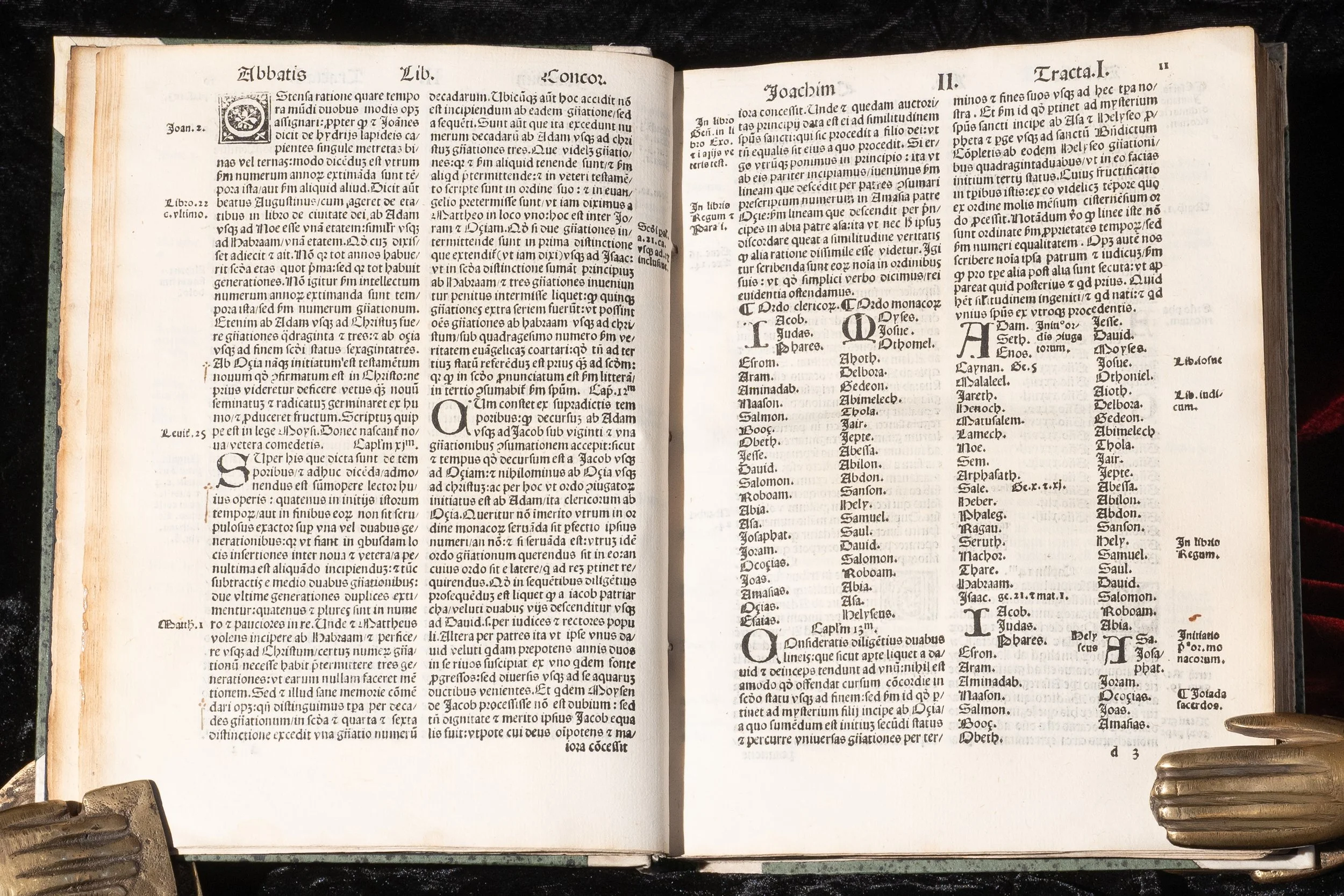 Image 3 of 11
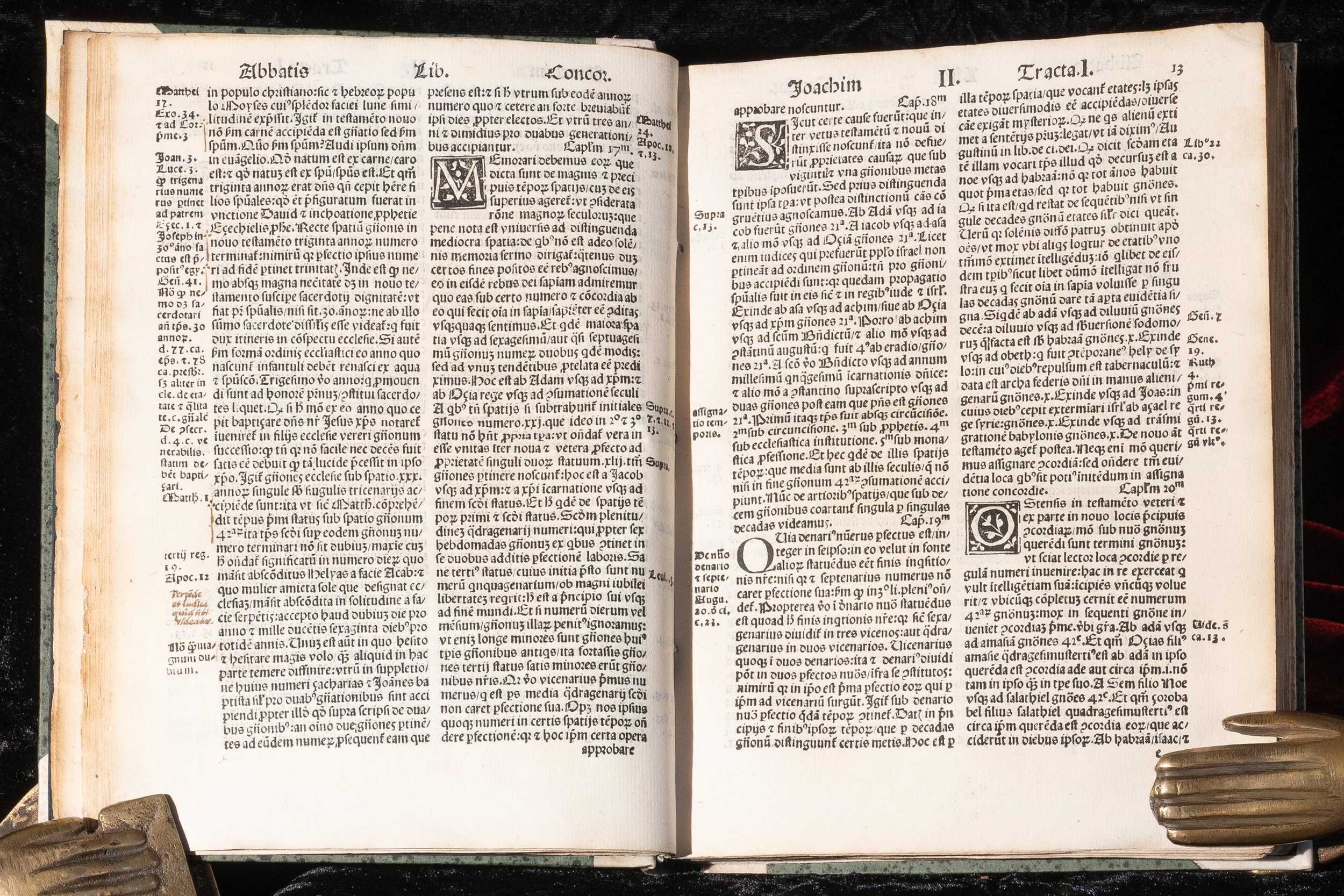 Image 4 of 11
 Image 5 of 11
 Image 6 of 11
 Image 7 of 11
 Image 8 of 11
 Image 9 of 11
 Image 10 of 11
 Image 11 of 11