The only surviving novel from the ancient world is also its most dangerous book of magic. Apuleius' Metamorphoses, better known as The Golden Ass, follows Lucius, a young man transformed into a donkey through sorcery gone wrong, on a picaresque descent through lust, ignorance, and degradation before his redemption through the divine grace of the goddess Isis. Beneath the bawdy surface lies the most complete surviving record of ancient mystery cult initiation. Book XI, the narrative's spiritual climax, is the only extant first-person account of the rites of the Cult of Isis, describing the "blessed vision," the sacred silence, and the ritual purification required to gaze upon the Goddess. For Renaissance Neoplatonists and Hermeticists, Apuleius was no mere novelist: he was a philosophus platonicus, a sage who encoded the secrets of the soul's transmutation into fiction.
This edition wraps the text in the dense, encyclopedic commentary of Filippo Beroaldo the Elder (1453–1505), unpacking the hidden Neoplatonic meanings, etymologies, and magical references that made The Golden Ass a living document for the 16th-century reader. Beroaldo was the necessary guide, unlocking the esoteric architecture of Apuleius' Latin.
The Edition
This 1512 folio represents the transnational book trade of the Northern Renaissance at its most ambitious. It is a collaboration between the great Cologne publishing house of Ludwig Hornken and Gottfried Hittorp, pivotal figures in bringing the fruits of Italian Humanism to Northern Europe, and the Parisian printer Jean Philippi. The title page lists two addresses for sale: Hornken's shop in Paris ("at the sign of the Three Crowns") and his headquarters in Cologne ("behind the Great Church"). The presence of Hornken's device (referencing the Three Magi of Cologne) alongside Philippi's "Holy Trinity" device in the colophon marks this as a high-status commercial venture, designed for the libraries of serious scholars and universities.
Provenance
The Royal Jesuit Connection. The title page bears the stamp: COLL. SOC. IESV SALM. EX DONO REGVM (Collegium Societatis Jesu Salmanticensis Ex Dono Regum). This identifies the volume as belonging to the library of the Real Clerecía de San Marcos in Salamanca, Spain, one of the most prestigious Jesuit libraries of the Spanish Golden Age. The phrase Ex Dono Regum ("From the Gift of the Kings") refers to the college's royal founders, King Philip III and Queen Margaret of Austria, who endowed the institution in 1611.
The War over Fortune (Marginalia). A 16th-century reader engaged in a heated theological dispute with the text in the margins. Where Beroaldo and Apuleius discuss the power of Fortuna as a goddess governing human affairs, this reader pushes back with strict Christian Providentialism, declaring it a maxime error to attribute events to Fortune and arguing that all things flow solely from the divina mente (fol. Sv). Additional annotations include manicules and finding notes (Ci, Hiii) and Greek pen trials (Gelos, Oligos) with a Jesuit monogram (IHS) on the final Register leaf.
APULEIUS, Lucius (c. 124–c. 170 AD); BEROALDO, Filippo (Comm.). Commentarii a Philippo Beroaldo conditi in asinum aureum L. Apulei. (The Golden Ass, with the Commentary of Filippo Beroaldo). [Paris]: Venundantur in vico sancti Jacobi sub intersignio trium coronarum [Jean Philippi for Ludwig Hornken & Gottfried Hittorp], [1512].
Format: Folio. Roman type, text surrounded by commentary.
Collation: A–Z, AA–PP⁸. All gatherings ternions (6 leaves) except final gathering PP (quaternion, 8 leaves). Complete, conforming to the Register on the final leaf.
Binding: 17th or 18th-century vellum, likely a library binding executed for the Jesuit College in Salamanca. Significant wear to the spine; loss to vellum at the head exposing the liner and gathering structure.
Interior: Text block crisp, bright, and wide-margined. Extensive contemporary annotations in at least two hands. Tear to the lower margin of leaf Vv, mended with an early, historic paper repair. Scattered damp staining to signatures Iii, Qii, EEii, and HHvi.
The only surviving novel from the ancient world is also its most dangerous book of magic. Apuleius' Metamorphoses, better known as The Golden Ass, follows Lucius, a young man transformed into a donkey through sorcery gone wrong, on a picaresque descent through lust, ignorance, and degradation before his redemption through the divine grace of the goddess Isis. Beneath the bawdy surface lies the most complete surviving record of ancient mystery cult initiation. Book XI, the narrative's spiritual climax, is the only extant first-person account of the rites of the Cult of Isis, describing the "blessed vision," the sacred silence, and the ritual purification required to gaze upon the Goddess. For Renaissance Neoplatonists and Hermeticists, Apuleius was no mere novelist: he was a philosophus platonicus, a sage who encoded the secrets of the soul's transmutation into fiction.
This edition wraps the text in the dense, encyclopedic commentary of Filippo Beroaldo the Elder (1453–1505), unpacking the hidden Neoplatonic meanings, etymologies, and magical references that made The Golden Ass a living document for the 16th-century reader. Beroaldo was the necessary guide, unlocking the esoteric architecture of Apuleius' Latin.
The Edition
This 1512 folio represents the transnational book trade of the Northern Renaissance at its most ambitious. It is a collaboration between the great Cologne publishing house of Ludwig Hornken and Gottfried Hittorp, pivotal figures in bringing the fruits of Italian Humanism to Northern Europe, and the Parisian printer Jean Philippi. The title page lists two addresses for sale: Hornken's shop in Paris ("at the sign of the Three Crowns") and his headquarters in Cologne ("behind the Great Church"). The presence of Hornken's device (referencing the Three Magi of Cologne) alongside Philippi's "Holy Trinity" device in the colophon marks this as a high-status commercial venture, designed for the libraries of serious scholars and universities.
Provenance
The Royal Jesuit Connection. The title page bears the stamp: COLL. SOC. IESV SALM. EX DONO REGVM (Collegium Societatis Jesu Salmanticensis Ex Dono Regum). This identifies the volume as belonging to the library of the Real Clerecía de San Marcos in Salamanca, Spain, one of the most prestigious Jesuit libraries of the Spanish Golden Age. The phrase Ex Dono Regum ("From the Gift of the Kings") refers to the college's royal founders, King Philip III and Queen Margaret of Austria, who endowed the institution in 1611.
The War over Fortune (Marginalia). A 16th-century reader engaged in a heated theological dispute with the text in the margins. Where Beroaldo and Apuleius discuss the power of Fortuna as a goddess governing human affairs, this reader pushes back with strict Christian Providentialism, declaring it a maxime error to attribute events to Fortune and arguing that all things flow solely from the divina mente (fol. Sv). Additional annotations include manicules and finding notes (Ci, Hiii) and Greek pen trials (Gelos, Oligos) with a Jesuit monogram (IHS) on the final Register leaf.
APULEIUS, Lucius (c. 124–c. 170 AD); BEROALDO, Filippo (Comm.). Commentarii a Philippo Beroaldo conditi in asinum aureum L. Apulei. (The Golden Ass, with the Commentary of Filippo Beroaldo). [Paris]: Venundantur in vico sancti Jacobi sub intersignio trium coronarum [Jean Philippi for Ludwig Hornken & Gottfried Hittorp], [1512].
Format: Folio. Roman type, text surrounded by commentary.
Collation: A–Z, AA–PP⁸. All gatherings ternions (6 leaves) except final gathering PP (quaternion, 8 leaves). Complete, conforming to the Register on the final leaf.
Binding: 17th or 18th-century vellum, likely a library binding executed for the Jesuit College in Salamanca. Significant wear to the spine; loss to vellum at the head exposing the liner and gathering structure.
Interior: Text block crisp, bright, and wide-margined. Extensive contemporary annotations in at least two hands. Tear to the lower margin of leaf Vv, mended with an early, historic paper repair. Scattered damp staining to signatures Iii, Qii, EEii, and HHvi.

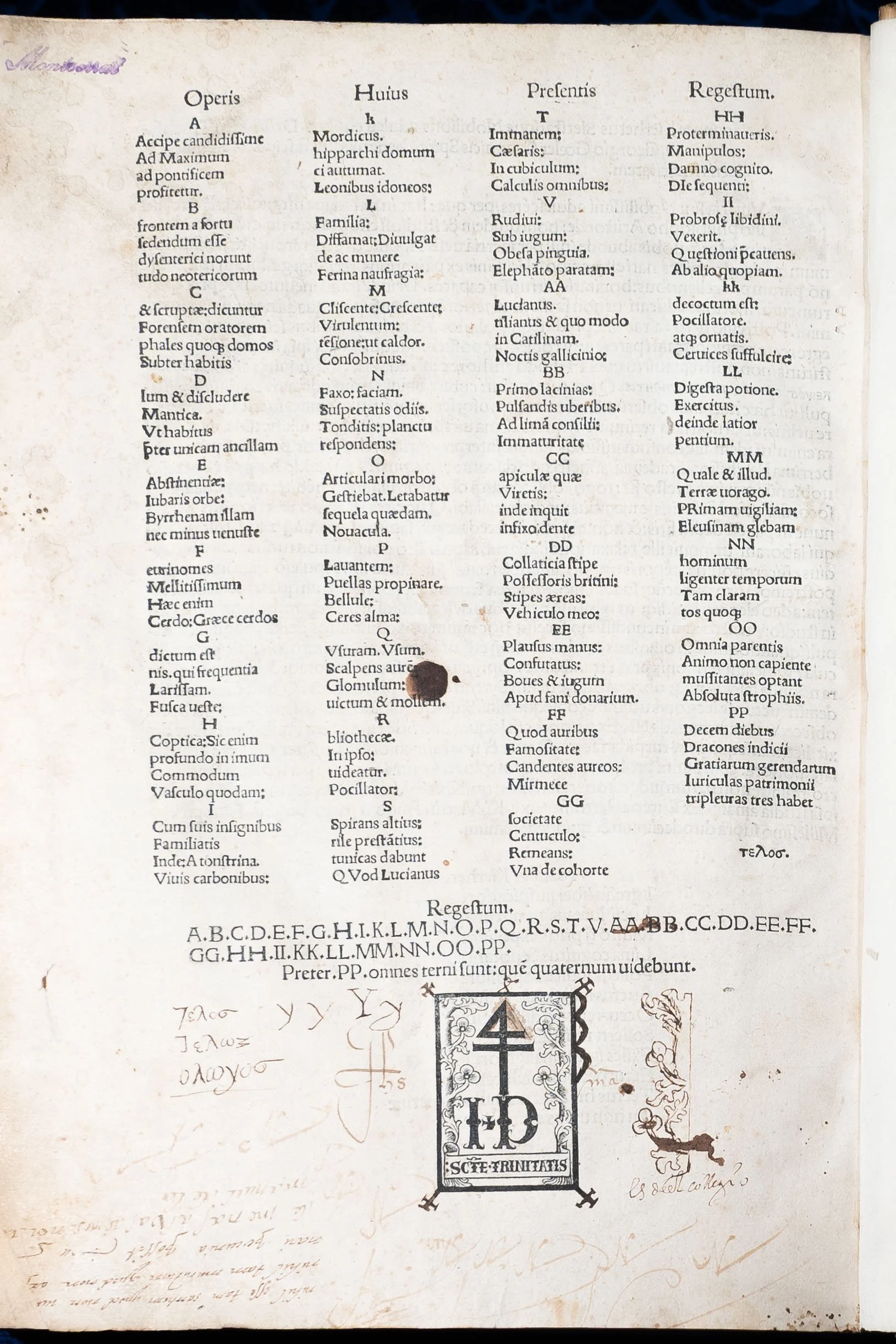 Image 1 of 9
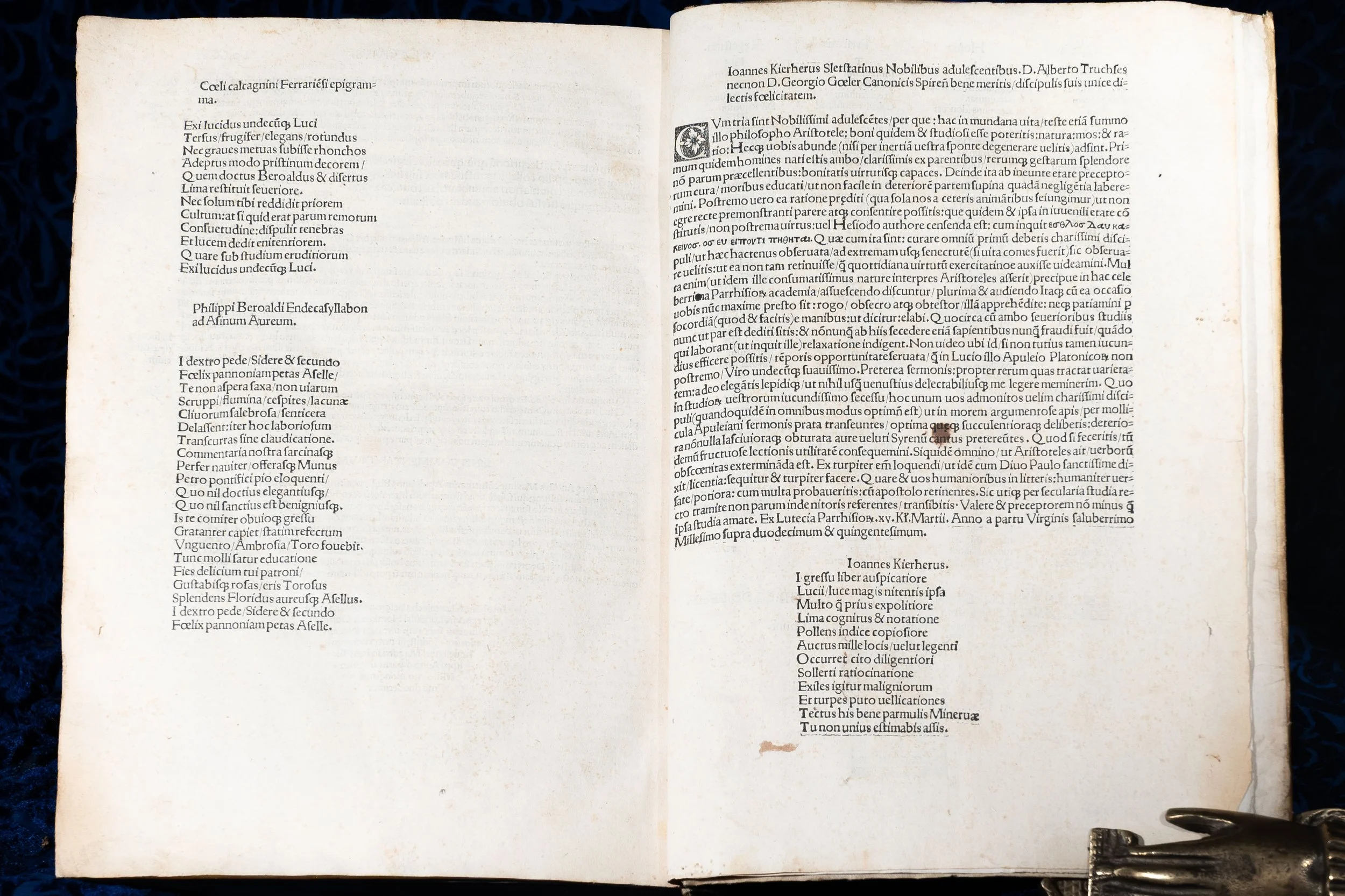 Image 2 of 9
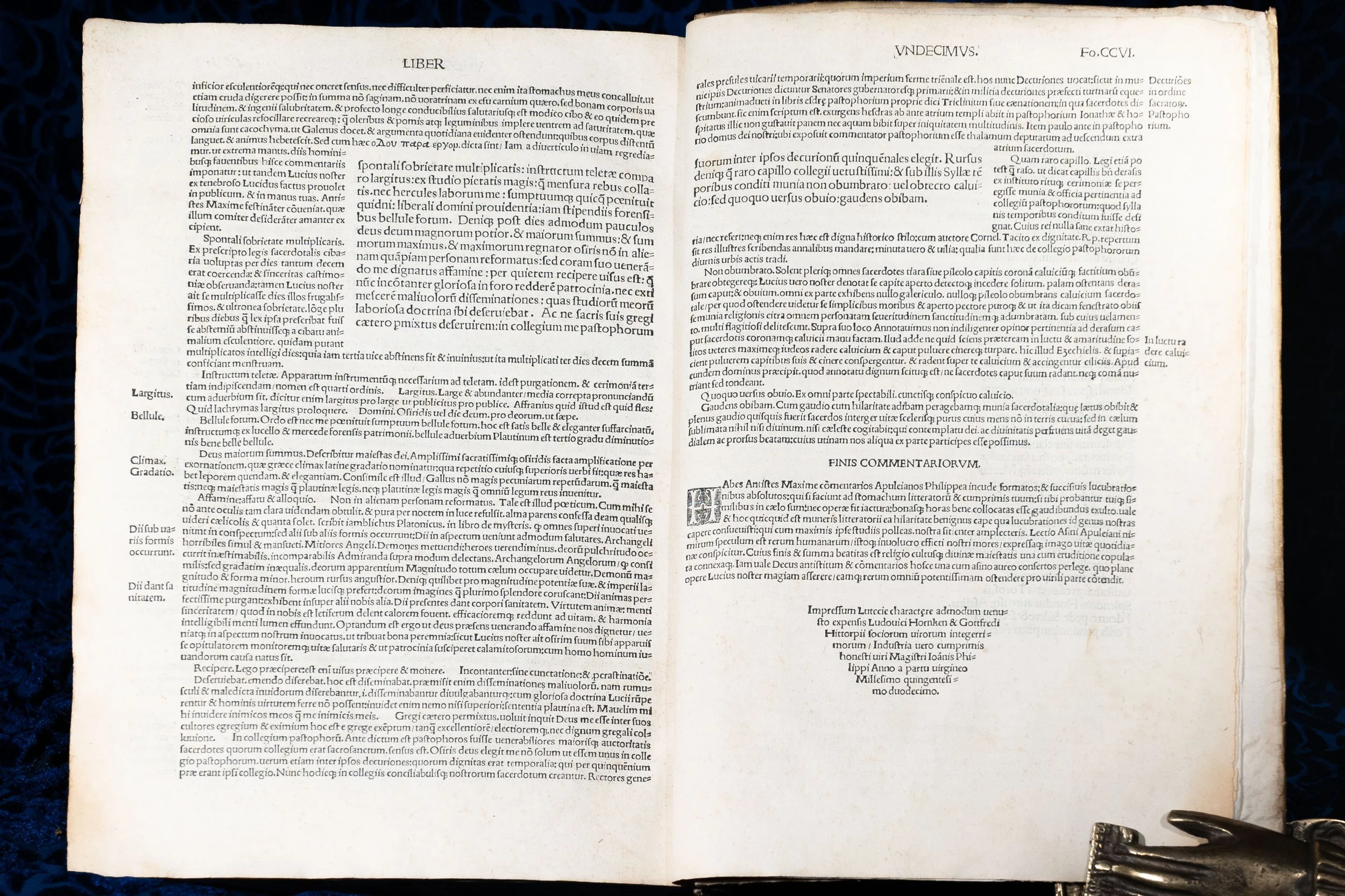 Image 3 of 9
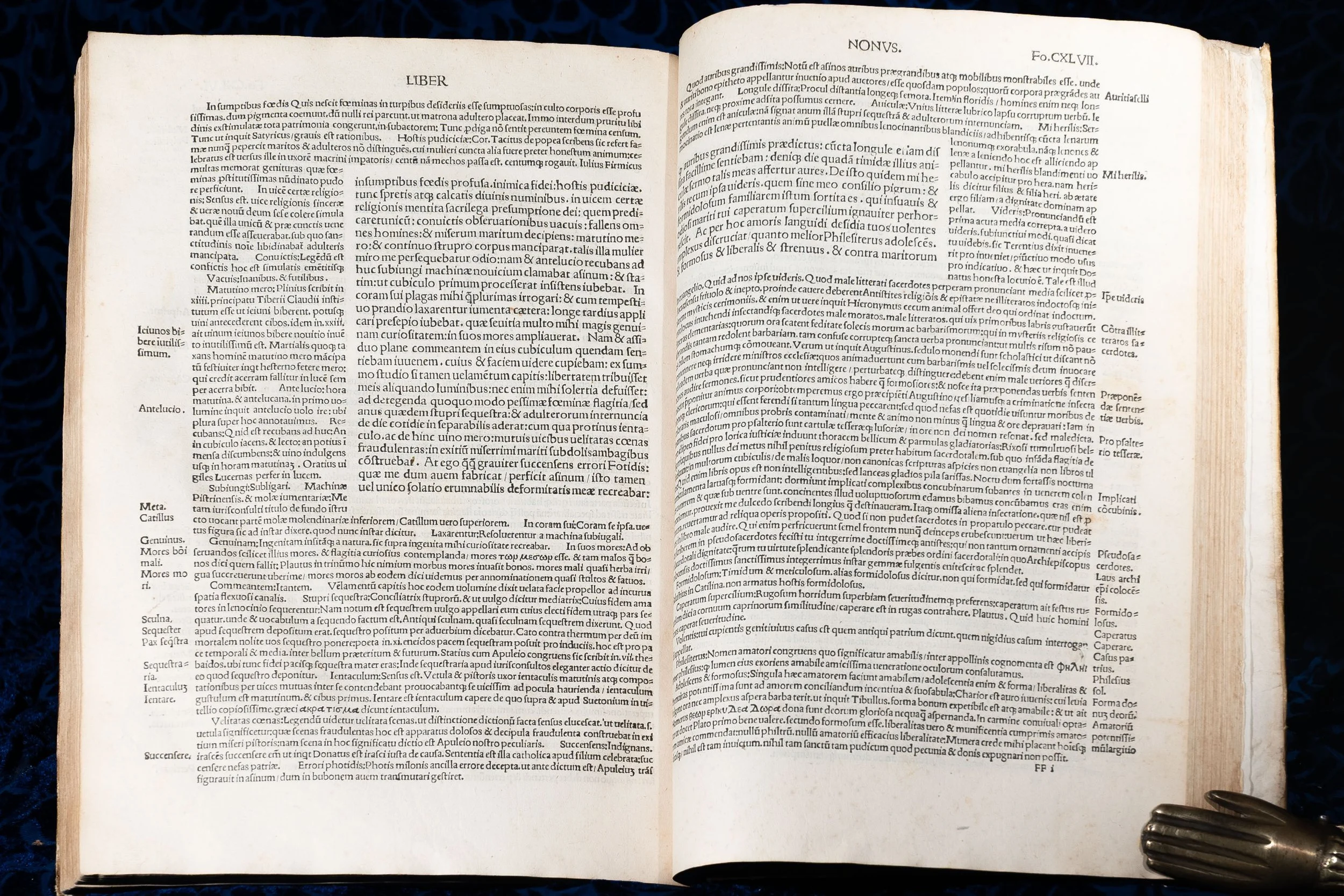 Image 4 of 9
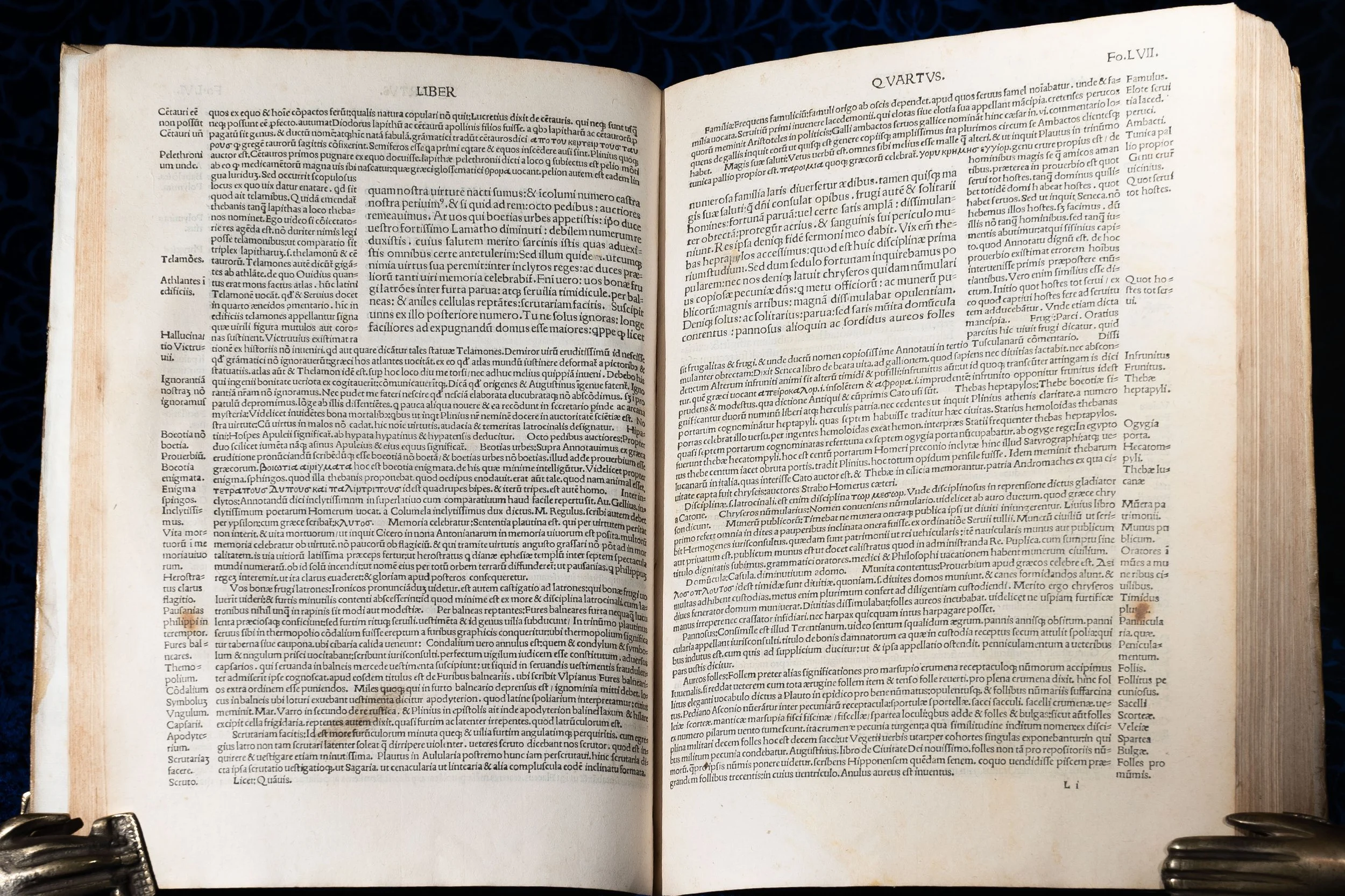 Image 5 of 9
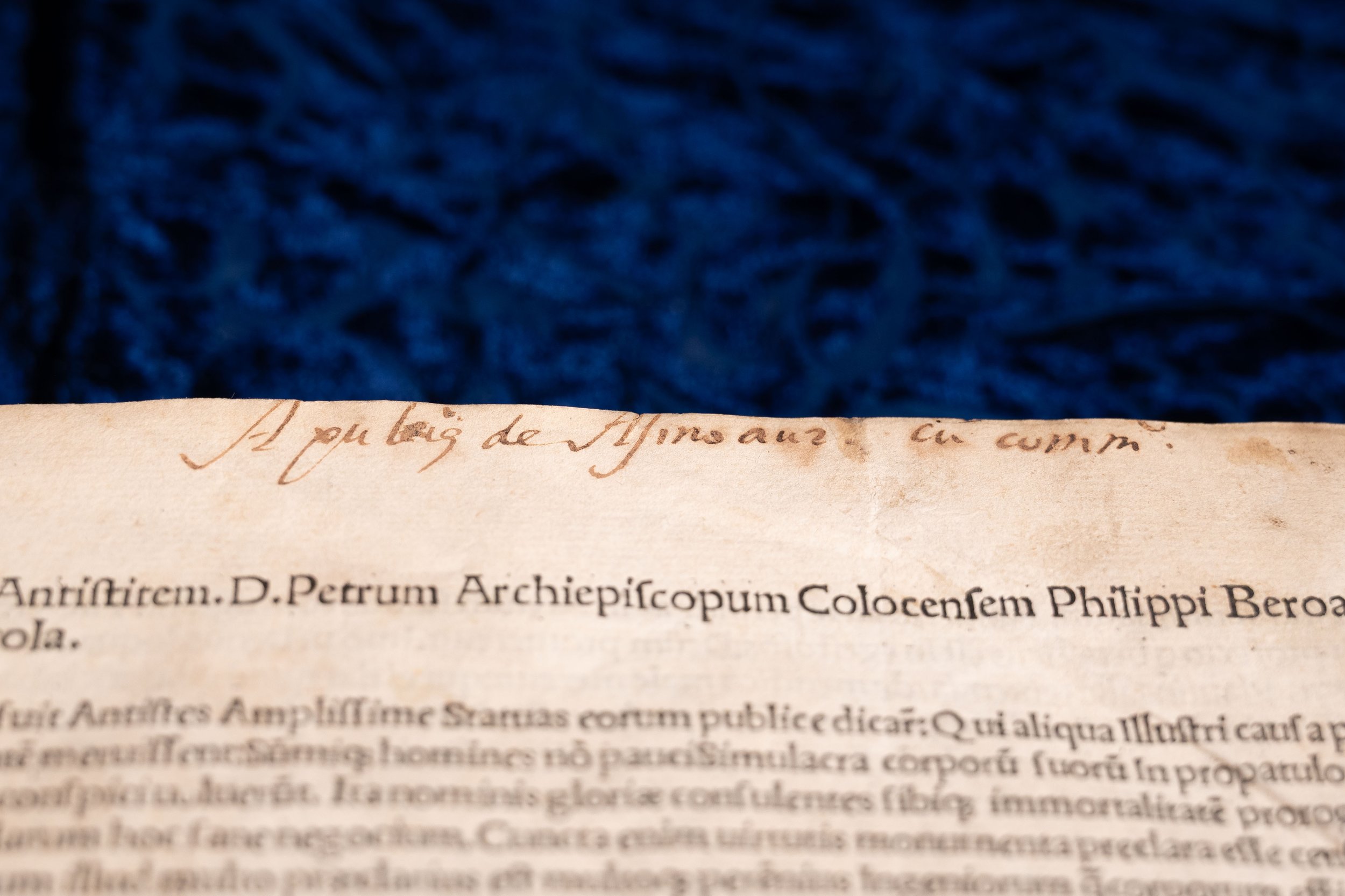 Image 6 of 9
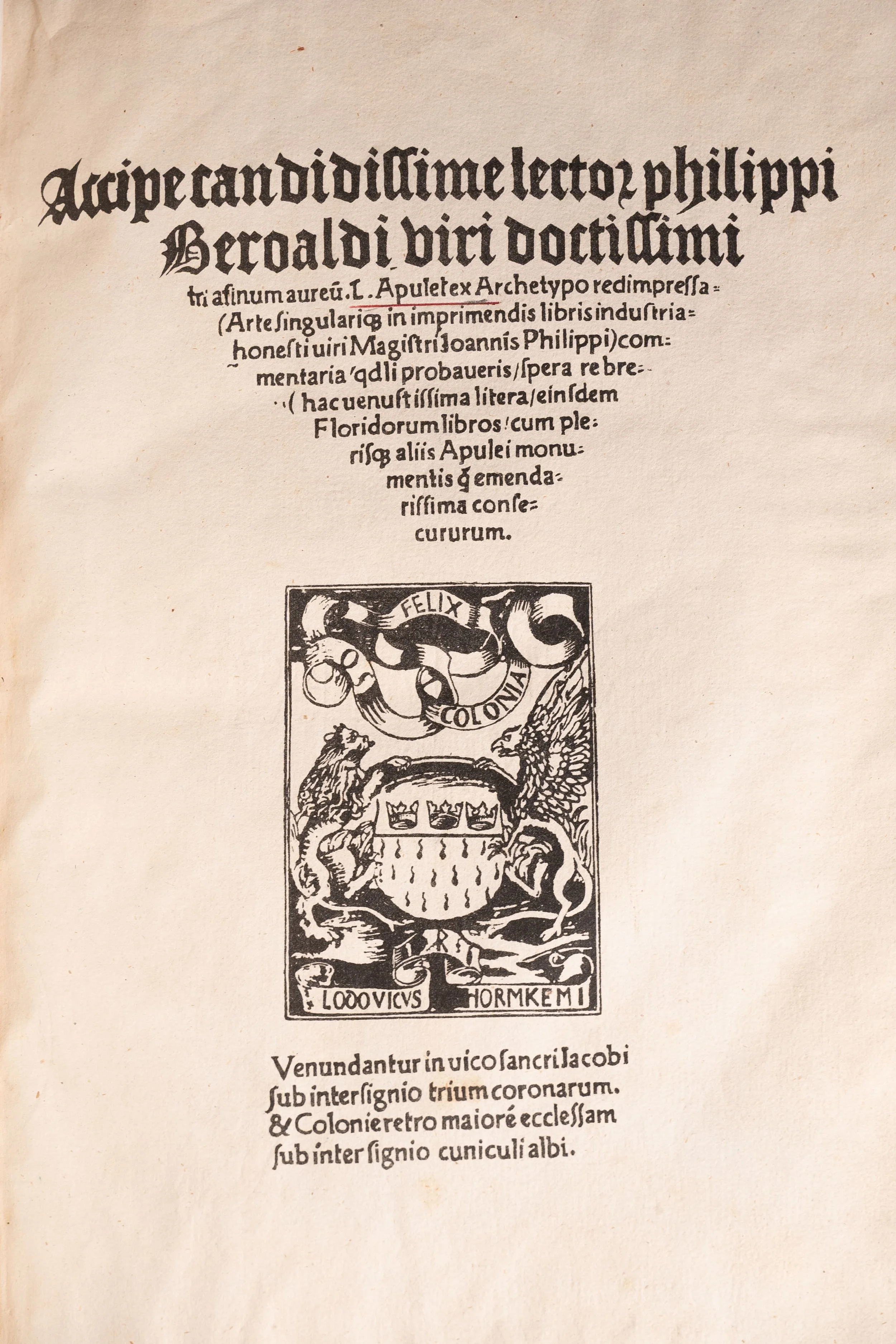 Image 7 of 9
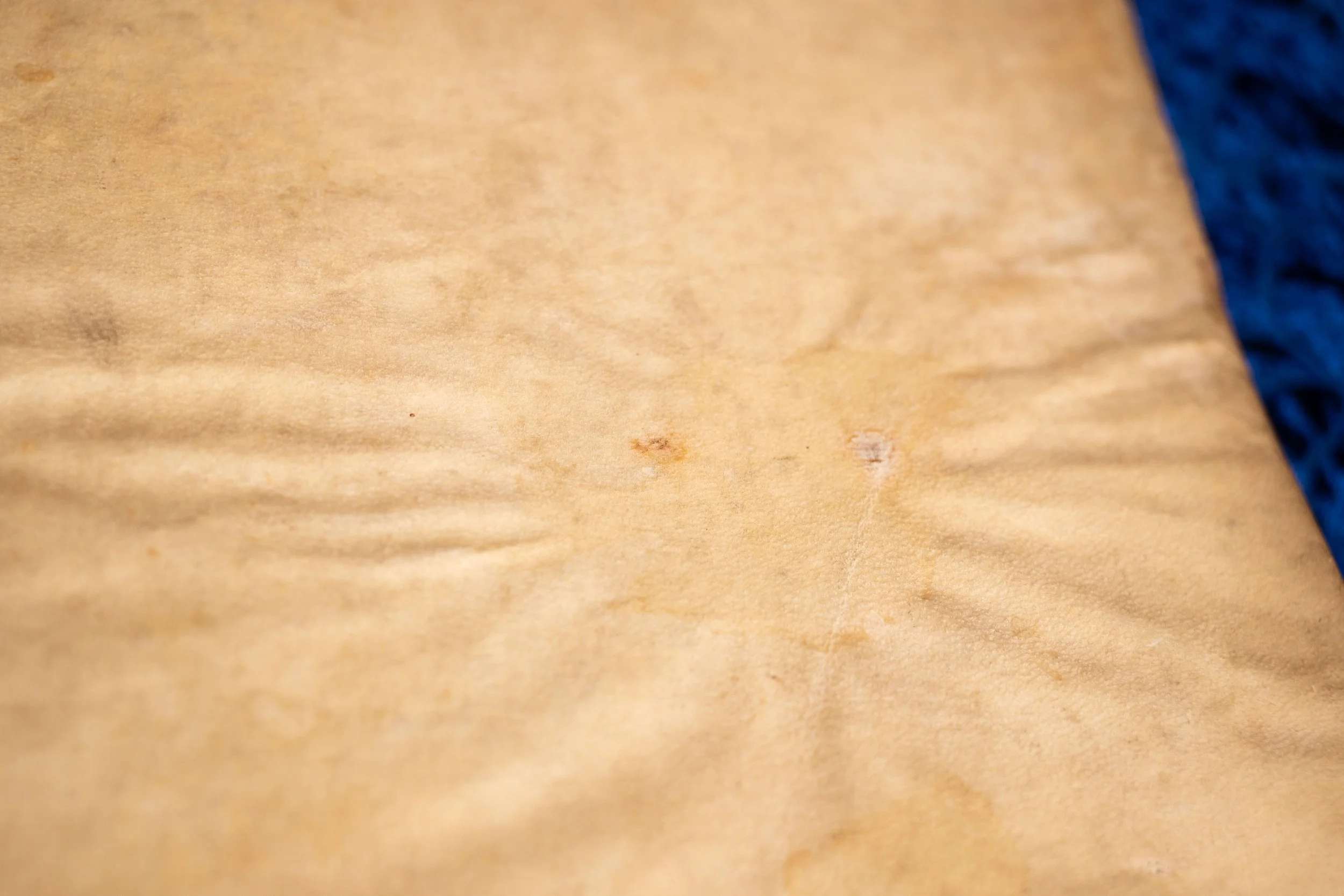 Image 8 of 9
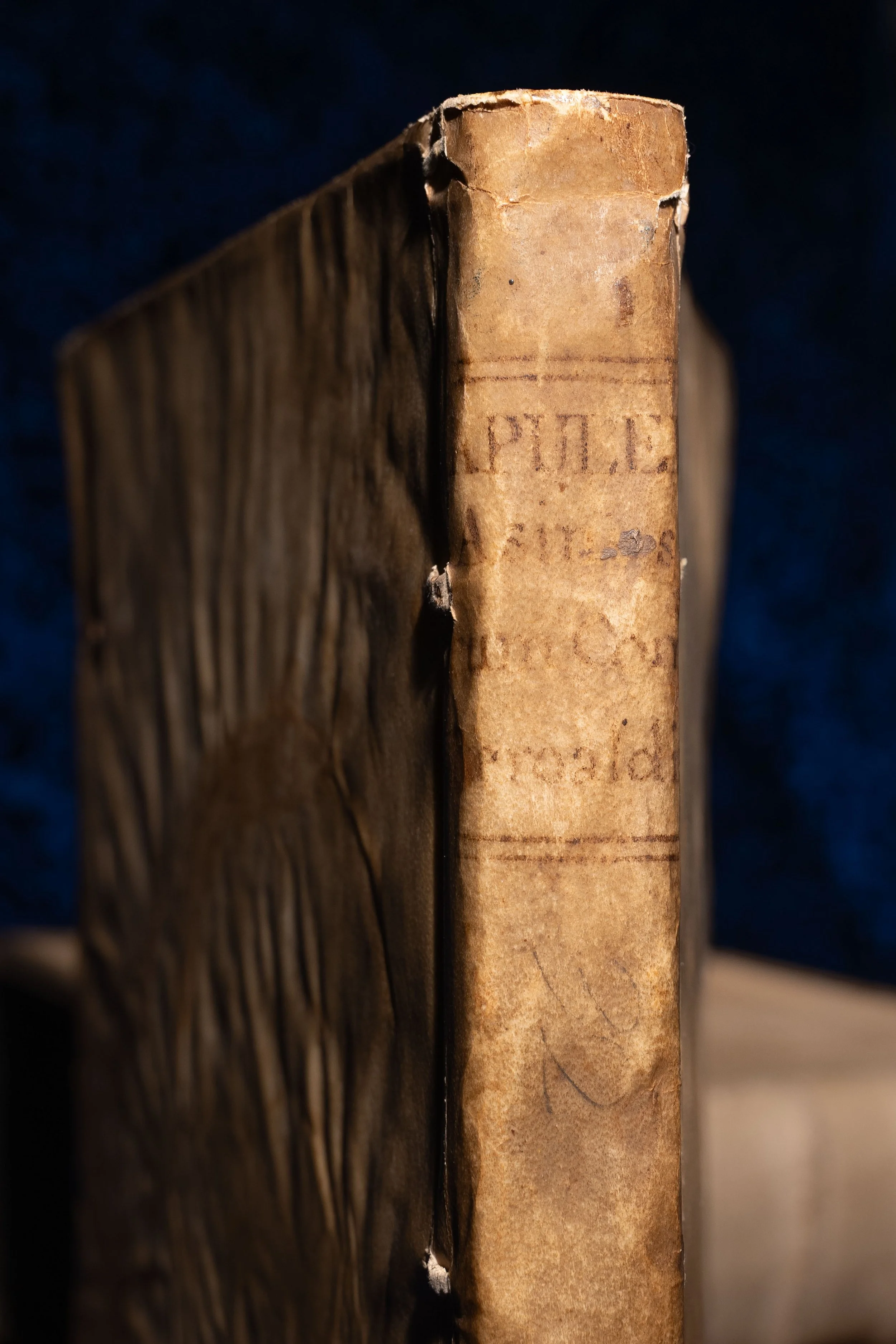 Image 9 of 9