
Sir Kenelm Digby (1603–1665) was an English courtier and natural philosopher who collected recipes, pursued alchemy and became a founding member of the Royal Society. His career also took in diplomacy and privateering. For Digby, investigating nature included finding out what medicines could do, and some of his claims were extraordinary even by the standards of his contemporaries.
His best-known remedy was the Powder of Sympathy, which was supposed to heal a wound without touching it. In one account, Digby treated a bloodied dressing from the injured hand of James Howell and claimed that Howell felt relief as the treatment continued. The proposed connection between the dressing and the distant wound was the “sympathy” of the name. These were disputed claims, not established cures. The Royal Society’s account of the controversy shows how seriously some early Fellows considered them.
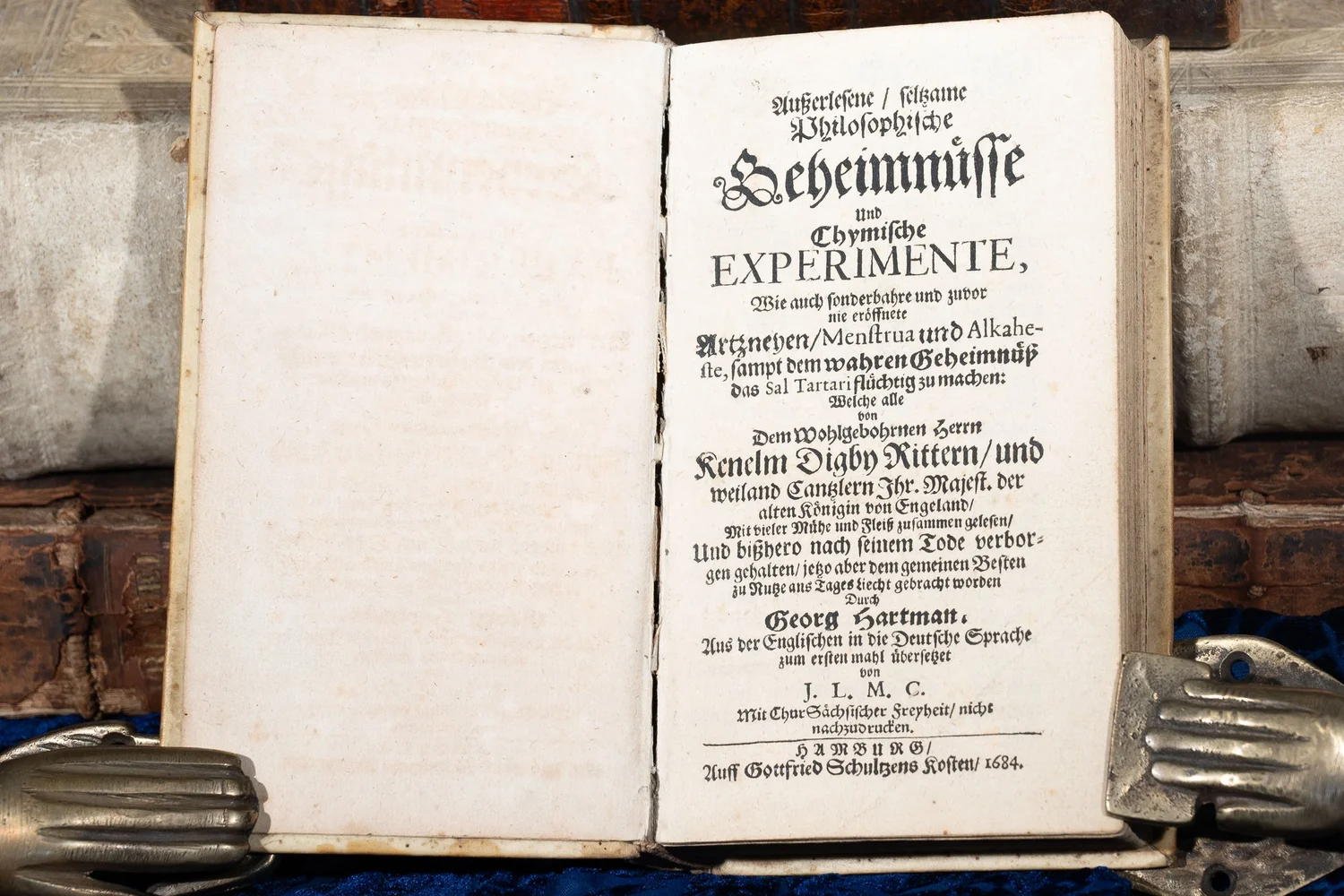
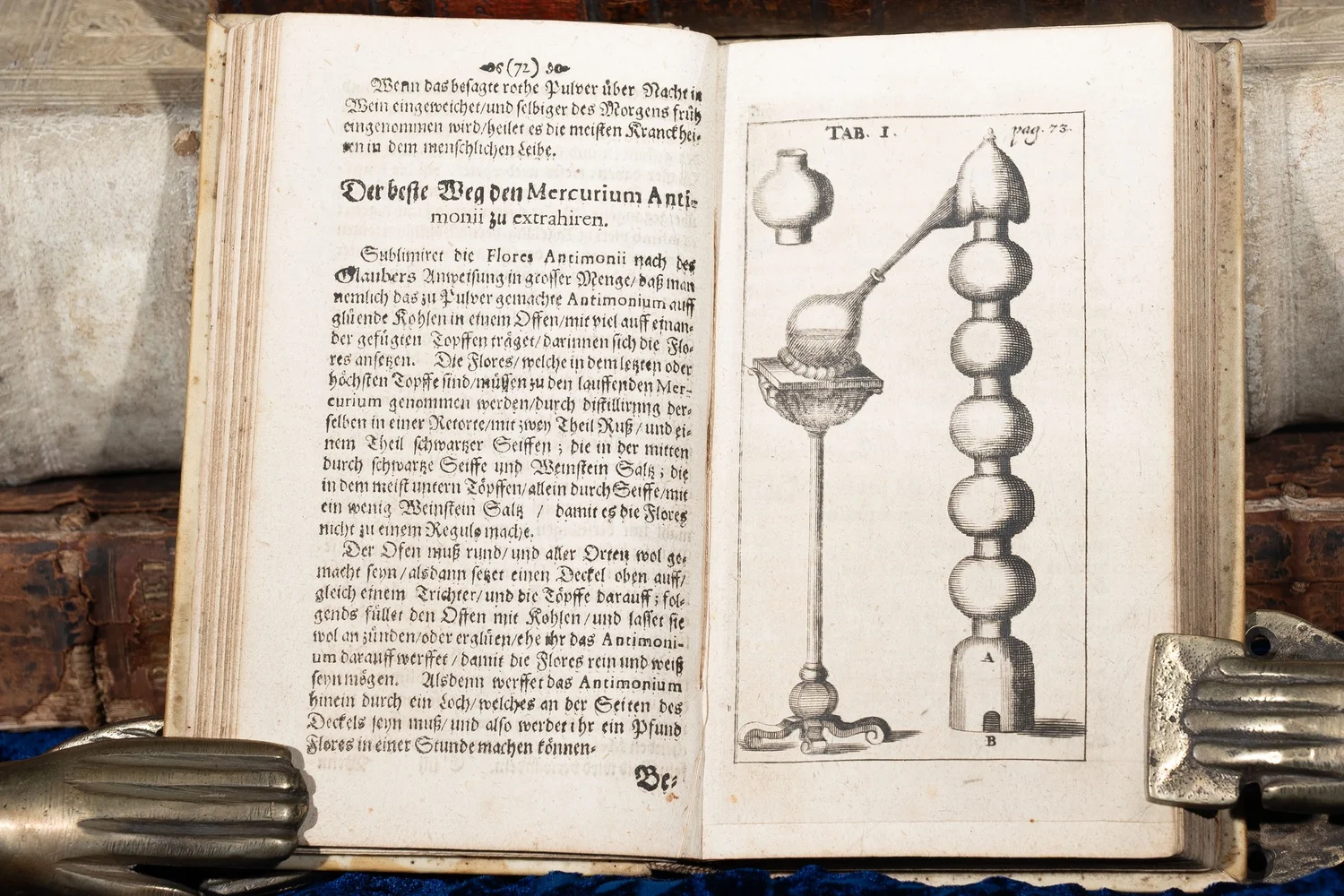
Our 1684 volume is the first German edition of Digby’s philosophical secrets and chymical experiments, published after his death by his assistant George Hartman. The Powder of Sympathy appears on page 255. Elsewhere, engraved apparatus accompanies the printed experiments: vessels, connecting tubes and equipment for working on substances. The book preserves the practical detail of a world in which alchemy and the search for medicines often occupied the same laboratory.
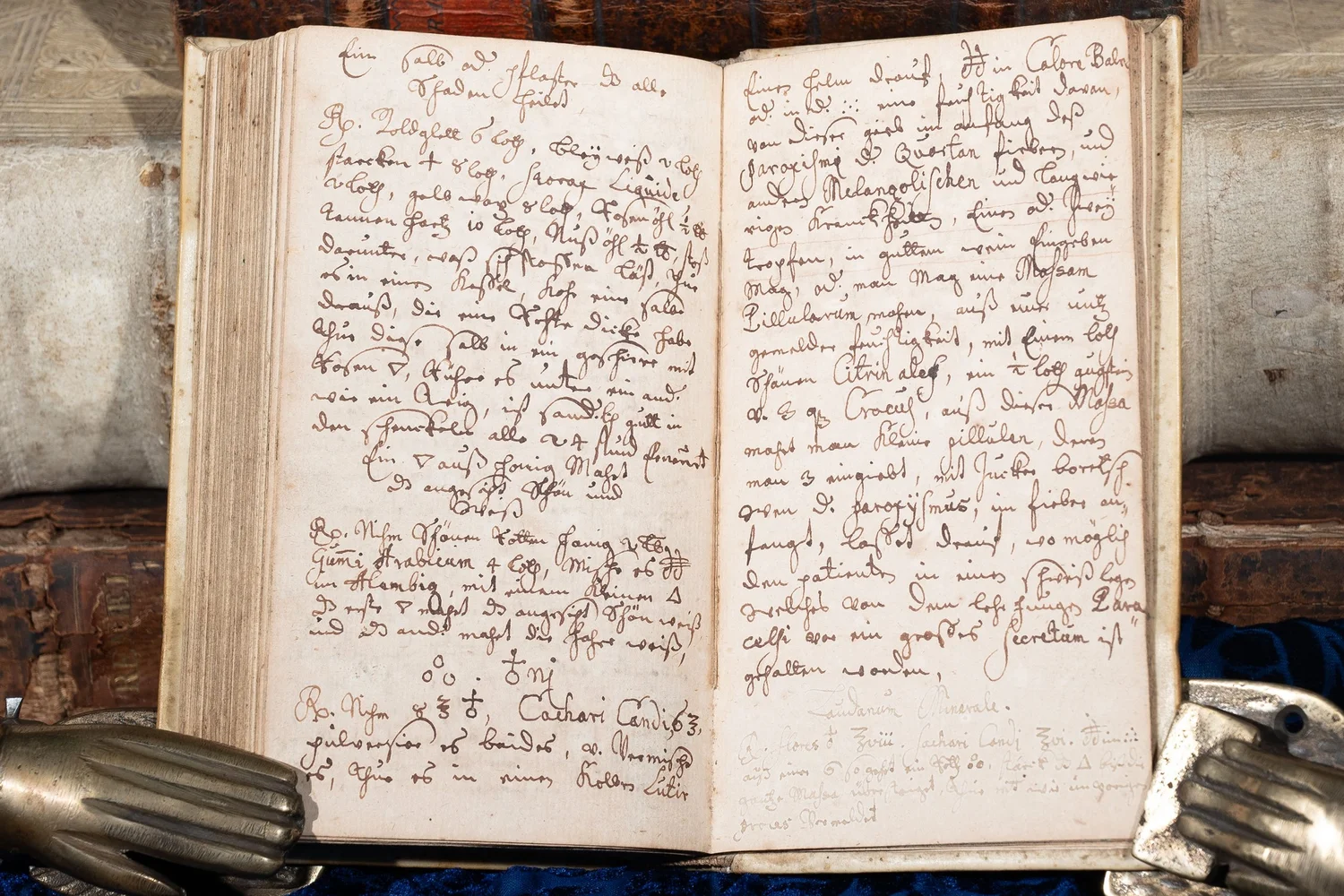
Turn past the printed text and the book continues in another hand. German cursive, Latin and alchemical symbols fill the leaves at the back. A green salve is attributed to the old Countess of Mansfeld; another entry ends by calling its recipe “a great secret.” Someone has brought a collection of their own to Digby’s published experiments.
The handwritten recipes suggest that this copy may have belonged to a practicing alchemist. The compiler remains unidentified, however, and we cannot tell whether the recipes were put to the test. Recording a promising remedy and making it are different things.
Later readers left other traces. A stamp records the library of the St. Mary Magdalene School in Breslau, now Wrocław, and Otto Fritz Böhme’s bookplate appears on the rear pastedown. Neither mark identifies the manuscript’s writer. A note on a front flyleaf, signed “H.J.” and dated 1903, converts old measures into metric quantities: “1 Unze = 30 Gram.” More than two centuries after publication, somebody was still working through the quantities.
View the 1684 Digby, with further photographs and full description.
Further reading
From a general introduction to specialist scholarship:
- Joe Moshenska, A Stain in the Blood: The Remarkable Voyage of Sir Kenelm Digby (William Heinemann, 2016; paperback, 2017). A biography for the general reader, centered on Digby’s Mediterranean voyage and the wider world in which he lived.
- Elizabeth Hedrick, “Romancing the salve: Sir Kenelm Digby and the powder of sympathy”, The British Journal for the History of Science 41, no. 2 (2008): 161–185. A focused scholarly study of the powder, Digby’s claims to priority and the ways his contemporaries challenged them.
- Laura Georgescu and Han Thomas Adriaenssen, eds., The Philosophy of Kenelm Digby (1603–1665) (Springer, 2022). A specialist collection on Digby’s natural philosophy, metaphysics and attempts to reconcile Aristotle with mechanical explanations of nature.
The journal article and edited volume may require library access or purchase for the full text.