
In 1509 a convert from Judaism named Johannes Pfefferkorn obtained the Holy Roman Emperor’s authority to confiscate the books of the Jews, and he meant to have them burned. The Hebrew scholar Johann Reuchlin was asked for his opinion and said the books should be left alone. The dispute lasted another decade, and Reuchlin himself was tried for heresy. This 1550 folio brings two books from that controversy together.
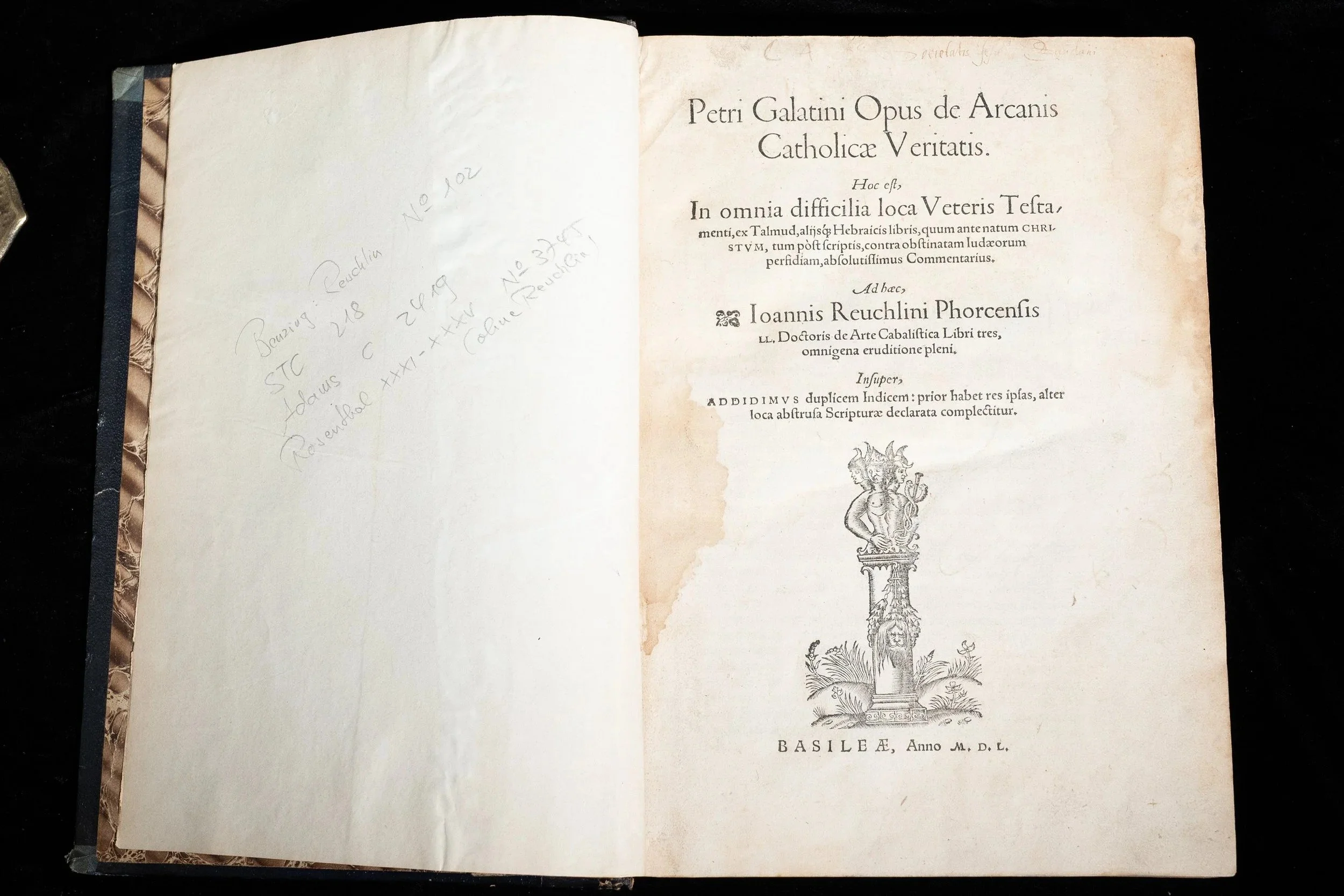
The Basel folio of 1550, with the printer’s three-headed herm on the title page.
Reuchlin (1455–1522) was a lawyer and the leading Christian scholar of Hebrew in Germany. In 1517, during the controversy, he published De arte cabalistica, On the Art of the Kabbalah, with a dedication to Pope Leo X. The book is a conversation set in Frankfurt among Simon the Jew, Philolaus the Pythagorean and Marranus the Muslim. In their conversation, the Kabbalah is presented as the oldest revelation, and as the source of Pythagoras’s teaching. Reuchlin discussed divine names and seventy-two angels, along with ways of interpreting Hebrew words through their numbers, initials and rearranged letters. Agrippa drew on it in the Third Book of Occult Philosophy.
The other book is by Pietro Galatino, a Franciscan scholar of Hebrew from Apulia. Galatino framed his defense as a conversation among three living men: himself, Reuchlin and the Cologne inquisitor Jacob Hoogstraten. He argued that the deepest truths of Christianity, the Trinity included, lie hidden in Jewish learning. Galatino wanted Jewish books preserved because he thought they contained Christian truths that their Jewish readers had misunderstood. His book was first printed in 1518 by Gershom Soncino, the greatest Hebrew printer of the age.
Both men wanted Jewish books preserved and read for Christian purposes. Reuchlin argued that Jews had a legal right to their books, and the order to destroy them was withdrawn.
The two texts were printed together in this Basel edition of 1550. It came from the shop of Johannes Herwagen, whose device, a three-headed herm on a column, stands on the title page and again at the end. Our copy carries the stamps of the Dominican convent of Saint-Romain in Toulouse.
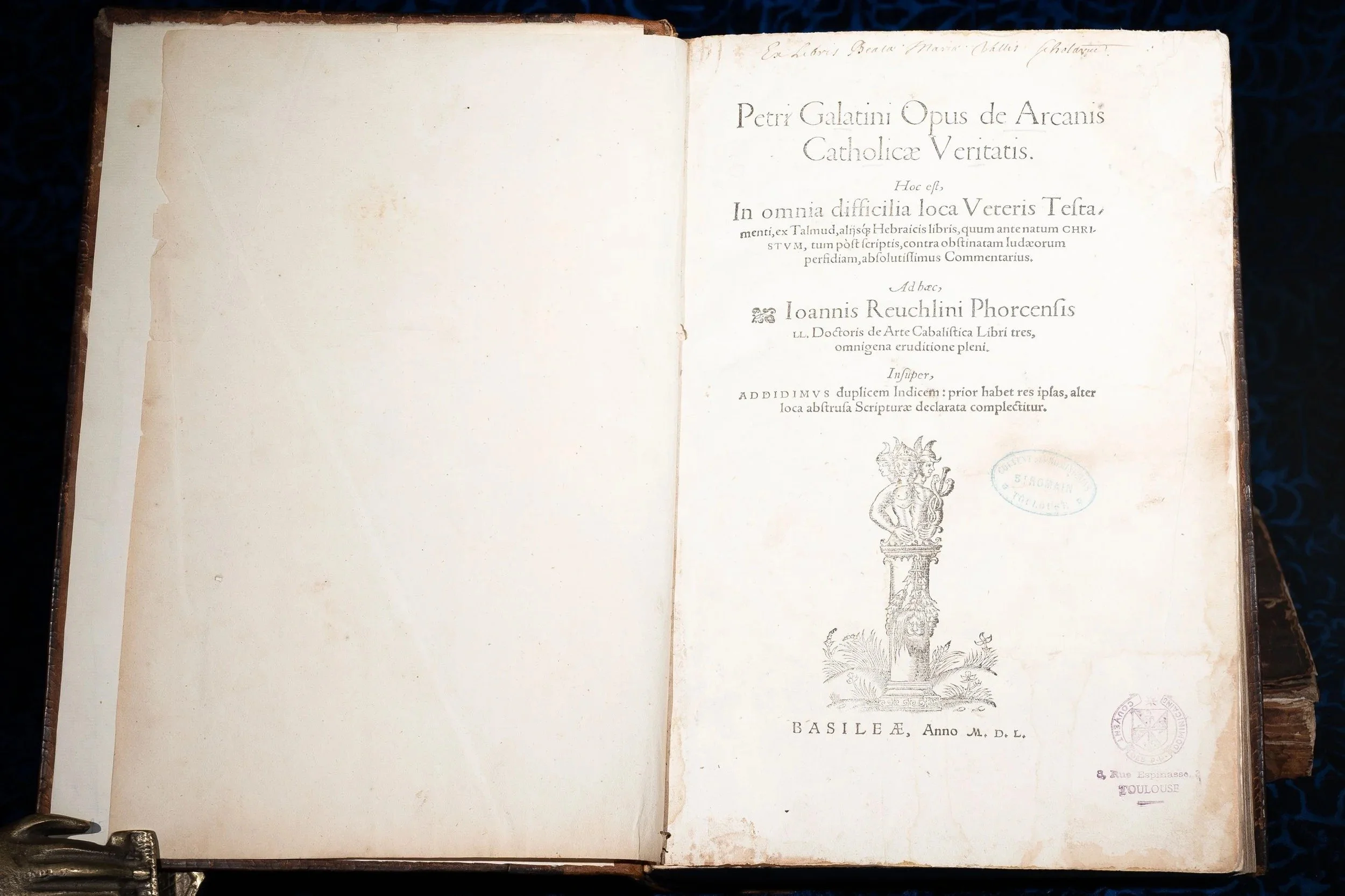
Stamps of the Dominican convent of Saint-Romain, Toulouse, on the title page.
View the copy with the Toulouse Dominican stamps.
Critical Apparatus
Read (free): Hebrew Union College Libraries, “Censorship and Dissent in Early Modern Christendom: Johannes Reuchlin’s Defense of Jewish Scholarship and the Rise of Humanism” (2021). A clear short account of the confiscations, Reuchlin’s opinion for the emperor and the pamphlet war that followed.
Go deeper: David H. Price, Johannes Reuchlin and the Campaign to Destroy Jewish Books (Oxford University Press, 2011). The standard scholarly history of the controversy.
Go deeper: Johann Reuchlin, On the Art of the Kabbalah (De arte cabalistica), translated by Martin and Sarah Goodman, with introductions by G. Lloyd Jones and Moshe Idel (University of Nebraska Press, 1993). The text itself, Latin and English on facing pages.