
There is something genuinely metal about a page headed “Mass for the Dead.” The words being sung, though, ask for rest and light. On the leaf pictured below, a large red R begins “Requiem aeternam dona eis, Domine: et lux perpetua luceat eis.” Grant them eternal rest, Lord, and let perpetual light shine upon them.
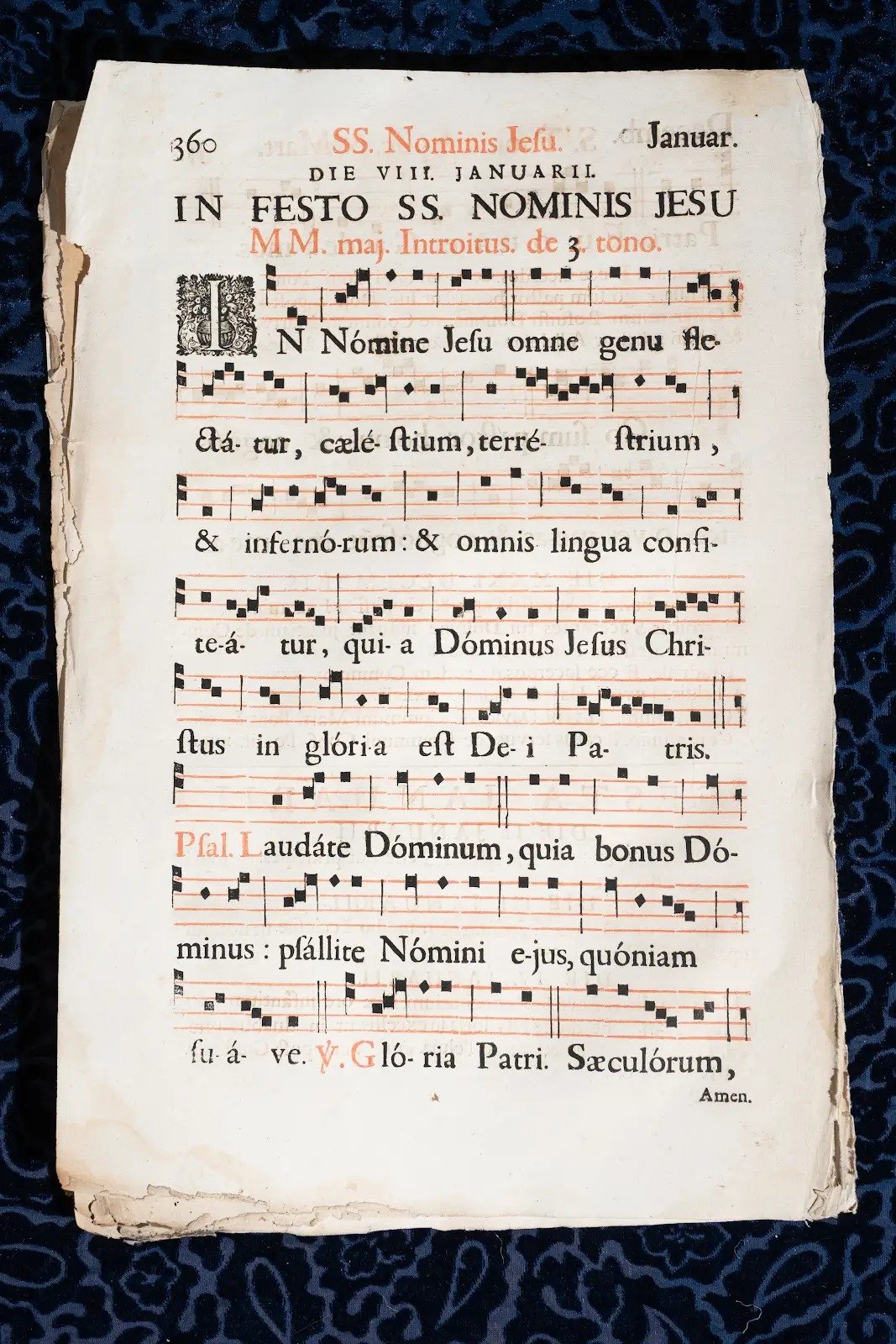
These printed leaves came from a Cistercian gradual, a book containing the chants of the Mass. Their size had a practical purpose: several singers could gather around one book. The Holy Name of Jesus page above shows the same working arrangement, with a foliate initial I, four red staff lines, and black square notes held apart from the words.
On the Mass for the Dead leaf, look just left of that red R. “Graduale” identifies the chant written out here. The introit is mentioned in a separate instruction above it; this is the gradual. Follow the notes over “aeternam” and “luceat.” Several gather over a single syllable. The singer has to remain there. A few words asking for eternal rest become seriously demanding on the lungs.
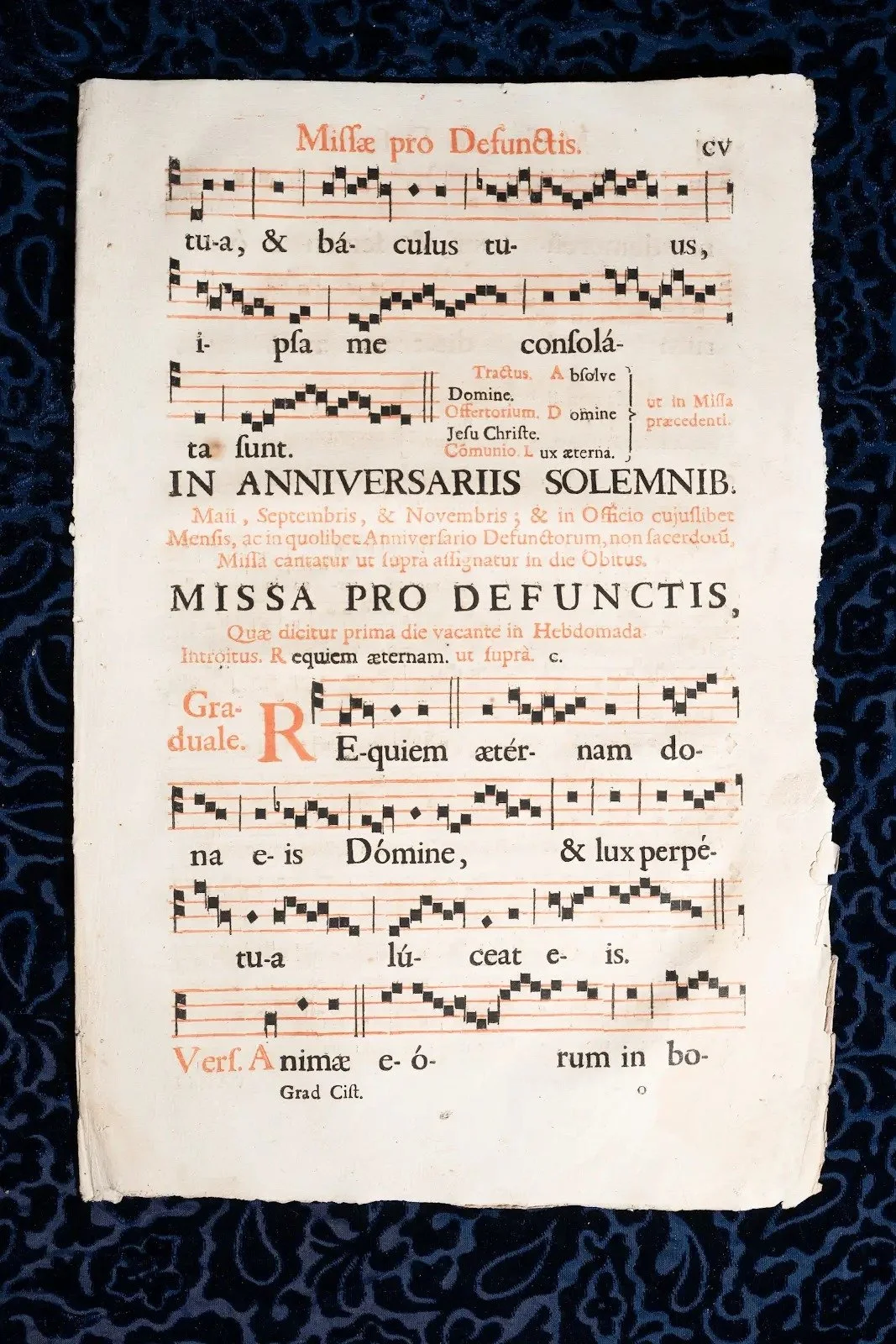
The little “Grad. Cist.” at the foot identifies the kind of book. Our present attribution is to the Graduale Cisterciense printed in Paris by Frédéric Léonard in 1696, but it remains provisional: these leaves have not been compared with a complete copy. We do not know which monastery used this one.
The paper has worn edges, tears, and old damp stains. Its source volume was dispersed after water damage. This is a printed page, not a medieval manuscript, but it preserves something wonderfully physical about communal singing: large words, visible notes, and room for the living to sing for the dead.
Further reading
Getty, “Songs of Praise: Illuminated Choir Books.” A free illustrated introduction to choirbooks, their scale, notation, and use.
David Hiley, Gregorian Chant (Cambridge University Press, 2009). An accessible introduction.
David Hiley, Western Plainchant: A Handbook (Clarendon Press, 1993). The fuller scholarly reference.