Nicholas Culpeper's herbal is the most famous book of plant medicine in the English language, and this is its most occult incarnation. In 1790 Ebenezer Sibly, astrologer, Freemason, Mesmerist, and the man who cast the horoscope of the United States of America, reissued the seventeenth-century classic "with a display of their Medicinal and Occult Properties," the first edition of Culpeper ever illustrated. The title page announces him as "Fellow of the Harmonic Philosophical Society at Paris," Mesmer's school, and author of the Complete Illustration of Astrology; the frontispiece sets Culpeper's portrait inside a ring of zodiacal calculations recording the great man's own nativity, above an emblematic scene of a radiant magus with a shield turning back a dragon. Culpeper's plant-by-plant astrology is all here, every herb assigned its planetary governor, Venus's herbs for Venus's diseases, with Sibly's notes running underneath. It is the book through which astrological herbalism passed into the nineteenth century and the occult revival.
What makes this copy special is that somebody used it exactly as Culpeper and Sibly intended. An early owner, evidently a practicing herbalist with a small professional library, has worked through the entire herbal section pen in hand: every plant entry up to page 311 is labeled in the margin with its botanical or common name, Melissa beside Bawm, Solanum beside Amara-dulcis, Artemisia beside Mugwort, and many entries carry several sentences of notes on virtues and preparations. Beside Borage and Bugloss the annotator distills the plant's reputation into a working summary, the flowers "a fine cordial," good to "comfort the heart," cheer melancholy, revive the spirits, and purify the blood, and then cites the source: "Salmon's Family Dict., 1705," William Salmon's famous household dictionary of physic. This is the reading practice of someone who compounded remedies and cross-referenced authorities, a Georgian herbalist's working tool, and such densely annotated copies of Culpeper are far harder to find than clean ones.
The book is a double monument. The first part is the herbal itself, 396 pages, complete, with the full suite of engraved plates figuring upwards of 450 plants, all in cheerful period hand-color, basil and barley, mandrake and mushroom, the bay tree and the deadly nightshades, arranged in tidy grids like a paper physic-garden. The second part is Sibly's "Family Dispensatory," a complete system of home physic with its anatomical plates strikingly printed in sanguine red ink, among them the suite of the human heart and the affecting "Position of a Child in the Womb just before Delivery." The dispensatory preserves its period recipes in full cry: plague and fever water, eye-water, anodyne balsam, the bolus of jalap with mercury.
The volume has been professionally restored in a modern red binding with marbled endpapers, the once-detached preliminaries securely reattached, and it now opens and handles well. The herbal section is complete in text and plates. The medical section is not: it lacks sixteen pages (229 to 244, the midwifery chapter) and five of its thirteen anatomical plates, though eight are present including the finest of the sanguine suite. There is toning and finger-soiling throughout, the honest grime of a book that earned its keep. An erased early ownership signature sits on the front flyleaf, only partly recoverable. Priced accordingly: as a complete fine copy this book commands several times this figure, but as an annotated working herbalist's copy with the colored botanical plates complete, it offers the collector of occult herbalism the most interesting kind of imperfection.
CULPEPER, Nicholas (1616-1654); SIBLY, Ebenezer (1751-c.1799), editor. Culpeper's English Physician; and Complete Herbal. To which are now first added, Upwards of One Hundred additional Herbs, with a Display of their Medicinal and Occult Properties, Physically applied to The Cure of all Disorders incident to Mankind... Forming a Complete Family Dispensatory, and Natural System of Physic... By E. Sibly, M.D., Fellow of the Harmonic Philosophical Society at Paris. London: Printed for the Author, and Sold at the British Directory Office, Ave-Maria-Lane; and by Champante and Whitrow, Jewry-Street, Aldgate, [c. 1790]. The first illustrated edition of Culpeper, early issue.
Physical Description: 4to (approx. 10 x 8.5 in.). Two parts in one volume: herbal, 396 pp.; medical part ("Culpeper's Dispensatory, for Family Use"), 256 pp. Engraved frontispiece portrait of Culpeper within an astrological border; engraved botanical plates figuring upwards of 450 plants, in period hand-color, complete for the herbal section; 8 (of 13) anatomical plates in the medical section, printed in sanguine. "Directions to the Binder" leaf present at end. Lacking pp. 229-244 of the medical part (the midwifery chapter) and five medical plates (Celestial Influx on Woman; Muscles, Plate I; The Human Skeleton; Process of Delivery; Position of the Embryos in a plural Conception).
Binding: Modern red cloth, recently and sympathetically restored, the preliminaries reattached; marbled endpapers. A sound, handleable copy.
Condition: Herbal section complete in text and plates. Toning and finger-soiling throughout; occasional creased or torn corners; plates clean with strong color. Defects in the medical part as itemized above.
Provenance: (1) Early erased ownership signature on the front flyleaf, only partly legible. (2) Extensive early annotations in the herbal section: every entry to p. 311 labeled with botanical or common plant names, many with notes on virtues citing Salmon's Family Dictionary (1705), the working apparatus of a practicing herbalist.

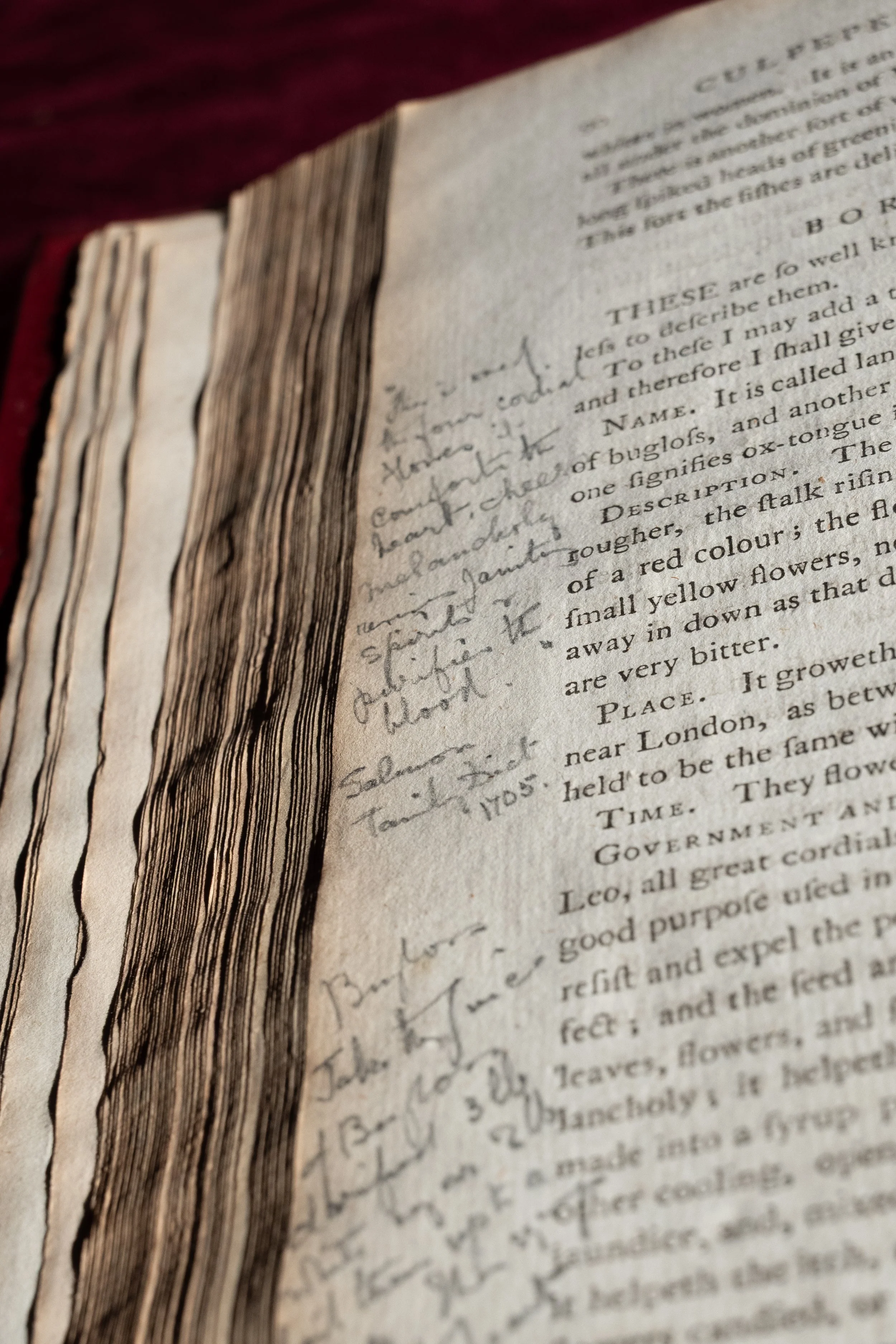 Image 1 of 10
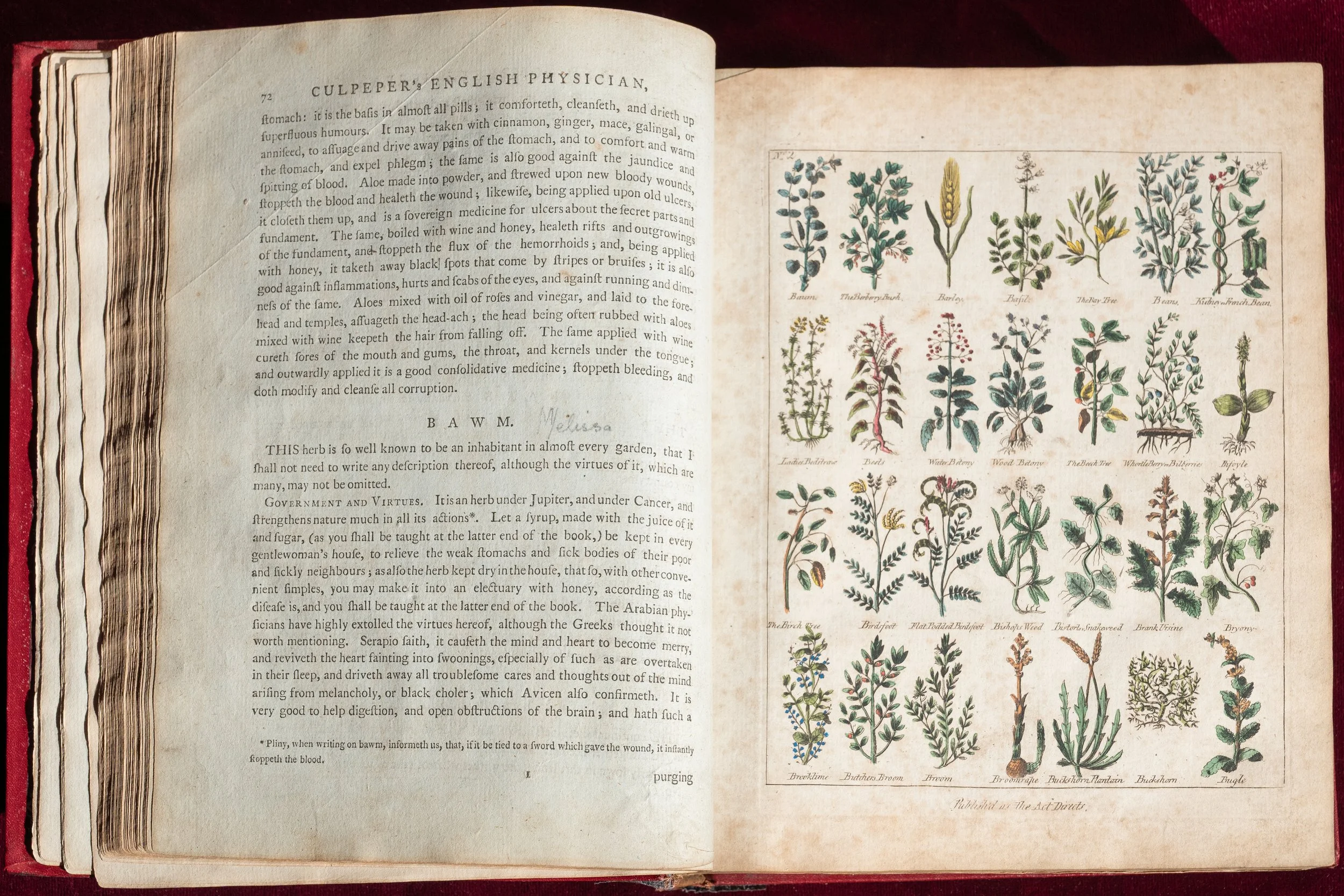 Image 2 of 10
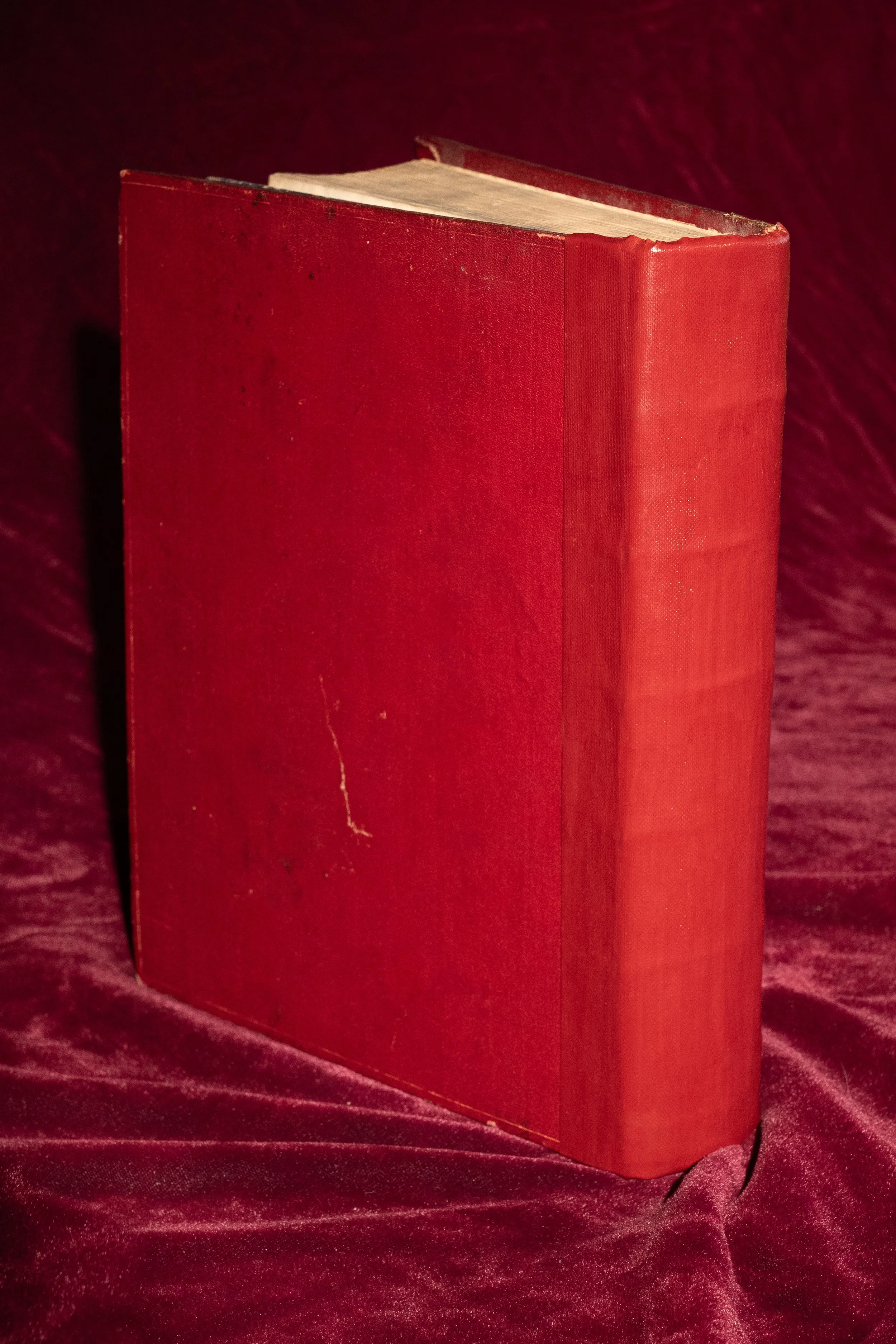 Image 3 of 10
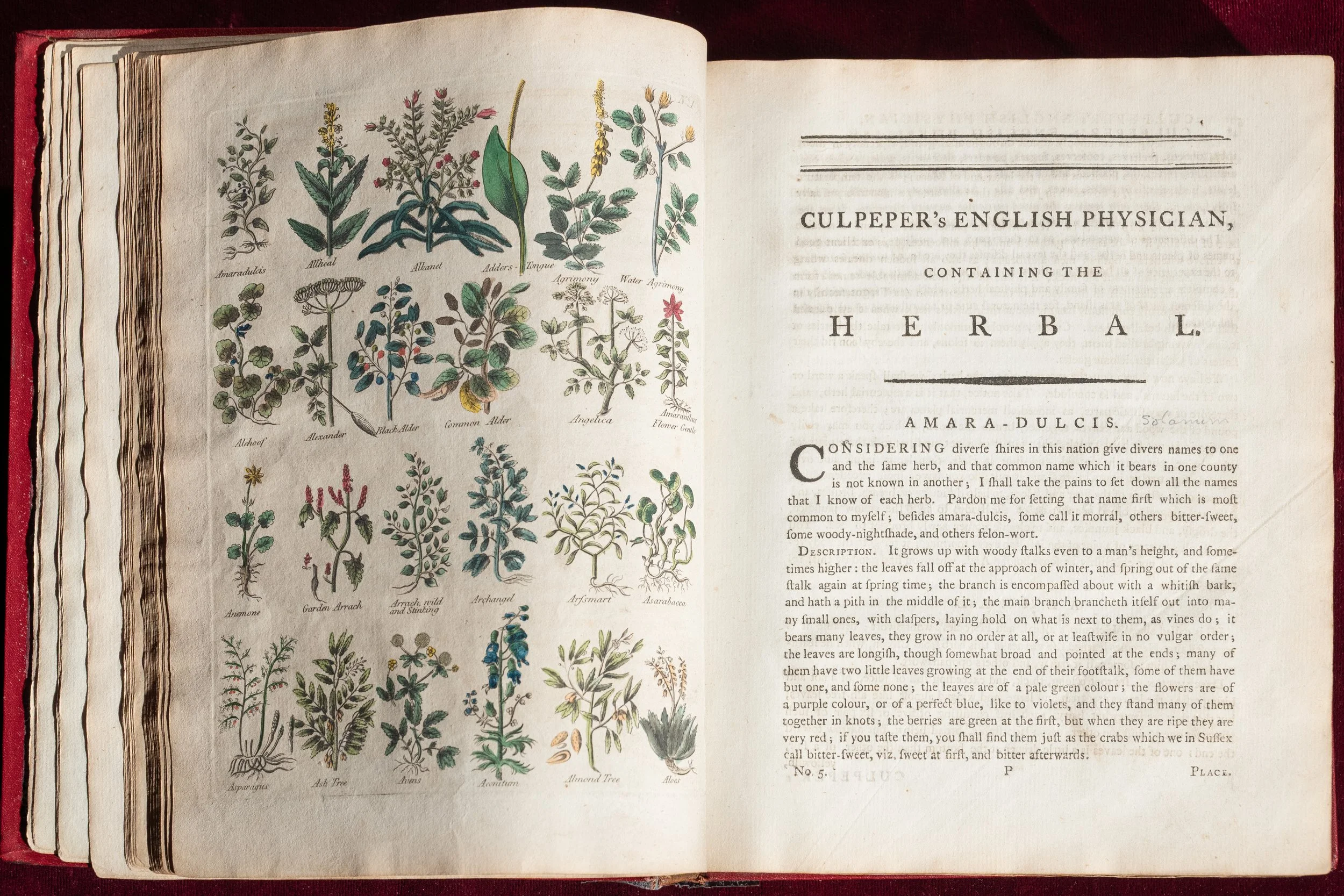 Image 4 of 10
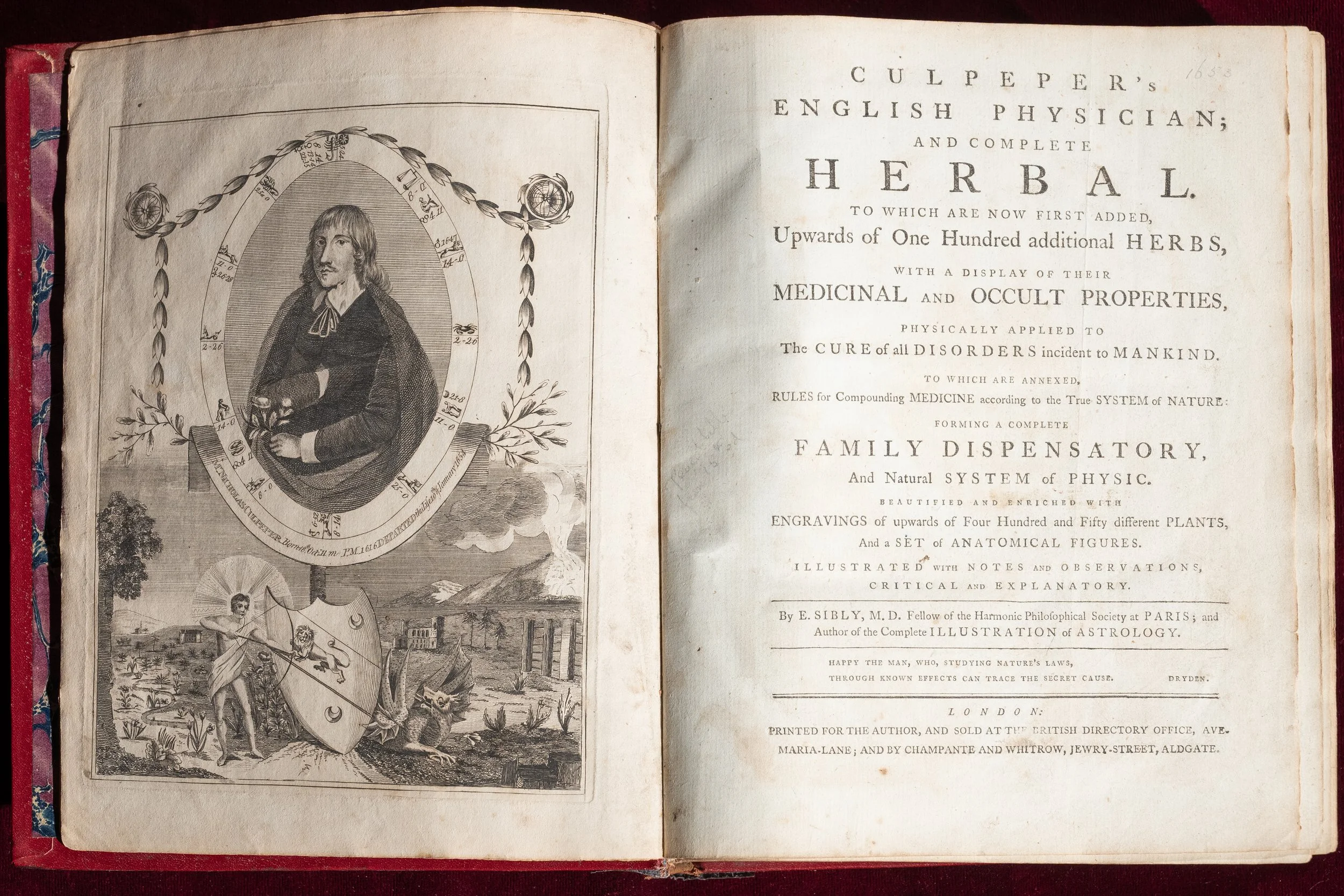 Image 5 of 10
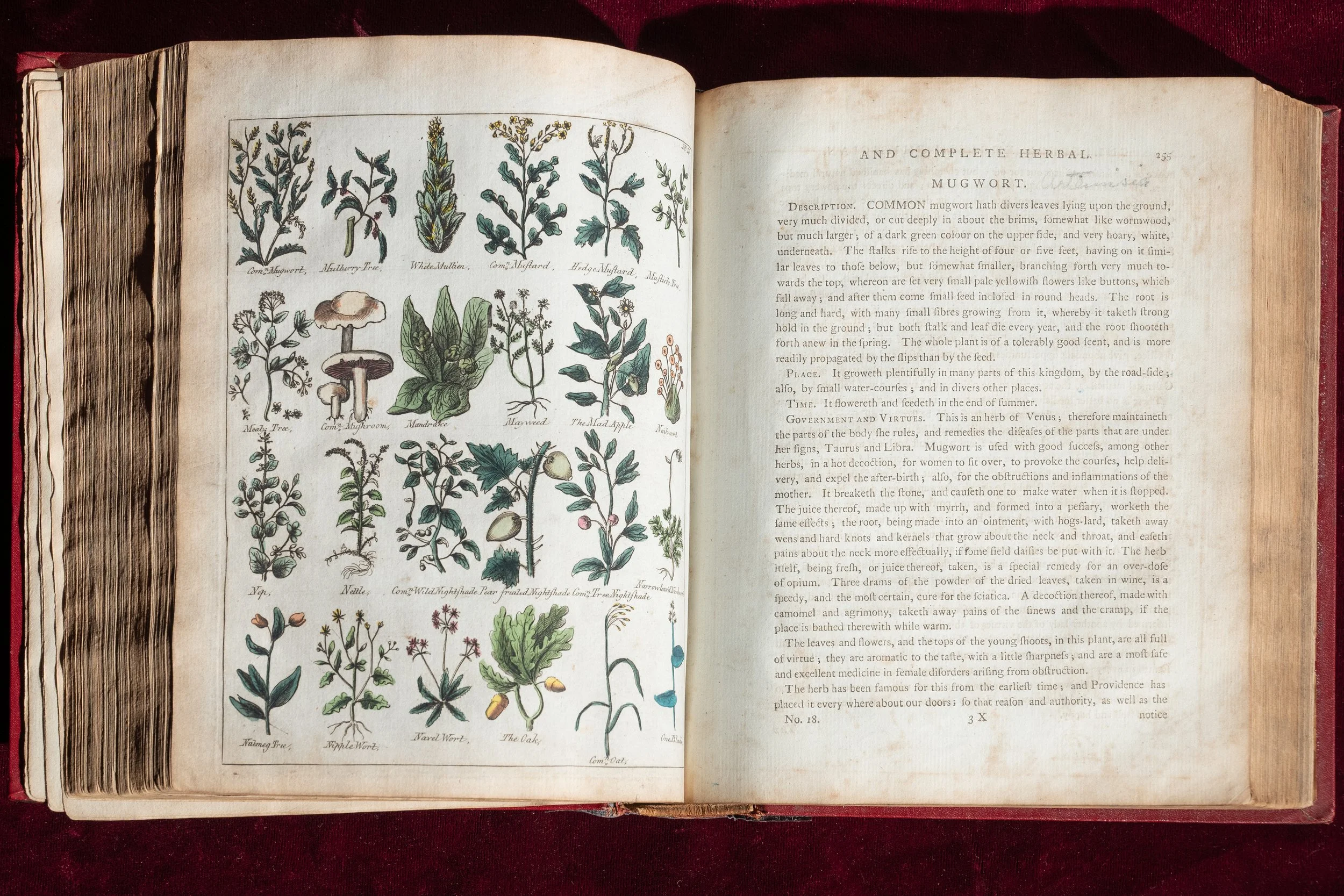 Image 6 of 10
 Image 7 of 10
 Image 8 of 10
 Image 9 of 10
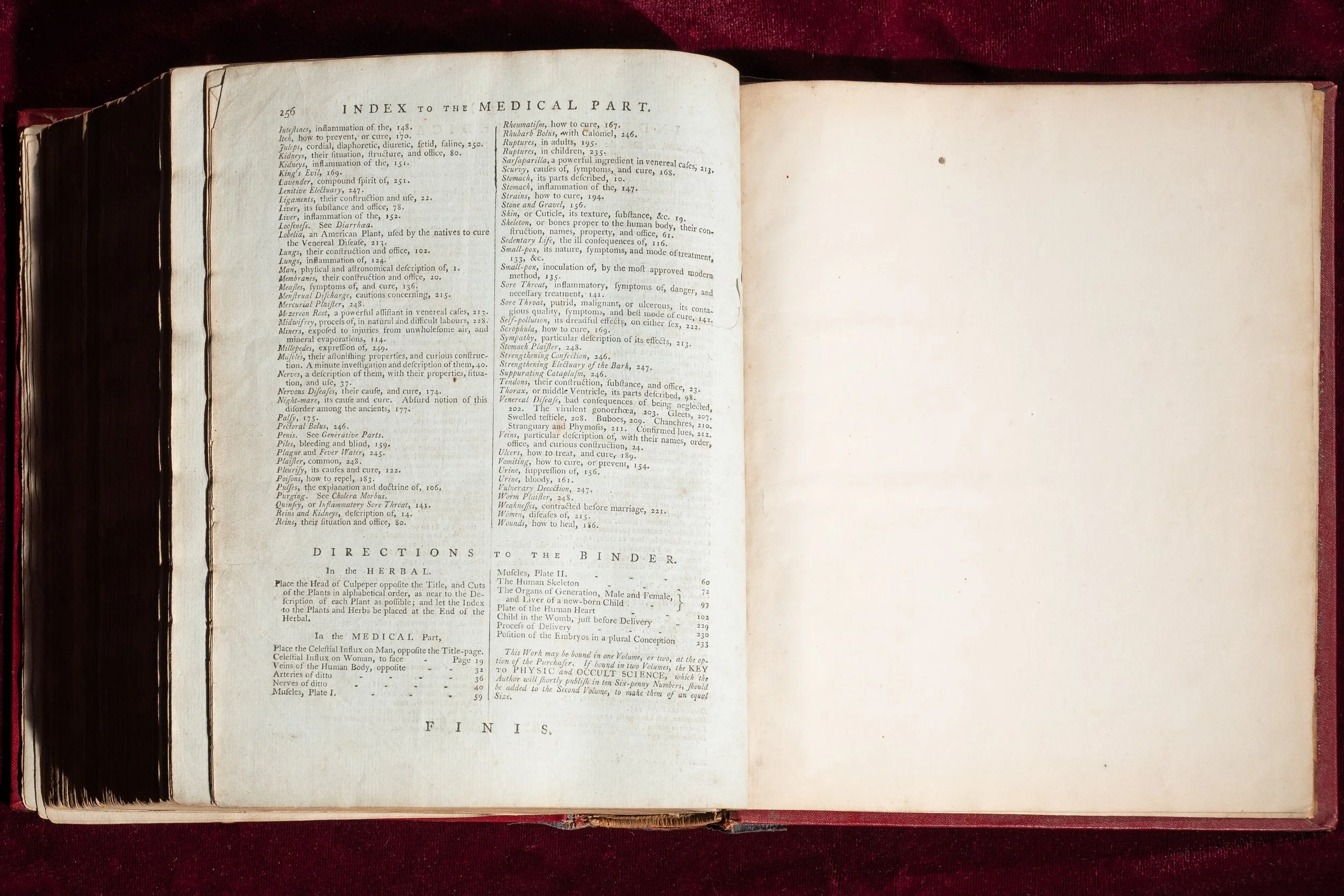 Image 10 of 10