
Culpeper’s English Family Physician · London, 1792
An engraved plant plate and its accompanying text preserve two ways of looking at the same herb.
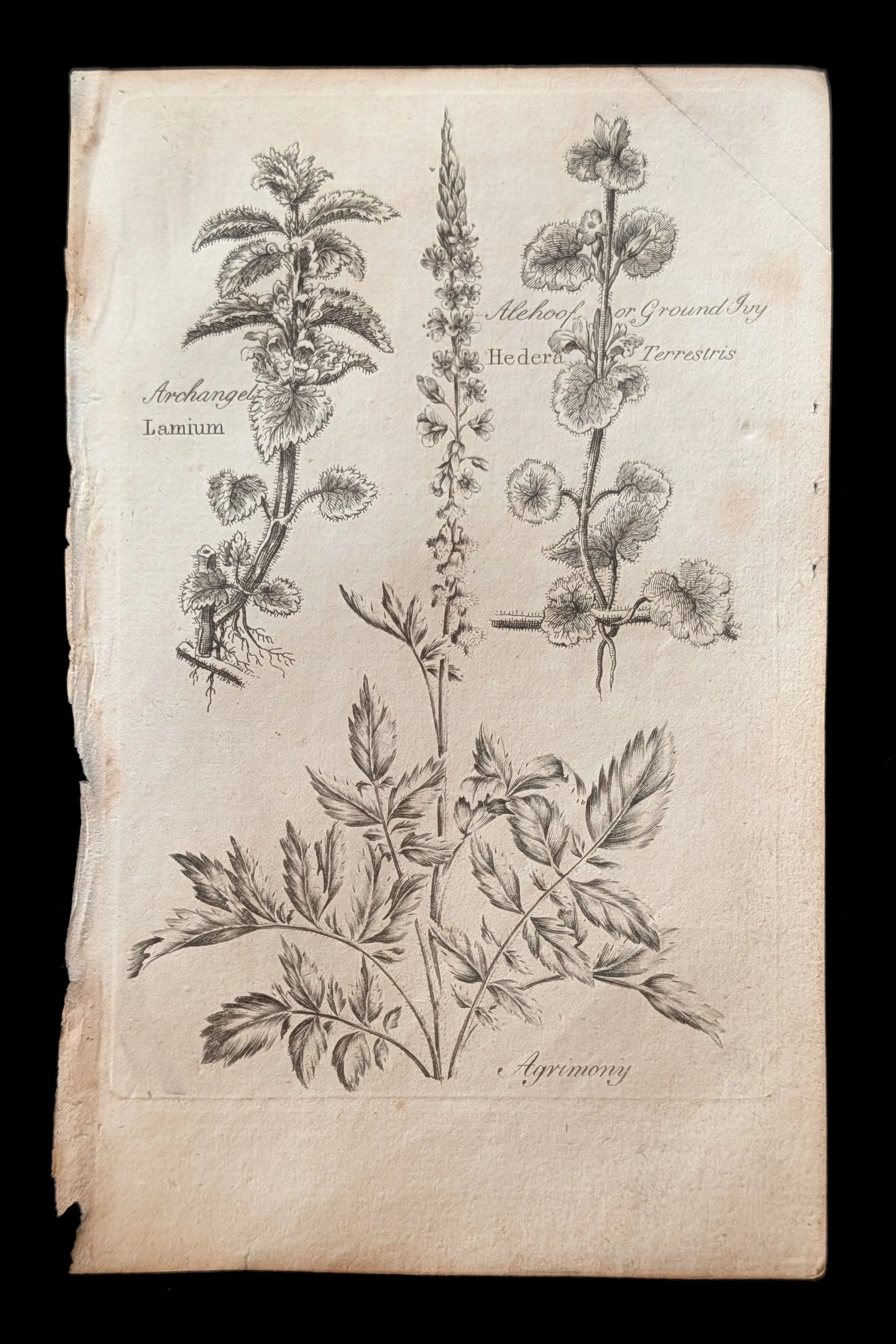
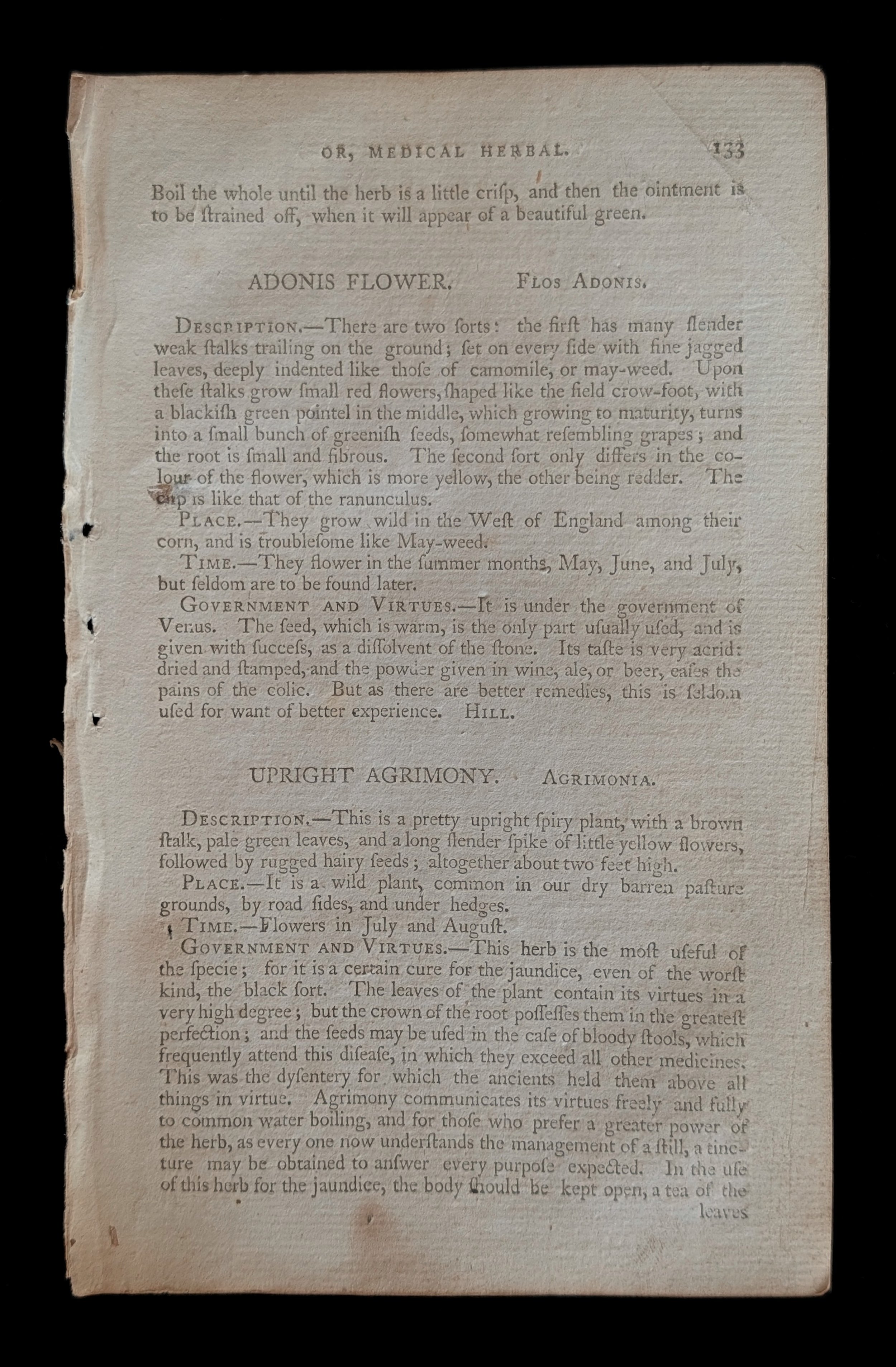
On this plate, agrimony, archangel, and ground ivy share a sheet. Their stems and leaves spread across the paper, with English and Latin names tucked between them. The engraved lines remain clear against the unevenly toned surface. Beside the plate, the printed description takes the reader from the plant’s appearance and growing place to its “Government and Virtues.”
That last heading is where the planets enter. In Culpeper’s herbal, astrology helped explain a plant’s supposed medicinal properties and the appropriate time to gather it. The book connects herbs with planetary rulers, bringing observations of the garden into the same account as the movements of the heavens. Reading picture and text together makes that relationship especially clear: the plant that can be recognized by its leaves also has a place in an astrological order.
These leaves were printed long after Nicholas Culpeper’s lifetime. He died in 1654; this edition appeared in London in 1792, published by W. Locke. Joshua Hamilton enlarged the herbal with several hundred additional plants, chiefly drawn from Sir John Hill, while retaining an arrangement in Culpeper’s medical and astrological manner. The title, Culpeper’s English Family Physician, preserves his name alongside a substantially later editorial undertaking.
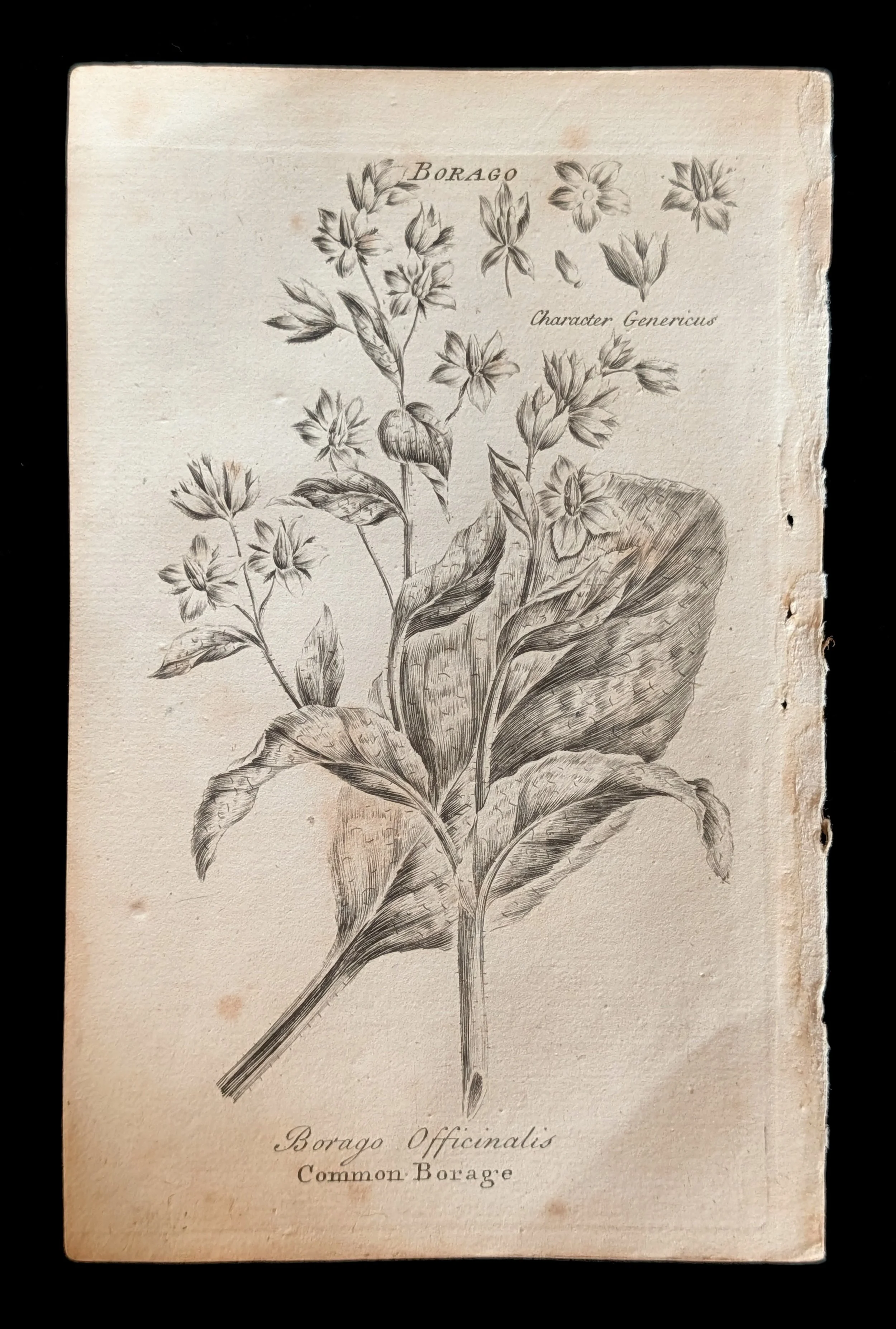
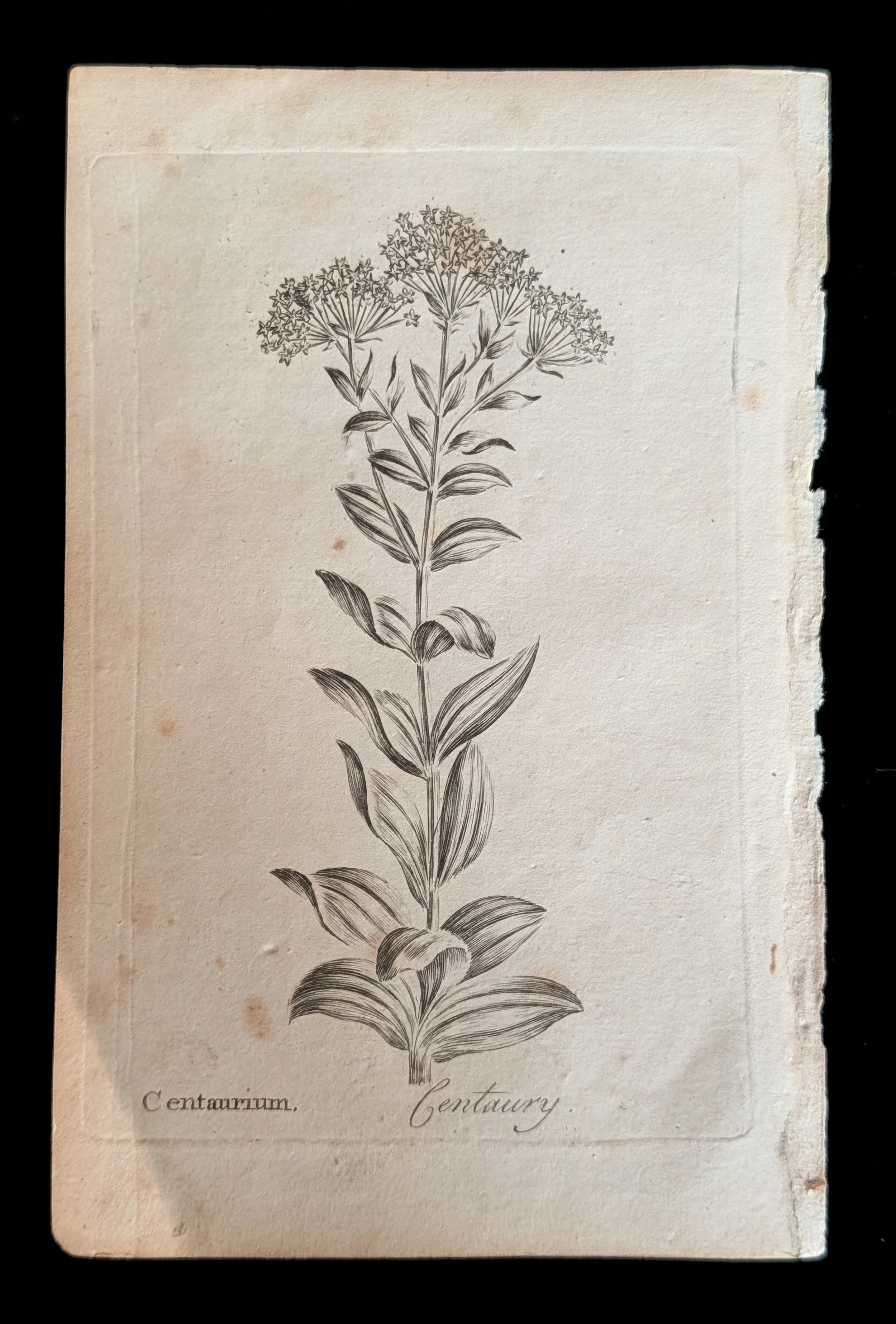
The plates reward attention on their own terms, too. Small flower studies accompany larger plants, and several specimens can occupy one sheet. Turning back to the text changes the pace of looking: names become entries, and entries reveal the assumptions through which earlier readers understood familiar plants.
Our leaves come from an incomplete, damaged first volume, already disbound and lacking its companion volume. The engravings are uncolored. Selected plates are offered with their corresponding text leaf, keeping the image and its description together.
See the available plate-and-text pairs — $42 →
Critical Apparatus
If you’d like to go further into Culpeper’s herbal and the astrological medicine behind these plates, here are a few sources we can stand behind.
Listen
“Nicholas Culpeper: Herbalist and Radical,” Not Just the Tudors, hosted by Suzannah Lipscomb with guest Benjamin Woolley (July 14, 2025).
A lively conversation, just under an hour, between a historian and Culpeper’s biographer. It covers his break with the College of Physicians and his push to put medicine into English for ordinary readers, and it asks frankly how much the astrology really mattered.
Read (free)
Graeme Tobyn, “Did the Astrological Content of Culpeper’s English Physitian Undermine Its Usefulness?” Culture and Cosmos 26, no. 2 (2022): 35–53.
An open-access article that shows how a reader was actually meant to use the planetary rulers: with an almanac in hand, you matched an illness to its herb. It’s the best short guide to the astrological lines on these leaves.
Go deeper
Patrick Curry, Prophecy and Power: Astrology in Early Modern England (Princeton: Princeton University Press, 1989; reissued by Sophia Centre Press, 2024).
The standard scholarly history of English astrology from the mid-1600s through the late 1700s. It follows how astrology lost its place among the learned and lived on in almanacs and popular print, which is useful background for why a 1792 edition still kept Culpeper’s planetary scheme.